
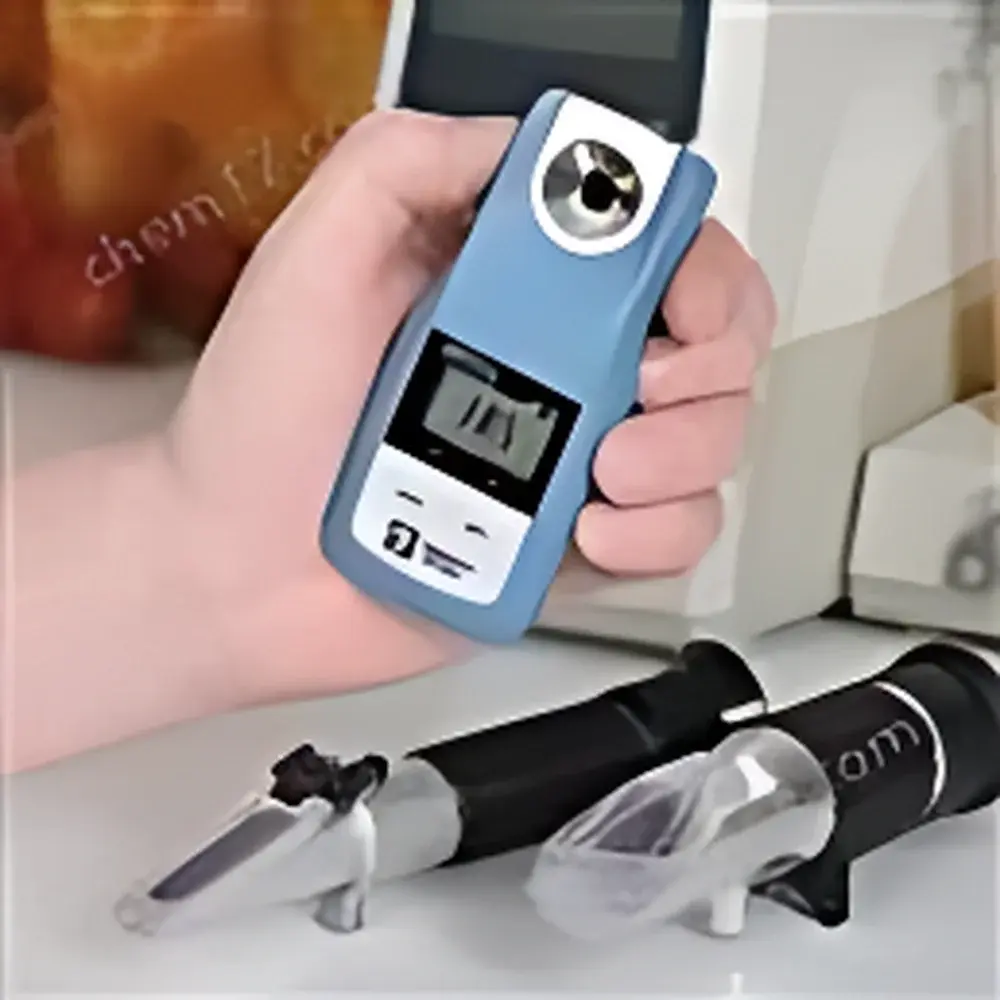
Bellingham + Stanley OPTi Handheld Refractometer
| Brand | Bellingham + Stanley |
|---|---|
| Origin | United Kingdom |
| Model | OPTi |
| Type | Handheld Refractometer |
| Temperature Compensation | Automatic (ATC) |
| Display | Digital LCD |
| IP Rating | IP65 |
| Construction | Stainless steel prism, ultrasonically welded waterproof housing |
| Calibration | Pure water zero-point calibration |
| Sample Compatibility | Aqueous solutions, juices, wines, worts, musts, syrups |
| Compliance | Designed and manufactured in accordance with ISO 21748 (Refractometry — Guidance for the use of refractometers), ASTM D1152 (Standard Test Method for Ethanol Content of Denatured Fuel Ethanol), and EU Regulation No. 1308/2013 (Wine sector standards) |
Overview
The Bellingham + Stanley OPTi Handheld Refractometer is a precision optical instrument engineered for rapid, field-deployable measurement of refractive index in liquid samples—primarily used to determine soluble solids concentration (°Brix), alcohol content (ABV), Oechsle, KMW, Baume, Plato, and Zeiss scales in beverage and food production environments. Based on the fundamental principle of total internal reflection at the prism–sample interface, the OPTi employs Abbe-type optical geometry calibrated to the sodium D-line (589.3 nm). Its design integrates rigorous metrological traceability to NPL (National Physical Laboratory, UK) standards, ensuring long-term stability and inter-laboratory comparability. Unlike benchtop units requiring sample temperature equilibration, the OPTi features built-in Automatic Temperature Compensation (ATC) across a functional range of 10–40 °C, minimizing operator-induced error during dynamic process monitoring.
Key Features
- Stainless steel prism assembly fabricated via single-piece cold forging—eliminates adhesive interfaces, enhances chemical resistance, and enables rapid cleaning with ethanol or deionized water.
- Ultrasonically sealed IP65-rated housing—fully protected against dust ingress and low-pressure water jets; suitable for wet processing floors, fermentation cellars, vineyards, and outdoor sampling.
- Ergonomic, one-handed operation with textured non-slip grip—optimized for prolonged use in gloves or humid conditions.
- Dual-scale models available: simultaneous display of primary (e.g., °Brix) and secondary (e.g., ABV or Oechsle) units without manual conversion.
- Zero-point calibration using deionized water at ambient temperature—no external reference fluids required for routine verification.
- Compact dimensions (165 × 45 × 35 mm) and mass (<180 g)—designed for integration into QC toolkits, mobile lab carts, or portable inspection workflows.
Sample Compatibility & Compliance
The OPTi is validated for use with transparent to slightly turbid aqueous solutions including grape must, wine, beer wort, cider, soft drinks, honey dilutions, and fruit concentrates. It is not intended for highly viscous, opaque, or solvent-based matrices (e.g., pure ethanol >95 % v/v, glycerol, or essential oils). All OPTi variants comply with the optical performance criteria outlined in ISO 21748:2022, and are routinely employed in facilities operating under HACCP, BRCGS Food Safety Issue 9, and IFS Food v7 frameworks. The device supports GLP-aligned documentation through user-recorded calibration logs and batch-specific measurement notes—though it does not provide electronic audit trails per FDA 21 CFR Part 11 due to its analog optical core and standalone digital display architecture.
Software & Data Management
The OPTi operates as a self-contained optical-electronic system with no embedded firmware, Bluetooth, or USB connectivity. Measurement data is recorded manually or transcribed into LIMS via standardized template forms (e.g., Wine Quality Control Sheet WQ-04). For traceable digital capture, users may pair the OPTi with third-party mobile applications (e.g., LabTwin or QMS Connect) using image-based reading of the LCD scale—subject to validation per laboratory SOPs. Bellingham + Stanley provides downloadable calibration checklists, uncertainty budget templates (GUM-compliant), and ISO/IEC 17025-aligned verification protocols for accredited laboratories performing in-house validation.
Applications
- Wine production: Monitoring sugar accumulation (°Brix) pre-harvest and fermentation progress (Oechsle/KMW/Baume); estimating potential alcohol (ABV) in must.
- Brewing: Measuring original gravity (°Plato) and apparent attenuation in wort; verifying consistency across kettle batches.
- Soft drink & juice manufacturing: Verifying concentrate dilution ratios and finished product sweetness compliance (°Brix).
- Academic teaching labs: Demonstrating refractive index–concentration relationships in physical chemistry and food science curricula.
- Contract testing labs: Performing rapid pass/fail screening prior to full compositional analysis (e.g., HPLC, densitometry).
FAQ
Does the OPTi require periodic recalibration by an accredited service provider?
No—routine zero-point verification with deionized water suffices for daily use. Full recalibration is recommended annually or after mechanical shock, and can be performed by Bellingham + Stanley’s UK service center (NPL-traceable certificate issued).
Can the OPTi measure ethyl alcohol concentration directly in distilled spirits?
No—it is optimized for aqueous mixtures up to ~25 % v/v ethanol. Higher concentrations cause non-linear refraction deviation and require dedicated alcoholmeters or gas chromatography.
Is the prism surface resistant to citric acid or sulfurous compounds commonly found in wine must?
Yes—the electropolished stainless steel prism exhibits excellent resistance to organic acids (pH 2.8–4.2) and SO₂ solutions up to 200 ppm, verified per ASTM G31 immersion testing.
What is the measurement uncertainty of the OPTi at 20 °C?
±0.2 °Brix (k = 2) when used per manufacturer instructions, based on repeatability studies conducted under ISO 5725-2 conditions.
Are replacement prisms or calibration tools available separately?
Yes—Bellingham + Stanley supplies certified prism kits (PRT-OPTi), ATC verification blocks (ATC-VER-20), and NIST-traceable sucrose reference standards (SRM-1900b equivalents) through authorized distributors.




