GW WL400 Submersible Water Level Sensor
| Brand | GW |
|---|---|
| Origin | USA |
| Model | WL400 |
| Pressure Range | 0–1, 5, 10, 20, 40, 75, 150 m H₂O |
| Output | 4–20 mA (2-wire) or 0.5–2.5 VDC (with 125 Ω shunt) |
| Power Supply | 8–36 VDC |
| Accuracy | ±0.1% FS (isothermal), ±0.2% FS (–1.1 °C to +21.1 °C) |
| Linearity & Hysteresis | ±0.1% FS |
| Overpressure Limit | ≤2× FS |
| Temperature Compensation | Dynamic, –1.1 °C to +21.1 °C |
| Barometric Compensation | Integrated via vented cable |
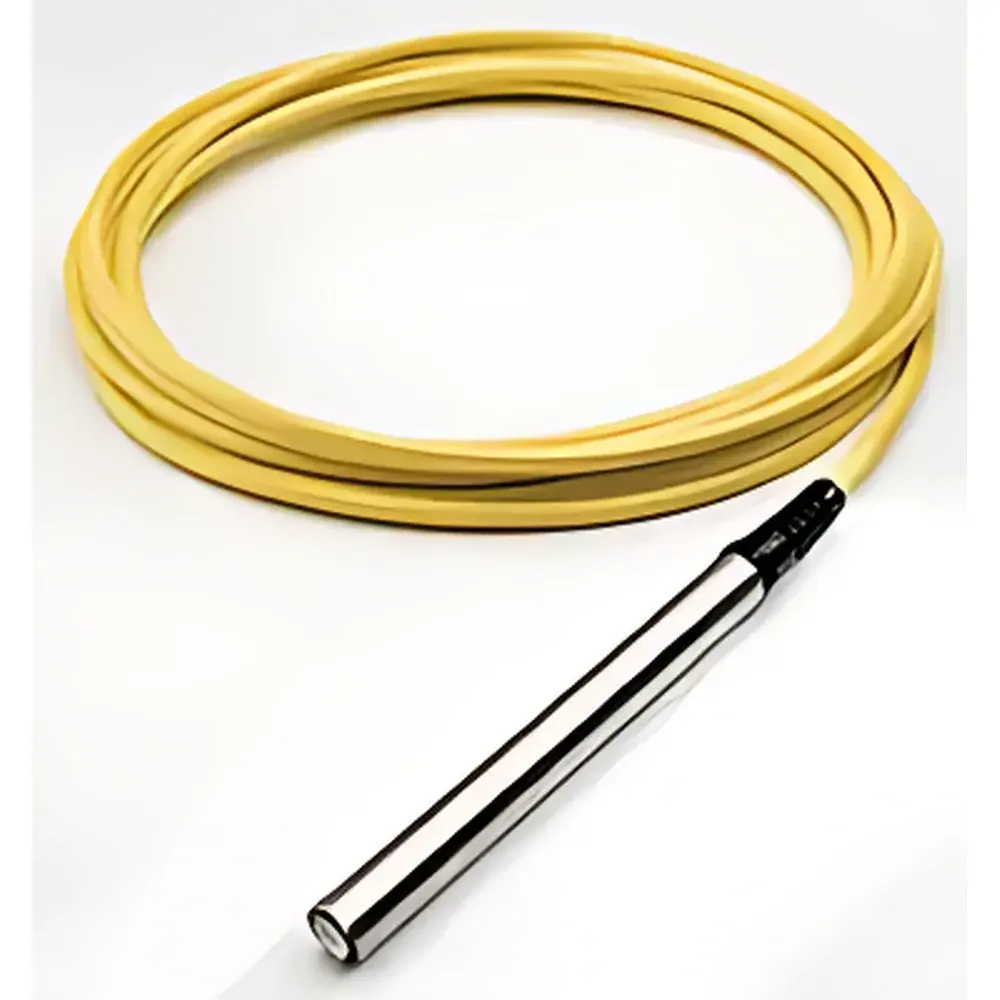
| Housing Material | 304L stainless steel |
| Diaphragm | High-elasticity silicone rubber (wetted/wetted design) |
| Encapsulation | Marine-grade epoxy |
| Cable | 4-conductor, 22 AWG, polyether jacket, PE vent tube, foil shield |
| Standard Length | 7.62 m (custom up to 152.4 m) |
| Operating Temp | –40 °C to +85 °C |
| Weight | 227 g |
| Dimensions | Ø20 mm × 140 mm |
| Compliance | Meets IEC 61326-1 (EMC), EN 61000-6-2/6-3, RoHS |
Overview
The GW WL400 is a high-stability, submersible pressure transducer engineered for precise hydrostatic water level measurement in diverse environmental and industrial applications. It operates on the fundamental principle of hydrostatic pressure sensing: water column height (h) generates a proportional pressure (P = ρ·g·h), which the sensor converts into a linear 4–20 mA analog output signal. Unlike traditional metal diaphragm sensors, the WL400 employs a wetted/wetted silicone rubber diaphragm—chemically inert, highly elastic, and immune to permanent deformation under cyclic loading. This eliminates long-term drift, hysteresis, and nonlinearity commonly observed in foil-based designs, especially critical in low-range applications (e.g., 0–1 m). The transducer is fully potted in marine-grade epoxy within a compact 304L stainless steel housing (Ø20 mm × 140 mm), enabling deployment in confined boreholes (≥25 mm diameter) and aggressive media including seawater, brackish groundwater, and tidal zones. Integrated dynamic temperature compensation across –1.1 °C to +21.1 °C ensures metrological stability without external calibration, while the vented cable provides real-time barometric reference—enabling true gauge pressure measurement without manual atmospheric correction.
Key Features
- True wetted/wetted design with high-elasticity silicone diaphragm—eliminates creep, wrinkling, and fatigue-induced drift
- Dynamic temperature compensation algorithm embedded in signal conditioning circuitry for ±0.2% FS accuracy over operational thermal range
- Vented polyether-jacketed cable with integral PE vent tube and full foil shielding—resists moisture ingress, EMI, and mechanical abrasion
- Compact, corrosion-resistant 304L stainless steel housing with sintered stainless steel microporous vent cover—prevents clogging by silt, biofilm, or suspended solids
- Standard 4–20 mA two-wire output compatible with SCADA systems, data loggers, PLCs, and telemetry units; supports transmission up to 900 m on twisted-pair wiring
- Optional voltage output (0.5–2.5 VDC) via integrated 125 Ω precision shunt resistor—facilitates direct connection to ADC inputs on microcontroller-based monitoring platforms
- CE-marked and compliant with IEC 61326-1 (EMC immunity/emission), EN 61000-6-2/6-3, and RoHS directives
Sample Compatibility & Compliance
The WL400 is validated for continuous immersion in freshwater, seawater, wastewater, and saturated soils. Its silicone diaphragm and epoxy encapsulation exhibit no measurable degradation when exposed to chlorinated water (10% H₂O₂), or concentrated chlorine solutions (>50 ppm)—for such environments, the WL450 variant with fluoropolymer cable is specified. The sensor meets requirements for long-term groundwater monitoring per USGS NWIS protocols and supports compliance with EPA Method 1604 (microbial water quality) and ASTM D4043 (groundwater sampling). Its passive analog output architecture inherently satisfies GLP/GMP data integrity expectations where digital audit trails are not mandated; when paired with Part 11-compliant data loggers (e.g., Campbell Scientific CR6), full 21 CFR Part 11 traceability is achievable.
Software & Data Management
As an analog-output device, the WL400 requires no embedded firmware or proprietary software. Its 4–20 mA signal is directly interpretable by any industrial-grade data acquisition system supporting loop-powered analog inputs. Calibration coefficients—including zero offset, span factor, and temperature compensation polynomial—are factory-trimmed and documented in the Certificate of Conformance supplied with each unit. Users may apply linear or polynomial corrections in post-processing using standard tools (MATLAB, Python SciPy, LabVIEW, or Excel). For automated deployments, integration with Modbus RTU gateways (e.g., GW-RTU-485) enables protocol translation to Modbus TCP or MQTT, allowing ingestion into cloud platforms (AWS IoT Core, Azure IoT Hub) with timestamped, context-tagged telemetry streams. No driver installation or OS-specific dependencies are required.
Applications
- Continuous groundwater level monitoring in observation wells (including artesian and confined aquifers)
- Tidal elevation tracking at coastal stations, marinas, and floating dock infrastructure
- Stormwater and sewer network level surveillance—particularly in shallow-draft conduits and combined sewer overflows (CSOs)
- Reservoir, tank, and sump level control in municipal water treatment and pumping stations
- Open-channel flow estimation using stage-discharge rating curves (per ISO 4359)
- Levee and dam seepage monitoring via piezometer arrays
- Environmental impact assessments requiring long-duration, low-maintenance field instrumentation
FAQ
What is the minimum measurable water depth for the 0–1 m range sensor?
The 0–1 m range offers resolution limited only by the connected data logger’s ADC (typically <0.1 cm at 16-bit resolution). It reliably detects changes as small as 0.5 cm in depths ≥5 cm.
Can the WL400 be used in pressurized pipes?
No—it is a gauge-pressure sensor requiring atmospheric reference via the vented cable. For closed-pipe pressure measurement, specify the PRPP/PRPM pressure tube accessory kit, which isolates the sensor from direct flow while maintaining static pressure coupling.
Is temperature output available as a standard feature?
Temperature sensing (0–50 °C, ±1% accuracy) is optional (WL-T module); it shares the same 4–20 mA loop using HART protocol or multiplexed time-domain signaling—no additional wiring required.
How is barometric compensation maintained if the vent tube becomes obstructed?
The microporous stainless steel vent cap (10 µm pore size) resists fouling but requires periodic visual inspection. If blockage occurs, output drift manifests as a slow, monotonic offset—detectable via baseline trending in monitoring software.
What cable extension options exist beyond 152.4 m?
WLEXC extension cables support total lengths up to 300 m. Beyond this, signal attenuation necessitates a local signal conditioner or loop-powered repeater installed near the sensor head.