
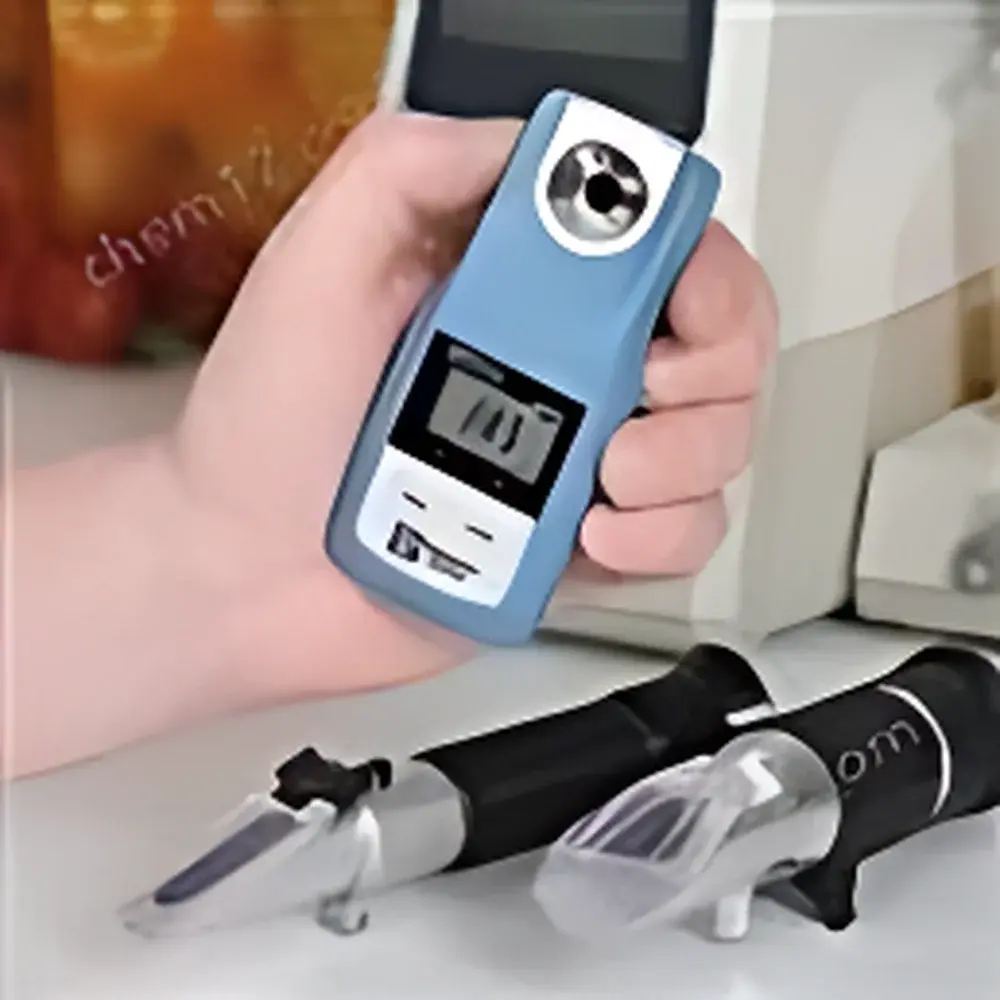
Bellingham + Stanley OPTi Life Sciences Digital Handheld Refractometer
| Brand | Bellingham + Stanley |
|---|---|
| Origin | United Kingdom |
| Manufacturer Status | Authorized Distributor |
| Origin Category | Imported |
| Model | OPTi Life Sciences Digital |
| Type | Handheld Refractometer |
| Temperature Control | Yes (ATC) |
| Digital Display | Yes |
| IP Rating | IP65 |
| Construction | Stainless steel prism housing, ultrasonically welded waterproof enclosure |
| Calibration | Pure water zero-point calibration |
| Ergonomics | Human-centered design |
| Compliance | Designed for clinical, veterinary, and sports science applications per ISO 21748 (Refractometry — Guidance for the estimation of measurement uncertainty) and aligned with CLSI EP10-A3 (Preliminary Evaluation of Quantitative Clinical Laboratory Measurement Procedures) |
Overview
The Bellingham + Stanley OPTi Life Sciences Digital Handheld Refractometer is an optically engineered, precision instrument designed for rapid, field-deployable refractive index measurements in life science environments. It operates on the fundamental principle of total internal reflection at the prism-sample interface, where the critical angle of refraction is directly correlated to the sample’s refractive index—and thus its solute concentration—under controlled thermal conditions. Engineered for reproducibility and operational robustness, the OPTi integrates automatic temperature compensation (ATC) across its full operating range (10–40 °C), eliminating manual correction and minimizing inter-operator variability. Unlike traditional analog refractometers, this digital platform delivers direct readouts in application-specific units without interpolation or visual estimation, supporting traceable, GLP-compliant documentation when paired with validated software workflows.
Key Features
- Stainless steel prism assembly manufactured via one-piece precision stamping—resistant to corrosion, chemically inert, and optimized for rapid cleaning between biological samples.
- Ultrasonically welded IP65-rated enclosure ensures dust-tight integrity and protection against low-pressure water jets—validated for use in clinical laboratories, veterinary clinics, and athletic training facilities.
- Dual-scale models available (e.g., urine SG + °Brix; seawater PPT + SG), each calibrated independently against NIST-traceable reference standards.
- High-resolution LCD display with backlighting enables clear visibility under variable ambient lighting conditions—including low-light clinical settings.
- Onboard pure-water zero-point calibration routine simplifies daily verification without requiring proprietary calibration fluids.
- Compact form factor (142 × 68 × 38 mm) and ergonomic grip facilitate extended single-hand operation during high-throughput sample screening.
Sample Compatibility & Compliance
The OPTi refractometer accommodates aqueous biological fluids including human and veterinary urine, serum dilutions, cell culture media, isotonic saline solutions, and sports hydration beverages. Its shallow-depth prism geometry minimizes residual sample retention—critical for preventing cross-contamination in diagnostic workflows. All models comply with ISO 21748 for uncertainty estimation in refractometric measurements and support alignment with ISO 15197:2013 (in vitro diagnostic test systems for blood glucose monitoring) where applicable. While not classified as an IVD device under EU IVDR or FDA 21 CFR Part 809, it meets essential performance criteria for non-in-vitro-diagnostics use in QC/QA and research-grade analysis. Device firmware and calibration logs are structured to support audit readiness under GLP and GMP frameworks.
Software & Data Management
The OPTi operates as a standalone instrument but is compatible with Bellingham + Stanley’s optional RS-232/USB data logging interface (sold separately). When connected, raw refractive index values, temperature readings, timestamp metadata, and user-defined sample IDs can be exported in CSV format for integration into LIMS or statistical analysis platforms (e.g., JMP, GraphPad Prism). Audit trail functionality—including operator ID tagging and calibration event logging—is enabled through the companion software suite, satisfying requirements for 21 CFR Part 11 electronic record integrity where local validation protocols are implemented.
Applications
- Clinical laboratories: Rapid assessment of urine specific gravity for renal concentrating ability evaluation—used alongside urinalysis dipstick interpretation.
- Veterinary diagnostics: Differentiation of small vs. large mammal urine SG ranges to support species-specific hydration status assessment.
- Sports medicine: Real-time monitoring of athlete hydration levels via urine SG or electrolyte-adjusted °Brix correlation in field settings.
- Bioprocessing R&D: Quick verification of buffer concentration, glycerol cryoprotectant levels, or sucrose-based stabilizer formulations prior to cell freezing.
- Academic teaching labs: Demonstrating optical principles of refraction, temperature dependence of RI, and calibration traceability in undergraduate biophysics curricula.
FAQ
Is the OPTi refractometer suitable for regulatory submissions?
It is not a Class II medical device nor CE-marked as an IVD; however, its metrological performance supports data generation for internal quality control, method validation, and preclinical research reporting.
Does it require annual recalibration by the manufacturer?
No—users perform routine zero-point verification with distilled water; full recalibration is recommended every 12 months or after mechanical impact, using certified reference standards traceable to NPL or NIST.
Can it measure viscous or particulate-containing samples?
Only clarified, particle-free liquids should be applied to the prism surface; turbid or highly viscous samples must be centrifuged or filtered prior to analysis to avoid measurement drift and prism damage.
What is the temperature compensation range and accuracy?
ATC operates from 10 °C to 40 °C with ±0.2 °C sensor resolution; compensation algorithm follows the standard Sellmeier equation adapted for aqueous biological matrices.
Is battery life sufficient for full-day field use?
Yes—two AAA alkaline batteries provide ≥10,000 measurements per set under typical usage, with auto-power-off after 3 minutes of inactivity.




