
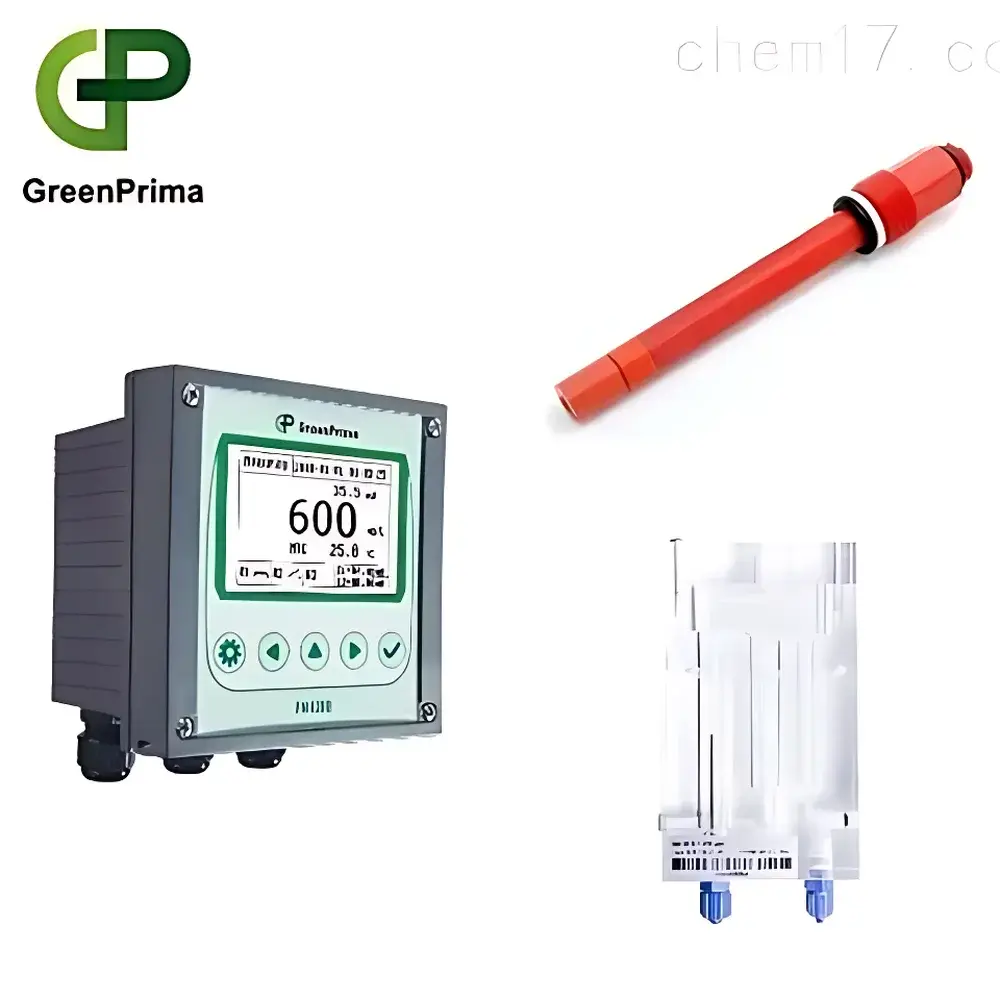
GreenPrima PM8200I Ammonia-N (NH₃-N) Online Ion Analyzer
| Brand | GreenPrima |
|---|---|
| Origin | United Kingdom |
| Manufacturer Type | Original Equipment Manufacturer (OEM) |
| Product Category | Imported Instrument |
| Model | PM8200I |
| Instrument Type | Online Ammonium/Ion-Selective Electrode (ISE) Analyzer |
| Measurement Range | 0–1000 mg/L NH₃-N |
| Detection Limit | 0.1 mg/L |
| Response Time | ≤5 minutes (t₉₀) |
| Measurement Accuracy | ±5% of Full Scale |
| Operating Temperature Range | 0–80 °C |
| Sensor Model | Bsen730 |
| Display | Backlit Graphic LCD |
| Output | Dual Isolated 4–20 mA, RS485 Modbus RTU |
| Enclosure Rating | IP65 |
| Mounting | Wall/Pipe/Panel |
| Dimensions (H×W×D) | 144 × 144 × 106 mm |
| Weight | 0.86 kg |
Overview
The GreenPrima PM8200I is a dedicated online ammonia-nitrogen (NH₃-N) analyzer engineered for continuous, real-time monitoring of ammonium ion concentration in aqueous matrices using potentiometric ion-selective electrode (ISE) technology. Unlike colorimetric or enzymatic methods, the PM8200I employs a solid-state, polyphenylene sulfide (PPS)-housed Bsen730 ammonia-selective electrode that responds selectively to unprotonated ammonia (NH₃) in equilibrium with ammonium (NH₄⁺), with automatic temperature compensation (NTC10K or PT1000) ensuring thermodynamic accuracy across 0–80 °C. The system operates on the Nernst equation principle, delivering stable millivolt-level potential shifts proportional to log[NH₃] activity. Designed for deployment in municipal drinking water distribution networks, wastewater treatment plant effluent streams, industrial process cooling water circuits, and aquaculture recirculation systems, the PM8200I provides traceable, maintenance-conscious measurement without reagents or optical components—reducing consumables, calibration drift, and operational overhead.
Key Features
- IP65-rated sealed enclosure with corrosion-resistant housing, suitable for humid, outdoor, or splash-prone environments
- High-contrast backlit graphic LCD display showing real-time NH₃-N concentration (mg/L), measured temperature (°C), relay status, and system diagnostics
- Dual isolated 4–20 mA analog outputs configurable for NH₃-N value and/or temperature—each with 0.1% FS linearity and loop load up to 500 Ω
- RS485 interface supporting Modbus RTU protocol for integration into SCADA, DCS, or PLC-based supervisory control architectures; optional HART compatibility available upon request
- Configurable cleaning cycle (0.1–1000 h interval; 1–1000 s duration) via programmable relay output to drive external solenoid valves or peristaltic pumps
- Two independent high/low alarm relays (5 A / 250 VAC / 30 VDC) with user-defined setpoints and adjustable hysteresis to prevent chatter during transient events
- Bilingual (English/Chinese) menu navigation with password-protected access levels: calibration mode (default code 1100), configuration mode (default code 1200)
- Low-maintenance sensor design—Bsen730 electrode requires only periodic standardization (typically every 7–30 days depending on matrix fouling potential) and no membrane replacement or electrolyte refilling
Sample Compatibility & Compliance
The PM8200I is validated for use in low-to-moderate conductivity waters (up to 5 mS/cm) with pH ≥6.5, where NH₃/NH₄⁺ equilibrium favors detectable free ammonia. It is unsuitable for highly acidic samples (50 mg/L without inline filtration. The analyzer complies with CE marking requirements for electromagnetic compatibility (EMC Directive 2014/30/EU) and low-voltage safety (LVD Directive 2014/35/EU). While not certified to ISO 5667 or EN 29001 out-of-the-box, its measurement traceability supports adherence to ISO/IEC 17025 laboratory quality systems when paired with documented calibration procedures using NIST-traceable NH₄Cl standards. Data integrity features—including timestamped calibration logs and relay event history—facilitate GLP-aligned recordkeeping.
Software & Data Management
No proprietary PC software is required for basic operation; all configuration is performed locally via the front-panel interface. For centralized data acquisition, the Modbus RTU register map enables direct polling of live NH₃-N values (40001), temperature (40002), sensor mV output (40003), calibration status flags (40004–40005), and relay states (40006–40007). All parameters are stored non-volatilely. Audit trails—including date/time stamps of each calibration, alarm activation, and output range changes—are retained internally for ≥30 days. The device does not support FDA 21 CFR Part 11 electronic signature functionality, but exported Modbus data may be archived in compliant LIMS or historian platforms meeting ALCOA+ principles.
Applications
- Continuous monitoring of ammonia breakthrough at chlorine contact tank exits in drinking water plants
- Effluent compliance verification against discharge limits (e.g., EU Urban Wastewater Treatment Directive, US EPA NPDES permits)
- Process control in activated sludge and MBR bioreactors—correlating NH₃-N trends with nitrification efficiency
- Early detection of ammoniacal contamination in industrial cooling towers and boiler feedwater circuits
- Real-time feedback for dosing control of breakpoint chlorination or zeolite-based ammonia removal units
- Environmental monitoring of surface water bodies impacted by agricultural runoff or landfill leachate
FAQ
What is the recommended calibration frequency for the Bsen730 sensor?
Calibration should be performed at least once per week under stable conditions; daily calibration is advised in high-fouling applications (e.g., raw sewage influent) or after sensor cleaning.
Can the PM8200I measure total ammonia (NH₃ + NH₄⁺) directly?
No—it measures free ammonia (NH₃) activity via ISE; total ammonia concentration must be calculated using simultaneous pH and temperature inputs per the equilibrium equation, or verified empirically with reference methods such as ASTM D1426.
Is the instrument compatible with existing SCADA systems using Modbus TCP?
The PM8200I supports Modbus RTU over RS485 only; integration with Modbus TCP networks requires an industrial protocol converter (e.g., Moxa EDS-G205A) configured as a gateway.
Does the analyzer include temperature compensation for the ISE response?
Yes—automatic temperature compensation is applied using either integrated NTC10K or external PT1000 sensors, covering –10 °C to +130 °C per the controller’s full specification.
What maintenance is required beyond calibration?
Routine visual inspection of the sensor’s PPS body and reference junction; periodic cleaning of the sensing surface with mild detergent and deionized water if biofilm or calcium scaling is observed.







