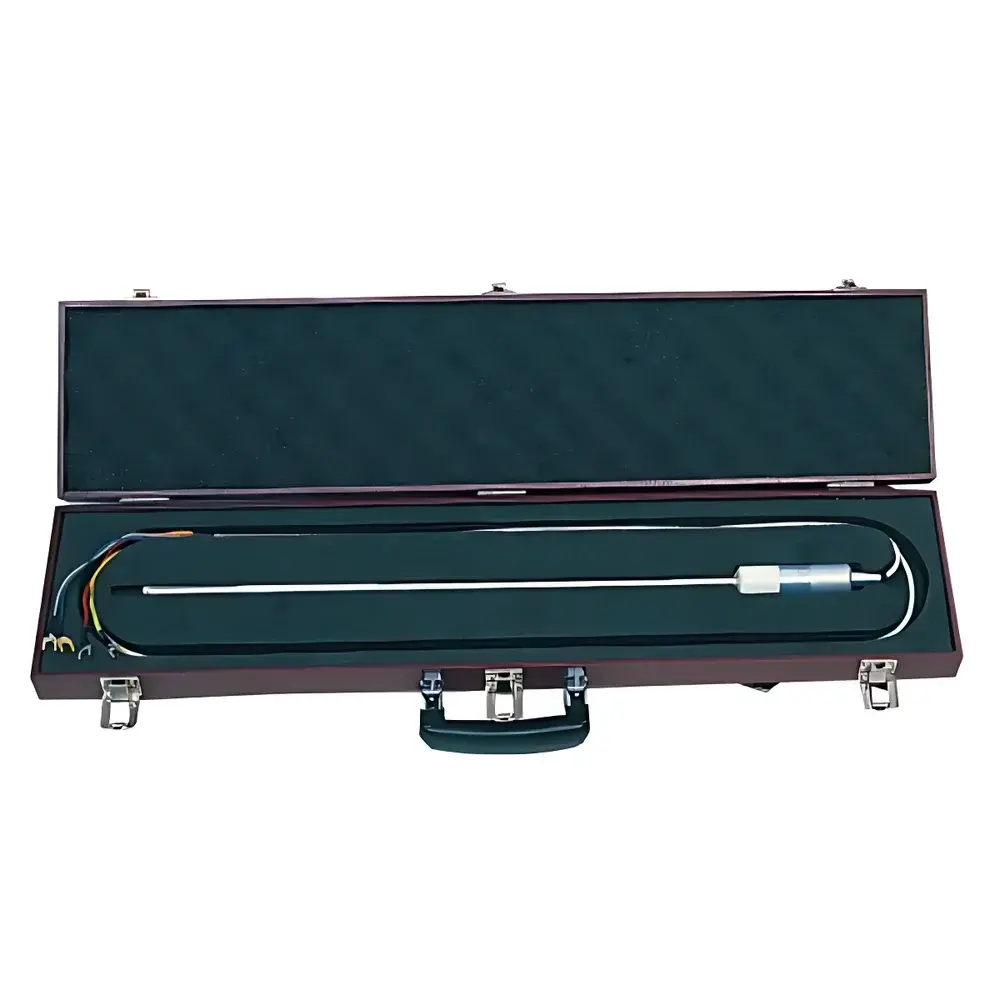
ISOTECH Standard Platinum Resistance Thermometer Model 670,909
| Brand | ISOTECH |
|---|---|
| Origin | United Kingdom |
| Model | 670,909 |
| Temperature Range | −200 °C to 1000 °C |
| Construction | Sealed recrystallized alumina sheath (Ø2.5 mm) |
| Compliance | ITS-90 primary interpolation standard |
| Type Options | R-type and S-type configurations |
| Reproducibility | < ±0.1 mK (at fixed points) |
| Drift Rate | < 10 mK per year (typical, under proper handling and storage) |
Overview
The ISOTECH Standard Platinum Resistance Thermometer (SPRT) Model 670,909 is a high-accuracy, primary-standard reference thermometer engineered for realization and dissemination of the International Temperature Scale of 1990 (ITS-90). As defined by the Consultative Committee for Thermometry (CCT), SPRTs serve as the sole authorized interpolating instruments between the triple point of hydrogen (13.8033 K) and the freezing point of silver (961.78 °C). This model meets or exceeds the stringent stability, reproducibility, and resistance ratio specifications outlined in IEC 60751:2022 and ISO/IEC 17025–accredited calibration laboratories. Its platinum sensing element—constructed from high-purity, strain-free Pt wire—is hermetically sealed within a recrystallized alumina (Al₂O₃) sheath with an outer diameter of 2.5 mm, providing exceptional mechanical rigidity and long-term thermal stability while minimizing susceptibility to oxidation, thermal shock, and mechanical stress.
Key Features
- Primary-standard compliance with ITS-90 interpolation requirements across the full range from −200 °C to 1000 °C
- Two configuration options: R-type and S-type, both featuring identical metrological performance and physical sealing architecture
- Ultra-low drift rate—typically less than 10 mK per year when stored and handled in accordance with BIPM guidelines
- High reproducibility at defining fixed points (e.g., triple point of water, zinc, aluminum, silver), with deviations consistently below ±0.1 mK
- Robust recrystallized alumina sheath (Ø2.5 mm) offering superior thermal conductivity, chemical inertness, and resistance to thermal cycling fatigue
- Optimized lead-wire geometry and low-thermal-EMF connections to minimize parasitic thermoelectric effects during precision bridge measurements
Sample Compatibility & Compliance
The Model 670,909 is designed for use in controlled calibration environments—including national metrology institutes (NMIs), accredited calibration laboratories, and R&D facilities engaged in thermometric traceability. It is compatible with standard AC resistance bridges (e.g., Hart Scientific 1590, Fluke 6601, or ASL F18) and cryogenic temperature baths operating down to liquid hydrogen temperatures. The device conforms to international standards including ISO/IEC 17025:2017 (for calibration laboratories), ASTM E1137/E1137M (Standard Specification for Platinum Resistance Thermometers), and supports audit-ready documentation for GLP and GMP applications. Its construction satisfies the mechanical and electrical requirements for use in fixed-point cells per CCT-WG3 recommendations and is suitable for participation in key comparison exercises coordinated by the BIPM.
Software & Data Management
While the Model 670,909 is a passive resistance sensor requiring external measurement instrumentation, ISOTECH provides comprehensive digital calibration support tools. These include NIST-traceable calibration certificates with full uncertainty budgets (k = 2), ITS-90 deviation function coefficients (W(rt) or ΔW(rt)), and optional integration with laboratory information management systems (LIMS) via CSV or XML export. Calibration data comply with FDA 21 CFR Part 11 requirements when used with validated bridge software platforms supporting electronic signatures, audit trails, and user access control. All calibration reports are archived with unique serial-number traceability and include environmental conditions (pressure, humidity) recorded at time of measurement.
Applications
- Primary calibration of industrial PRTs, thermistors, and thermocouples in ISO/IEC 17025-accredited labs
- Realization of ITS-90 fixed points (e.g., Sn, Zn, Al, Ag) for internal validation and inter-laboratory comparisons
- Reference standard in temperature uniformity surveys of environmental chambers and ovens (per IEC 60068-3-5)
- Thermal validation of pharmaceutical stability chambers and autoclaves (aligned with USP and )
- Research-grade temperature metrology in cryogenics, materials science, and aerospace thermal testing
- Supporting uncertainty analysis in heat flux measurements and thermal conductivity determinations
FAQ
What is the recommended excitation current for resistance measurement?
A maximum of 1 mA is recommended to limit self-heating error to < 0.1 mK in air; lower currents (e.g., 0.25 mA) are advised for high-accuracy bath measurements.
Can this SPRT be used above the silver point (961.78 °C)?
Yes—while ITS-90 interpolation ends at the silver point, the Model 670,909 maintains structural integrity and measurable resistance up to 1000 °C; however, extrapolated values require empirical characterization and are not ITS-90 compliant.
Is recalibration required before each fixed-point measurement?
No—recalibration is performed annually or after mechanical shock; however, a pre- and post-measurement check at the water triple point (0.01 °C) is mandatory for all ITS-90 interpolation sequences.
Does the 2.5 mm alumina sheath affect response time?
The sheath contributes to a typical 63% step-response time of ~15 s in stirred oil baths at 100 °C; faster response is achievable using bare-element variants (not offered in this model).
Are R-type and S-type versions interchangeable in calibration protocols?
Yes—both types share identical resistance characteristics, drift behavior, and ITS-90 compliance; selection depends solely on existing infrastructure (e.g., bore diameter of fixed-point cells or probe holders).