
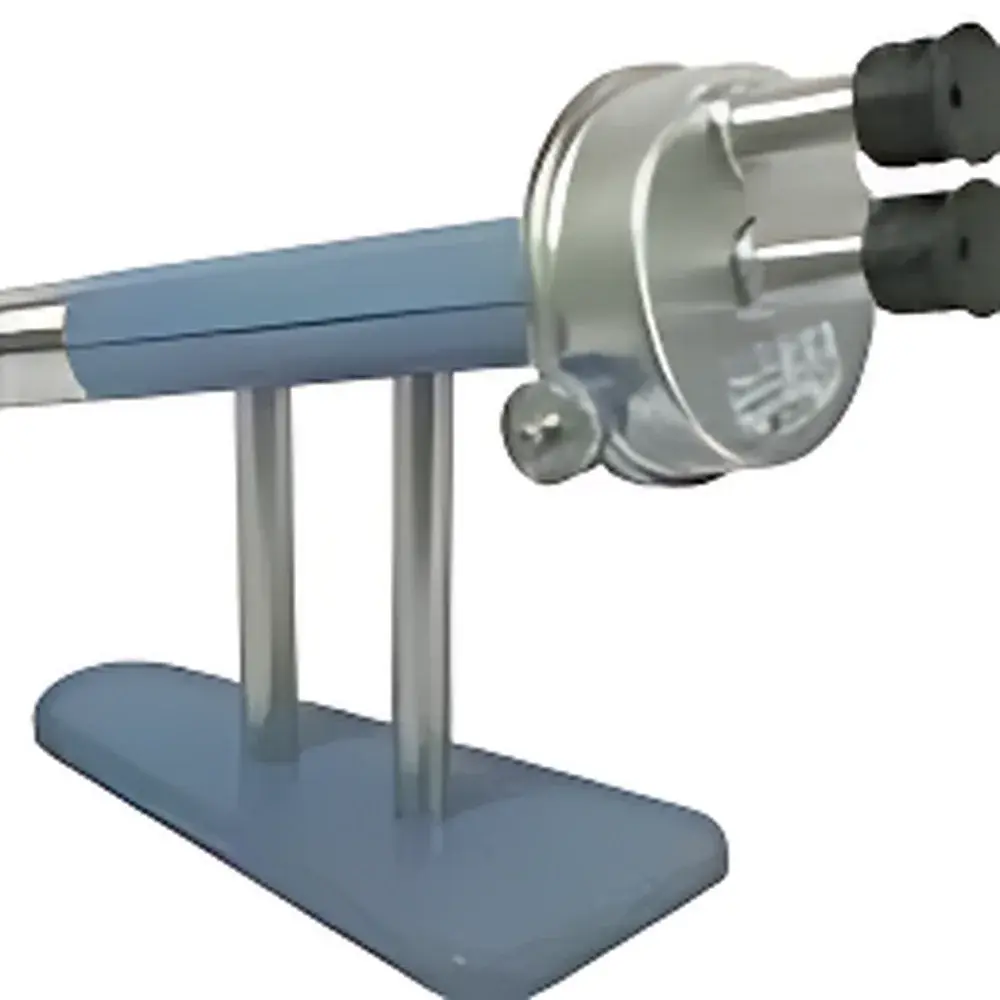
B+S ADS400 Series Automatic Polarimeter
| Brand | Bellingham + Stanley |
|---|---|
| Origin | United Kingdom |
| Model | ADS400 (ADS420 & ADS480 NIR variants) |
| Type | Automatic Polarimeter |
| Temperature Control | Yes (Peltier-regulated cell holder) |
| Display | Digital LCD readout |
| Light Source | LED with interference filter (ADS420) |
| Wavelength | 589.3 nm (Na-D line equivalent, ADS420) |
| Measurement Range | –45° to +45° optical rotation (A-scale) |
| Resolution | 0.001° (A-scale) |
| Accuracy | ±0.003° (A-scale, traceable to NPL standards) |
| Cell Path Length | Up to 220 mm |
| Calibration | Certified quartz control plates (e.g., Model D7 reference standard) |
| Compliance | ISO 11541:2016, ASTM E1254, USP <788> (for sucrose assay validation) |
Overview
The B+S ADS400 Series Automatic Polarimeter is a precision optical instrument engineered for accurate, repeatable measurement of optical rotation in chiral substances—primarily sucrose, fructose, glucose, and other optically active compounds in solution. Based on the fundamental principle of polarimetry—quantifying the angular deviation of plane-polarized light as it traverses an optically active medium—the ADS400 implements a robust double-beam null-balance detection architecture. This design minimizes drift and enhances long-term stability, especially critical in continuous process monitoring or high-throughput quality control environments. The series comprises two distinct configurations: the ADS420, optimized for routine sucrose analysis in sugar refineries using sodium-D line–equivalent illumination (589.3 nm), and the ADS480 NIR, which employs a near-infrared LED source (1550 nm) to mitigate interference from colored or turbid samples common in molasses, beet juice, or bioethanol feedstocks. Both models integrate Peltier-based temperature stabilization (±0.1 °C control over 15–40 °C range), ensuring compliance with standardized test conditions required by ISO 11541 and ICUMSA methods.
Key Features
- High-stability LED light source with interference filter (ADS420) or NIR LED (ADS480 NIR), rated for >100,000 hours MTBF and offering adjustable intensity for optimal signal-to-noise ratio
- Digital angular readout with 0.001° resolution (A-scale) and 0.01°Z resolution (sucrose scale), displayed on backlit LCD with dual-unit capability (°A / °Z)
- Peltier-controlled sample compartment enabling precise thermal regulation of the measurement cell—essential for reproducible results per ICUMSA Method GS2/3-15 and USP
- Interchangeable cell holders accommodating tubes up to 220 mm path length; optional flow-through cell kit available for inline or at-line deployment in sugar production lines
- Factory-calibrated using NPL-traceable quartz control plates (e.g., B+S Model D7 reference standard), with built-in verification protocol supporting GLP audit trails
- Robust mechanical design featuring micrometer drum fine-adjustment mechanism for manual null-point verification and operator training applications
Sample Compatibility & Compliance
The ADS400 series accommodates a broad range of liquid and dissolved-phase samples—from clarified cane juice and refined syrup to fermentation broths and pharmaceutical intermediates. Its NIR variant (ADS480) significantly improves measurement fidelity in samples exhibiting strong visible absorbance or particulate scattering, where traditional 589 nm systems suffer from low photometric throughput. All models conform to international standards governing polarimetric analysis: ISO 11541:2016 (optical instruments—polarimeters—requirements and tests), ASTM E1254 (standard guide for use of polarimeters), and USP Chapter (for sucrose content determination in excipients). Instrument validation documentation—including IQ/OQ protocols, calibration certificates traceable to UK’s National Physical Laboratory (NPL), and temperature uniformity mapping reports—is provided to support FDA 21 CFR Part 11–compliant environments and GMP/GLP audits.
Software & Data Management
While the ADS400 operates as a standalone benchtop instrument with full local control, optional RS-232/USB interface enables bidirectional communication with LIMS or SCADA systems. B+S PolarSoft™ v4.x software (Windows-compatible) supports automated data logging, statistical process control (SPC) charting, user-defined report templates (PDF/CSV export), and electronic signature functionality aligned with 21 CFR Part 11 requirements. Audit trail records capture all parameter changes, calibration events, and user logins with timestamps and operator IDs—ensuring full data integrity and regulatory traceability.
Applications
- Sugar industry: Real-time sucrose concentration monitoring in affination, carbonation, and evaporation stages per ICUMSA GS2/3-15
- Pharmaceutical manufacturing: Quantitative assay of chiral APIs (e.g., levodopa, chloramphenicol) during synthesis and purification
- Food & beverage QA/QC: Verification of honey authenticity, fruit juice adulteration screening, and sweetener composition analysis
- Academic research: Teaching polarimetric theory in physical chemistry labs; kinetic studies of enzymatic hydrolysis (e.g., invertase activity via optical rotation change)
- Biofuels: Rapid estimation of fermentable sugar content in lignocellulosic hydrolysates prior to yeast inoculation
FAQ
What is the difference between ADS420 and ADS480 NIR?
The ADS420 uses a stabilized 589.3 nm LED source matching the sodium-D line, ideal for clear, colorless sucrose solutions. The ADS480 NIR employs a 1550 nm source to penetrate colored or suspended-particle-laden samples—common in raw beet juice or molasses—without requiring extensive filtration.
Does the ADS400 support automated calibration verification?
Yes. It includes a dedicated calibration mode that guides users through verification using supplied quartz control plates (e.g., ±5°, ±15°, ±30°), logging each result with timestamp and operator ID for audit purposes.
Can the instrument be integrated into a factory automation system?
Absolutely. With optional serial or USB connectivity and Modbus RTU protocol support, the ADS400 can feed real-time rotation values directly into PLCs or MES platforms for closed-loop process control.
Is temperature control mandatory for compliant measurements?
Per ISO 11541 and ICUMSA guidelines, optical rotation is temperature-dependent. The Peltier-regulated cell holder ensures measurements are performed at defined, stable temperatures—typically 20 °C or 25 °C—required for reporting certified sucrose values.
What sample volume is required for standard operation?
Using a 100 mm cell, typical sample volume is 15–20 mL. Flow-cell configurations reduce dead volume to <5 mL and enable continuous sampling at rates up to 120 mL/min.






