
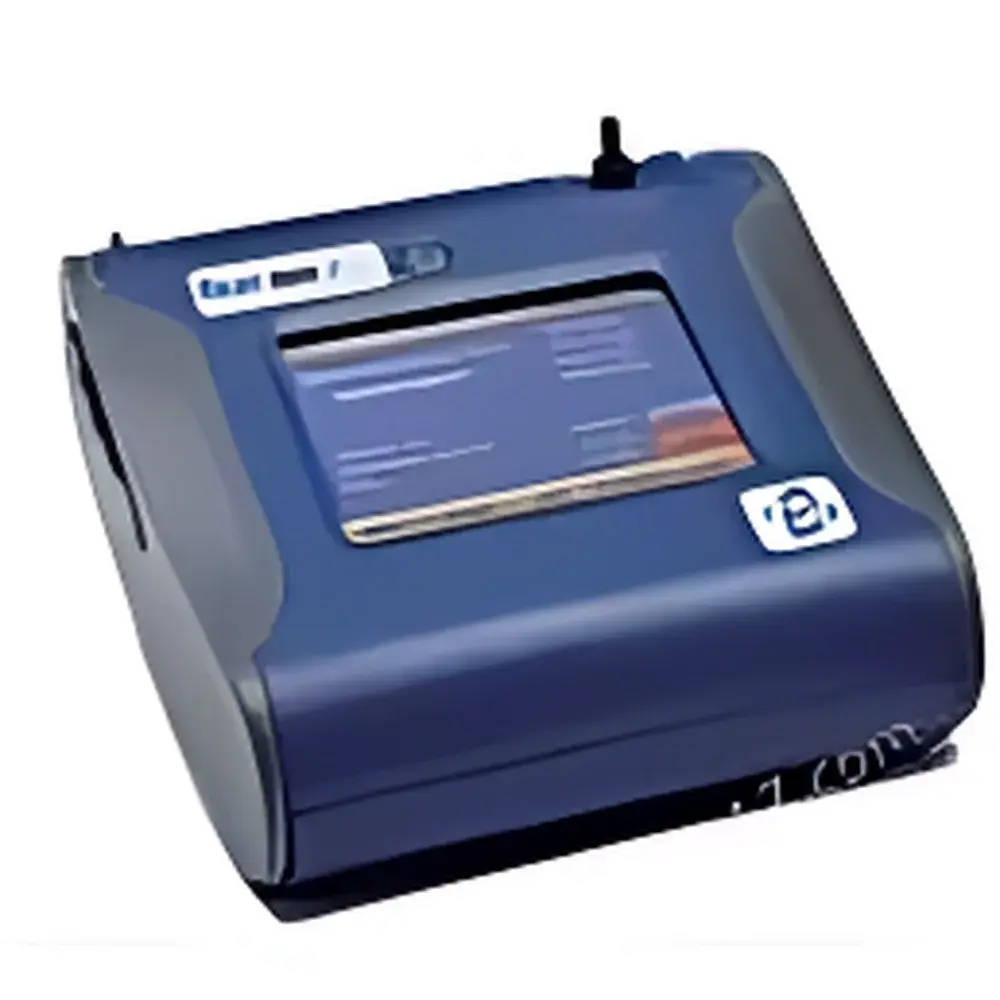
TSI Model 8530 Desktop Dust Monitor
| Brand | TSI |
|---|---|
| Origin | USA |
| Model | 8530 |
| Aerosol Concentration Range | 0.001–400 mg/m³ |
| Sensor Type | 90° Light Scattering |
| Flow Rate | 1.4–3.0 L/min (factory-set at 3.0 L/min) |
| Resolution | ±0.1% of reading or 0.001 mg/m³ (whichever is greater) |
| Zero Stability | ±0.002 mg/m³ over 24 h (10-s time constant) |
| Particle Size Range | 0.1–10 µm |
| Temperature Coefficient | +0.001 mg/m³/°C |
| Operating Temperature | 0–50 °C |
| Storage Temperature | −20–60 °C |
| Operating Humidity | 0–95% RH (non-condensing) |
| Time Constant | User-selectable, 1–60 s |
| Data Memory | 5 MB (>60,000 data points |
| Display | 3.5-inch VGA color touchscreen |
| Dimensions (H×W×D) | 12.5 × 12.1 × 31.6 cm |
| Weight | 1.3 kg (1.5 kg with battery) |
| Power | 115–240 VAC |
| Communication | USB |
| Compliance | EN 61326-1:2006 (EMC immunity & emissions) |
Overview
The TSI Model 8530 Desktop Dust Monitor is a precision-engineered, real-time aerosol mass concentration measurement instrument designed for occupational health, environmental monitoring, and indoor air quality (IAQ) applications. It operates on the principle of 90° light scattering photometry — a well-established, NIOSH- and ISO-compliant optical detection method for quantifying airborne particulate matter. The device simultaneously reports mass concentrations corresponding to total dust, PM₁, PM₂.₅, and PM₁₀ fractions, enabling comprehensive exposure assessment without requiring separate sampling trains or gravimetric analysis. Its compact desktop form factor integrates a calibrated internal pump, temperature-compensated optical sensor, and high-resolution VGA touchscreen interface — all housed in a robust, field-deployable enclosure. Unlike filter-based samplers, the 8530 delivers immediate, continuous concentration readings with traceable calibration traceability to NIST-traceable polystyrene latex (PSL) standards. It is not a personal sampler but a stationary or semi-portable reference-grade monitor intended for fixed-location trend analysis, engineering control verification, and regulatory screening in accordance with OSHA Method ID-253, NIOSH Method 0600, and ISO 7708:1995.
Key Features
- Real-time simultaneous measurement of total dust, PM₁, PM₂.₅, and PM₁₀ mass concentrations using dual-wavelength optical compensation
- User-adjustable time constant (1–60 s) for optimized response in dynamic environments — critical for capturing short-term peak exposures during maintenance or process upsets
- Internal flow control system maintaining ±5% accuracy across the full 1.4–3.0 L/min range, eliminating need for external rotameters or manual flow checks
- Temperature-compensated sensor electronics with documented coefficient (+0.001 mg/m³/°C), supporting reliable operation from 0–50 °C ambient conditions
- 5 MB onboard memory storing >60,000 timestamped data points, configurable for logging intervals from 1 second to 1 hour
- VGA color touchscreen interface with intuitive menu navigation, real-time graphing, and on-device statistical summary (min/max/avg/std dev)
- Compliance-ready design: CE-marked per EN 61326-1:2006 for electromagnetic compatibility in industrial and laboratory settings
Sample Compatibility & Compliance
The Model 8530 is validated for use with ambient and workplace aerosols including mineral dusts (e.g., silica, coal, limestone), metal fumes, welding particulates, biomass smoke, and indoor resuspended dust. It does not discriminate by chemical composition but responds proportionally to particle surface area within its 0.1–10 µm aerodynamic diameter range — consistent with thoracic, respirable, and inhalable fraction definitions per ISO 7708 and ACGIH conventions. Calibration is performed using PSL spheres traceable to NIST SRM 1963, and factory calibration certificates include uncertainty budgets per ISO/IEC 17025 requirements. While not FDA 21 CFR Part 11–compliant out-of-the-box, audit trails and exportable CSV logs support GLP/GMP-aligned documentation when paired with controlled SOPs and electronic signature protocols.
Software & Data Management
Data retrieval occurs via USB connection to Windows-based systems using TSI’s proprietary TrakPro™ Lite software (v7.5+), which supports automated report generation, overlay plotting, and compliance export formats (e.g., OSHA Form 90, NIOSH 5800 templates). Raw binary files are convertible to ASCII CSV for integration into LIMS or statistical platforms (e.g., JMP, Python pandas). The device stores timestamps with millisecond resolution, and all logged parameters — concentration, flow, temperature, humidity, and battery voltage — are synchronized per record. No cloud connectivity or remote telemetry is embedded; data sovereignty remains fully under user control — a requirement for many EU and APAC regulatory jurisdictions.
Applications
- Occupational hygiene surveys: mapping spatial and temporal PM exposure gradients near grinding, sanding, or bagging operations
- Indoor air quality baseline studies: evaluating HVAC filtration efficiency, occupant-generated aerosols, or infiltration of outdoor PM
- Engineering control validation: quantifying reduction in respirable dust before/after local exhaust ventilation upgrades
- Point-source emission screening: rapid identification of fugitive dust sources in warehouses, loading docks, or material transfer points
- Research-grade trend monitoring: long-term (weeks-to-months) PM₁₀/PM₂.₅ ratio analysis in urban or peri-urban microenvironments
FAQ
Does the Model 8530 require periodic recalibration?
Yes. TSI recommends annual calibration against NIST-traceable aerosol standards or after any physical impact, extended storage (>6 months), or exposure to condensation or corrosive atmospheres.
Can it measure diesel particulate matter (DPM) or elemental carbon?
It measures total aerosol mass concentration in the defined size range but cannot speciate carbonaceous fractions; complementary methods (e.g., thermal-optical analysis per NIOSH 5040) are required for DPM quantification.
Is the flow rate adjustable in the field?
Yes. Flow can be manually adjusted between 1.4 and 3.0 L/min via the instrument’s service menu, with automatic compensation applied to concentration calculations.
What is the minimum detectable concentration?
The lower limit of detection is 0.001 mg/m³, validated under clean-room conditions with zero-air purge and 10-second averaging.
Does it support external analog output or alarm relays?
No. The Model 8530 provides USB digital output only; analog voltage or 4–20 mA outputs are not available on this platform.







