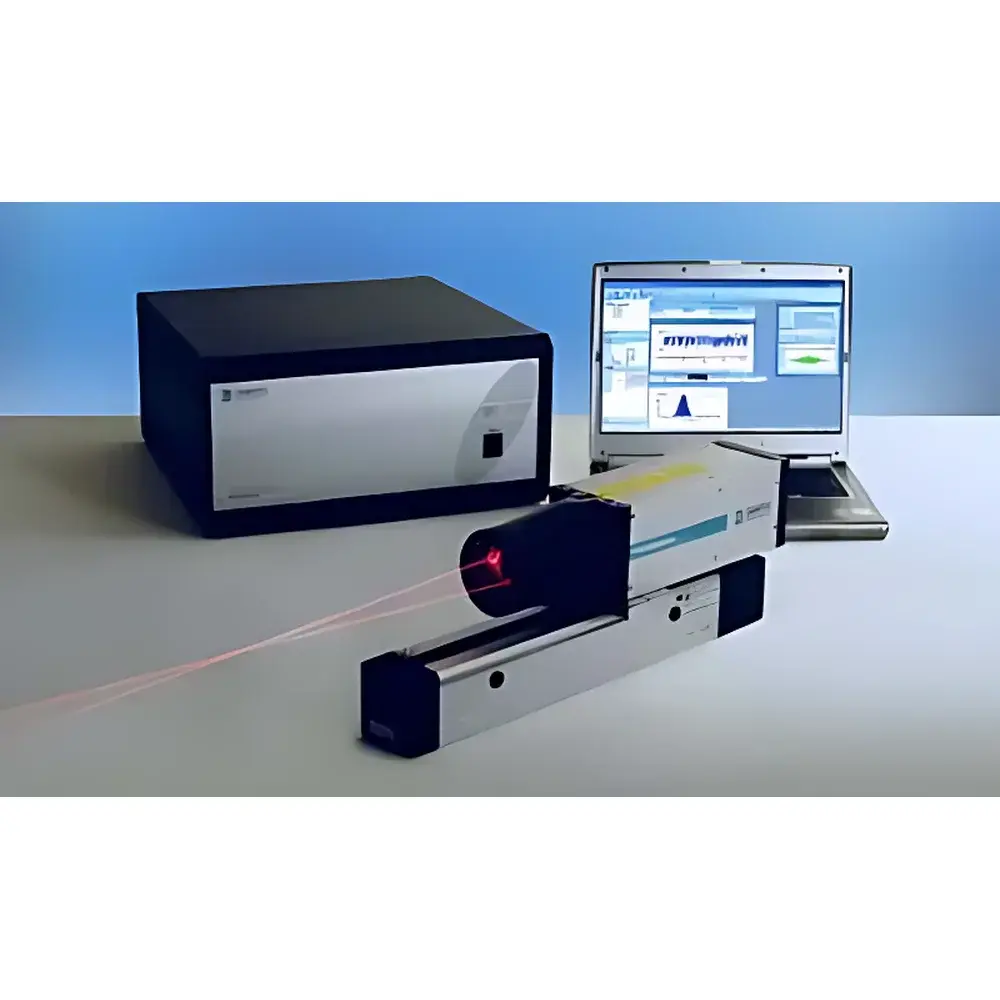
Dantec FlowExplorer Laser Doppler Anemometry (LDA) System
| Brand | Dantec |
|---|---|
| Origin | Denmark |
| Manufacturer Status | Authorized Distributor |
| Origin Category | Imported |
| Model | FlowExplorer |
| Price Range | USD 13,500 – 40,500 (est. based on ¥100,000–300,000 @ 7.4 CNY/USD) |
| Type | Volumetric Flow Measurement System |
| Laser Source | DPSS |
| Output Power Options | 70 mW / 150 mW / 500 mW |
| Measurement Distance Options | 150 mm / 300 mm / 500 mm / 750 mm |
| Signal Processor Models | BSA F600 / BSA F800 |
| Max Processing Frequency | 120 MHz / 200 MHz |
| Max Measurable Velocity (lens-dependent) | 432 m/s / 798 m/s |
| Data Acquisition Rate | >100,000 bursts/sec |
| ADC Resolution | 16-bit |
| Calibration | NIST-traceable certificate included |
| Connectivity | Wi-Fi enabled |
| Integrated Oscilloscope Functionality | Yes |
Overview
The Dantec FlowExplorer Laser Doppler Anemometry (LDA) System is a high-integration, laboratory-grade optical velocimetry platform engineered for non-intrusive, point-wise velocity measurement in gaseous and liquid flows. Based on the fundamental principle of laser Doppler shift—where frequency modulation of scattered light from seeded particles encodes instantaneous fluid velocity—the FlowExplorer delivers exceptional spatial resolution, temporal fidelity, and measurement repeatability. Unlike time-of-flight or thermal anemometry techniques, LDA provides true zero-velocity detection capability and intrinsic immunity to flow direction reversal, making it uniquely suited for complex unsteady flows, turbulent boundary layers, and recirculation zones. The system is pre-aligned and factory-calibrated, eliminating user-dependent optical alignment and reducing setup time to minutes rather than hours. Its modular architecture supports both single-component (1C) and dual-component (2C) configurations out-of-the-box, with optional upgrade paths to Phase-Doppler Anemometry (PDA) for simultaneous size and velocity characterization of dispersed phases.
Key Features
- Pre-aligned, factory-calibrated optical probe heads—no user adjustment required for immediate deployment
- NIST-traceable calibration certificate supplied with each system, ensuring metrological traceability per ISO/IEC 17025 requirements
- DPSS laser options (70 mW, 150 mW, 500 mW) optimized for particle seeding density and measurement volume geometry
- BSA F600 and BSA F800 signal processors supporting up to 200 MHz burst processing bandwidth and >100,000 validated velocity samples per second
- 16-bit analog-to-digital conversion enabling high dynamic range and low-noise velocity spectra analysis
- Integrated real-time oscilloscope functionality for signal quality assessment and trigger diagnostics
- Wi-Fi-enabled remote control and data streaming—compatible with secure enterprise networks and firewall-constrained lab environments
- Modular scalability: seamless transition from 1C LDA to 2C LDA or full PDA configuration via hardware and software license upgrades
Sample Compatibility & Compliance
The FlowExplorer system operates effectively in air, water, oils, and other optically transparent Newtonian fluids when seeded with appropriate tracer particles (e.g., TiO₂, SiO₂, or hollow glass spheres sized 0.5–5 µm). It meets essential requirements for metrological validation in accredited laboratories, including compliance with ISO 20487:2020 (fluid velocity measurement using LDA), ASTM D7237 (standard practice for LDA use in wind tunnels), and ISO/IEC 17025 Annex A.5 (traceability of measurement standards). All calibration certificates include uncertainty budgets calculated per GUM (JCGM 100:2008) and are valid for 12 months under standard operating conditions. The system supports GLP-compliant audit trails when used with optional software modules compliant with FDA 21 CFR Part 11 (electronic records and signatures).
Software & Data Management
FlowExplorer is operated via the proprietary FlowManager software suite—a Windows-based application designed for experimental fluid mechanics workflows. It provides synchronized acquisition, real-time spectral display, burst-mode histogramming, and statistical post-processing (mean, RMS, skewness, kurtosis, auto-/cross-correlation). Graphical outputs include time series plots, probability density functions (PDFs), power spectral density (PSD) curves, and Reynolds stress tensor components. Export formats include CSV, HDF5, and MATLAB-compatible .mat files. Batch processing scripts support automated analysis across multi-run datasets. The software architecture separates acquisition logic from visualization layers, enabling integration with third-party platforms such as LabVIEW, Python (via TCP/IP API), and MATLAB for custom algorithm development and CFD validation pipelines.
Applications
- Aerodynamic testing in closed- and open-circuit wind tunnels—including wake surveys, separation point identification, and vortex shedding characterization
- Hydrodynamic investigations in water channels, towing tanks, and cavitation tunnels—especially for low-speed turbulent flows and near-wall velocity gradients
- Primary and secondary calibration of thermal mass flow meters, turbine meters, and ultrasonic flow sensors against SI-traceable velocity references
- Characterization of internal flows in pumps, valves, diffusers, and swirl chambers—supporting ISO 5167 and ISO/TR 11382 validation protocols
- Fundamental turbulence research: energy cascade analysis, intermittency studies, and wall-bounded turbulence modeling (e.g., log-law verification)
- CFD code validation: high-fidelity benchmark datasets for RANS, LES, and DNS simulations—particularly in regions where conventional probes suffer from spatial filtering effects
FAQ
What particle seeding is recommended for air and water applications?
For air, polyamide or titanium dioxide particles (0.5–2 µm) at mass concentrations of 0.1–1 mg/m³ are optimal. For water, hollow glass spheres (1–5 µm) or silver-coated silica particles ensure sufficient scattering cross-section without settling bias.
Can FlowExplorer measure velocity in opaque or highly turbid fluids?
No—LDA requires optical access to the measurement volume. Applications involving opaque media (e.g., slurries, emulsions) require alternative techniques such as PIV or ultrasound Doppler velocimetry.
Is the system suitable for field deployment outside controlled laboratory environments?
While robustly engineered, FlowExplorer is designed for stable, vibration-isolated optical tables. Portable operation is feasible with active damping mounts and environmental enclosures—but long-term field use is not its primary design intent.
How is velocity direction ambiguity resolved in single-component mode?
Direction is inferred via signal phase analysis relative to a reference channel or by combining with a known mean flow orientation. Dual-component configuration eliminates ambiguity entirely through vector decomposition.
Does the system support synchronization with external triggers or PIV lasers?
Yes—TTL-compatible trigger inputs and outputs enable precise temporal coordination with high-speed cameras, pressure transducers, or pulsed PIV lasers for hybrid measurement strategies.