Dantec Dynamics MiniPIV Particle Image Velocimetry System
| Brand | Dantec Dynamics |
|---|---|
| Origin | Denmark |
| Model | MiniPIV |
| Measurement Plane | 2D/3D |
| Frame Rate | >100 Hz |
| Velocity Range | 0–5 m/s |
| Accuracy | ±1% of reading |
| Measurement Area | 150 mm × 120 mm |
| Camera | FlowSense USB 2M-165 (1920 × 1200 px, 165 fps) |
| Laser Source | RayPower (2/5/10 W, air-cooled, TEM₀₀ mode) |
| Software Platform | DynamicStudio |
Overview
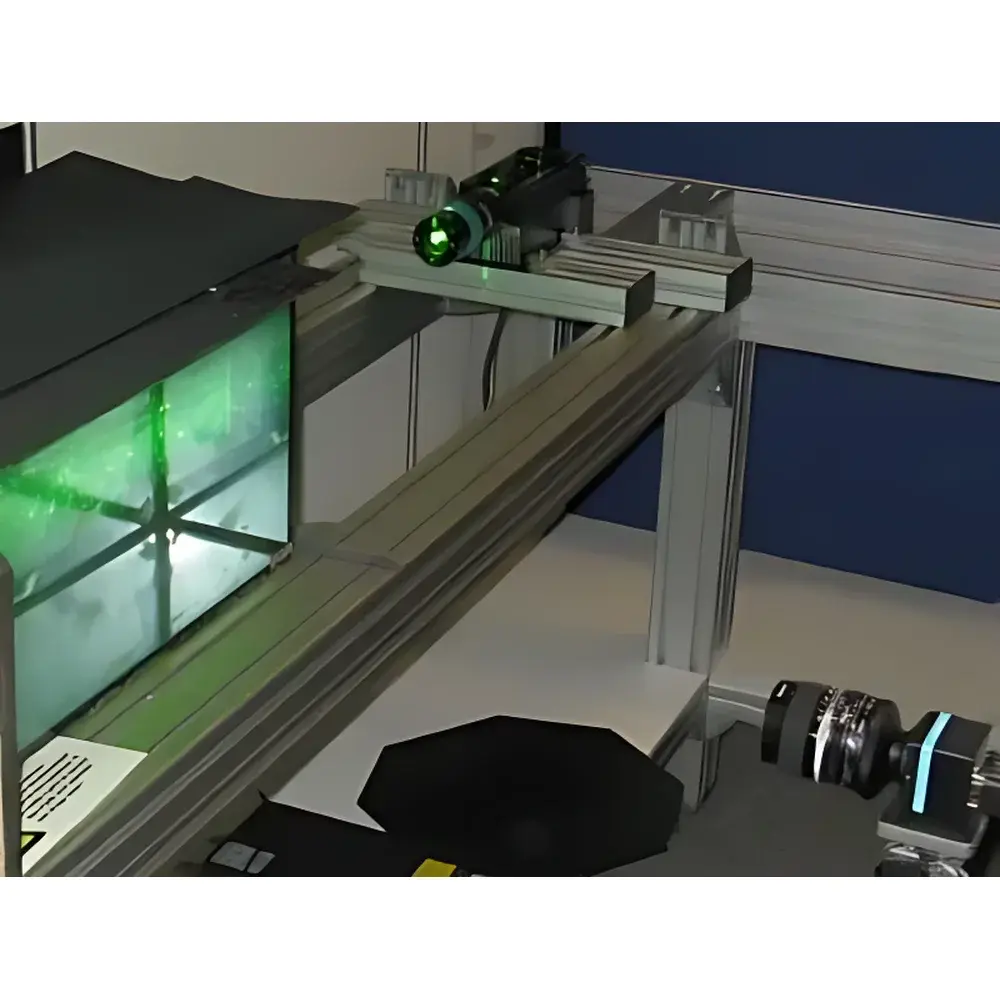
The Dantec Dynamics MiniPIV Particle Image Velocimetry System is a compact, high-fidelity optical measurement platform engineered for quantitative, non-intrusive analysis of fluid velocity fields in research laboratories and academic teaching environments. Based on the principle of double-pulse laser illumination and cross-correlation image analysis, MiniPIV captures instantaneous displacement of tracer particles seeded in a flow field—enabling full-field, two-dimensional (2D) or stereoscopic three-dimensional (3D) velocity vector mapping with sub-pixel resolution. Unlike point-wise techniques such as Laser Doppler Anemometry (LDA), MiniPIV delivers spatially resolved velocity data across an entire plane (150 mm × 120 mm), preserving both local gradients and global flow topology. Its design prioritizes experimental flexibility, robustness under low-velocity conditions (down to <0.1 m/s), and compatibility with transient phenomena—making it particularly suitable for vortex dynamics, boundary layer studies, microfluidics validation, and CFD benchmarking.
Key Features
- Optimized for low-speed flows: calibrated velocity range of 0–5 m/s with ±1% accuracy relative to measured value, traceable to NIST-traceable calibration standards.
- High-temporal-resolution imaging: FlowSense USB 2M-165 PIV camera delivers 1920 × 1200 pixel full-frame resolution at up to 165 Hz, supporting frame-straddling intervals down to 10 µs for accurate particle displacement capture.
- Integrated RayPower diode-pumped solid-state (DPSS) laser: Air-cooled, TEM₀₀-mode output with selectable power levels (2 W / 5 W / 10 W); minimal thermal drift and stable beam profile ensure consistent light sheet uniformity across the measurement plane.
- Real-time onboard image correction: Hardware-accelerated hot-pixel suppression, dead-pixel interpolation, and flat-field normalization reduce post-processing overhead and improve signal-to-noise ratio (SNR) without compromising acquisition speed.
- Modular architecture: Designed for rapid integration with stereo PIV add-ons, time-resolved volumetric PIV (tomographic or light-field configurations), and synchronized external triggers (e.g., pressure transducers, hot-wire probes).
Sample Compatibility & Compliance
MiniPIV operates with standard micron-scale seeding particles (e.g., hollow glass spheres, TiO₂, or DEHS droplets) appropriate for liquid or gaseous media. The system supports water, air, oil, and low-viscosity polymer solutions—provided refractive index matching and particle response time (Stokes number < 0.1) are maintained. All optical components comply with IEC 60825-1:2014 Class 4 laser safety requirements; interlocked enclosures and beam path containment meet EN 61000-6-3 EMC emission limits. For regulated environments, DynamicStudio supports audit trails, user access control, and electronic signature functionality aligned with FDA 21 CFR Part 11 and ISO/IEC 17025 documentation integrity guidelines.
Software & Data Management
DynamicStudio serves as the unified software environment for hardware orchestration, real-time visualization, and advanced interrogation. Its modular framework natively supports multiple algorithms—including FFT-based cross-correlation, iterative multi-grid interrogation, and Least-Squares Matching (LSM)—with adaptive window deformation and sub-pixel peak fitting. Distributed computing modules enable parallel processing across multi-core CPUs or GPU-accelerated nodes, reducing analysis time for large datasets (e.g., 10,000+ image pairs). Export formats include HDF5, ASCII, and Tecplot-compatible PLT files; metadata embedding ensures traceability of acquisition parameters, calibration coefficients, and processing history. Integration with MATLAB and Python via native APIs allows custom script deployment for Lagrangian coherent structure (LCS) extraction, vorticity decomposition, or Reynolds stress tensor computation.
Applications
- Academic instruction: Visualizing laminar-turbulent transition, wake formation behind bluff bodies (e.g., cylinder flow), and rotating flow instabilities in undergraduate and graduate fluid mechanics labs.
- CFD validation: Generating high-density ground-truth velocity fields for RANS/LES model assessment, including mean velocity profiles, turbulent kinetic energy (TKE), and strain-rate tensor components.
- Microscale flow characterization: Quantifying velocity gradients in microchannels, mixing efficiency in T-junctions, and electro-osmotic flow behavior under controlled electric fields.
- Combustion and spray diagnostics: Coupling with LIF or Mie scattering for simultaneous velocity–scalar field measurements in premixed flame stabilization or fuel injector atomization studies.
- Biomedical fluid dynamics: Mapping pulsatile flow patterns in anatomically realistic vascular phantoms or assessing shear stress distribution in stent models.
FAQ
What is the minimum resolvable velocity magnitude in MiniPIV?
The system achieves reliable detection down to ~0.05 m/s under optimal seeding density (10–20 particles per interrogation window) and illumination SNR > 25 dB, subject to camera exposure time and laser pulse energy settings.
Can MiniPIV be upgraded to stereoscopic (3D) configuration?
Yes—via optional dual-camera mounting kits, calibrated mirror rigs, and DynamicStudio StereoPIV module; requires separate calibration using a dot-grid target and triangulation-based reconstruction.
Is DynamicStudio compatible with third-party cameras or lasers?
Only Dantec-certified hardware is fully supported; however, SDK access enables limited integration with GenICam-compliant cameras through custom driver development.
How is measurement uncertainty quantified in MiniPIV?
Uncertainty propagation follows ISO 5725 and AIAA S-071A guidelines, incorporating pixel discretization error, peak-locking bias, particle image distortion, and correlation confidence thresholds—all reported alongside each velocity vector in exported datasets.
Does MiniPIV support time-resolved acquisition for unsteady flow analysis?
Yes—sustained frame rates up to 165 Hz enable direct observation of vortex shedding frequencies, flow instabilities, and transient acceleration events when paired with appropriate laser repetition rate and synchronization logic.