
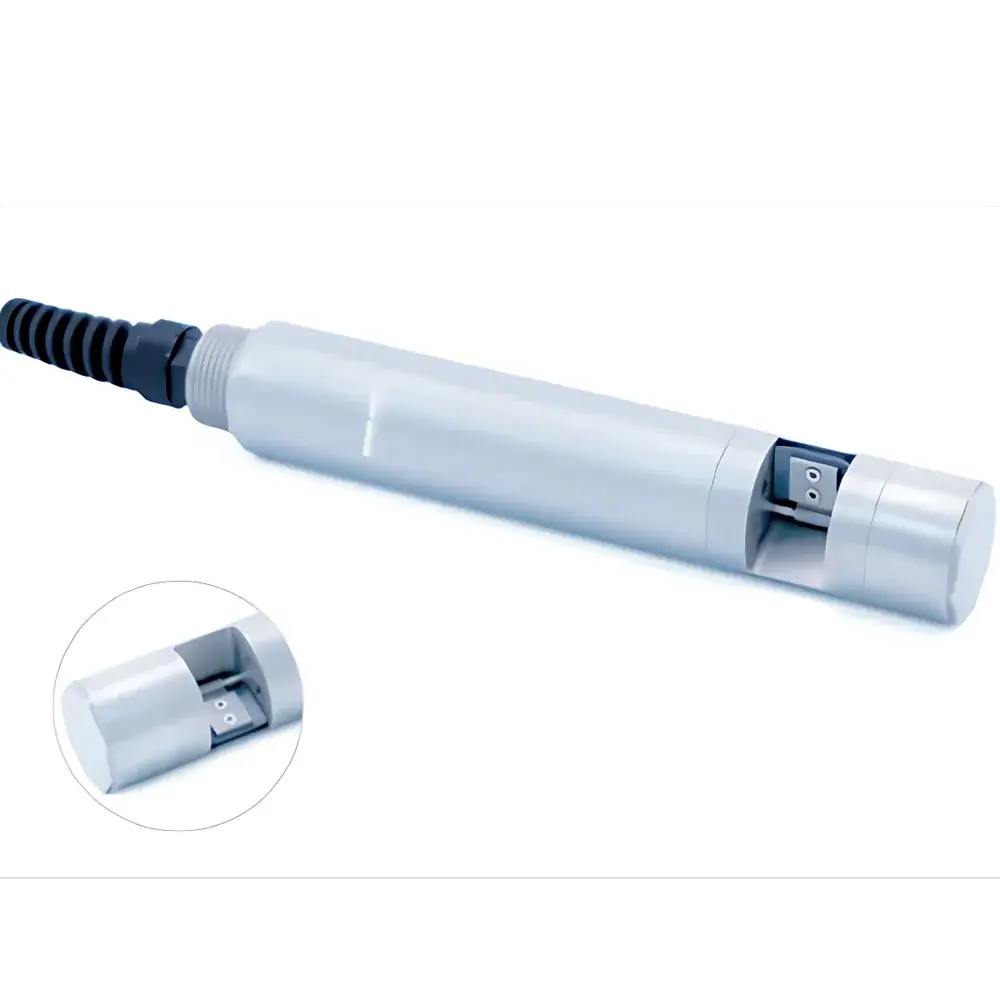
Zming Environmental HQ100-COD-STD UV Absorption-Based Online COD Sensor
| Brand | Zming Environmental Technology Co., Ltd. |
|---|---|
| Origin | Shanghai, China |
| Manufacturer Type | Authorized Distributor |
| Country of Origin | China |
| Model | HQ100-COD-STD |
| Price | Upon Request |
| Measurement Principle | UV254 nm Absorption Spectrophotometry |
| Range | 0–500 mg/L COD |
| Accuracy | ≤ ±10% FS |
| Resolution | 0.01 mg/L |
| Optical Path Length | 20 mm |
| Compensation Method | Dual-beam turbidity compensation at 546 nm |
| Response Time | ≤30 s (adjustable) |
| Output Interface | RS485 with Modbus RTU protocol |
| IP Rating | IP68 |
| Integrated Features | Simultaneous measurement of COD, turbidity, Specific UV Absorbance (SAC), and temperature |
| Cleaning Mechanism | Motor-driven mechanical wiper with programmable cleaning intervals |
| Power Supply | 12–24 VDC |
| Operating Temperature | 0–50 °C |
| Housing Material | Corrosion-resistant stainless steel (316L) and PEEK |
Overview
The Zming Environmental HQ100-COD-STD is a digital, in-situ ultraviolet absorption-based sensor engineered for continuous, reagent-free monitoring of Chemical Oxygen Demand (COD) in wastewater, stormwater, and industrial effluent streams. Unlike traditional wet-chemistry methods (e.g., dichromate digestion per ISO 6060 or EPA 410.4), this sensor employs spectrophotometric quantification at 254 nm — a wavelength strongly absorbed by aromatic compounds and unsaturated organic molecules that correlate robustly with COD concentration. Its dual-beam optical architecture incorporates a reference channel at 546 nm to dynamically correct for scattering effects caused by suspended solids and chromophoric dissolved organic matter (CDOM), thereby decoupling absorbance interference from true organic load. Designed for permanent submersion in open channels, discharge pipes, or wet wells, the sensor delivers stable, drift-resistant output under variable flow, biofouling-prone, and high-turbidity conditions — without consumables, calibration drift, or hazardous waste generation.
Key Features
- Reagent-free operation: Eliminates chemical handling, storage, disposal, and associated regulatory compliance burdens (e.g., OSHA hazard communication, EPA RCRA reporting).
- Multi-parameter integration: Simultaneously reports COD (mg/L), turbidity (NTU), Specific UV Absorbance (SAC₂₅₄, L·mg⁻¹·m⁻¹), and temperature (°C) — all synchronized within a single measurement cycle.
- Active optical fouling mitigation: Integrated stainless-steel wiper blade driven by a sealed stepper motor; cleaning frequency programmable via Modbus register (e.g., every 1–24 hours) to match site-specific biofilm accumulation rates.
- Digital-native interface: RS485 physical layer with Modbus RTU protocol (slave ID, baud rate, parity configurable); compatible with SCADA, PLCs (Siemens S7, Allen-Bradley ControlLogix), and cloud-based telemetry platforms (e.g., Ignition, ThingsBoard).
- Ruggedized deployment design: IP68-rated housing constructed from 316L stainless steel and PEEK polymer; pressure-tested to 10 bar; operational in temperatures from 0 to 50 °C and pH 4–10.
- Field-configurable response dynamics: Adjustable measurement interval (1–300 s) and averaging window (1–60 readings) to balance temporal resolution against signal noise in low-flow or highly variable matrices.
Sample Compatibility & Compliance
The HQ100-COD-STD is validated for use in municipal wastewater influent/effluent, combined sewer overflows (CSOs), industrial pre-treatment outfalls (textile, food processing, pharmaceutical), and surface water quality early-warning stations. It meets the functional requirements of ISO 15839 (Water quality — Specifications and performance testing of on-line sensors/analyzers for measuring physico-chemical parameters), and its Modbus implementation aligns with IEC 61158 standards for industrial communication. While not a replacement for laboratory-grade COD validation per ISO 6060, the sensor supports trend analysis, alarm triggering (e.g., >150 mg/L COD at discharge point), and mass balance estimation when periodically verified against grab-sample lab results. Data integrity complies with GLP principles through timestamped, non-volatile internal logging (up to 32,000 records) and audit-trail-capable system integration.
Software & Data Management
Configuration and diagnostics are performed using Zming’s PC-based ZM-ConfigTool (Windows), which provides real-time waveform visualization, spectral baseline verification, wiper status monitoring, and firmware update capability. Raw sensor data (including raw 254 nm and 546 nm absorbance values) can be extracted via Modbus function code 03 (Read Holding Registers). When integrated into enterprise systems, the sensor supports time-synchronized data ingestion with metadata tagging (e.g., location ID, sensor serial number, calibration history flag). Optional MQTT publishing modules enable direct forwarding to AWS IoT Core or Azure IoT Hub with TLS 1.2 encryption and certificate-based authentication — satisfying cybersecurity requirements for OT/IT convergence in modern water utilities.
Applications
- Real-time compliance monitoring at NPDES or EU Urban Wastewater Treatment Directive (91/271/EEC) discharge points.
- Early detection of process upsets in activated sludge plants (e.g., shock loads, nitrification failure, hydraulic overloads).
- Stormwater pollution tracking across urban catchments using distributed sensor networks.
- Optimization of chemical dosing (e.g., coagulants, oxidants) in tertiary treatment via feed-forward control logic.
- Long-term SAC₂₅₄ trend analysis for assessing dissolved organic carbon (DOC) variability and disinfection by-product (DBP) precursor monitoring.
- Remote monitoring of decentralized wastewater systems where maintenance access is infrequent or logistically constrained.
FAQ
Does the HQ100-COD-STD require periodic calibration with standard solutions?
No — it is factory-calibrated using traceable NIST-matched reference standards. Field verification is recommended quarterly using a certified COD reference solution (e.g., potassium hydrogen phthalate) to confirm correlation stability; zero-point validation may be performed in clean deionized water.
Can the sensor operate reliably in seawater or brackish environments?
Yes — the 316L stainless steel and PEEK construction resists chloride-induced pitting and crevice corrosion; however, long-term immersion in salinities >35 g/L requires more frequent wiper activation due to accelerated biofilm formation.
How does the dual-beam compensation handle colored dissolved organic matter (CDOM)?
The 546 nm channel measures non-specific light attenuation primarily from scattering and broad-spectrum absorption; subtracting this from the 254 nm signal isolates the aromatic-specific absorbance component, improving specificity for humic-like substances while maintaining sensitivity to phenolic and nitroaromatic contaminants.
Is the sensor compliant with FDA 21 CFR Part 11 for regulated pharmaceutical wastewater monitoring?
The device itself is not Part 11-certified, but its Modbus data stream and external logging infrastructure (e.g., validated historian software) can be configured to meet electronic record and signature requirements when deployed within a validated GxP environment.
What is the expected service life under continuous operation?
With scheduled wiper maintenance and avoidance of abrasive sediment abrasion, the optical module maintains metrological stability for ≥36 months; the wiper motor and seals are rated for >100,000 actuation cycles.




