
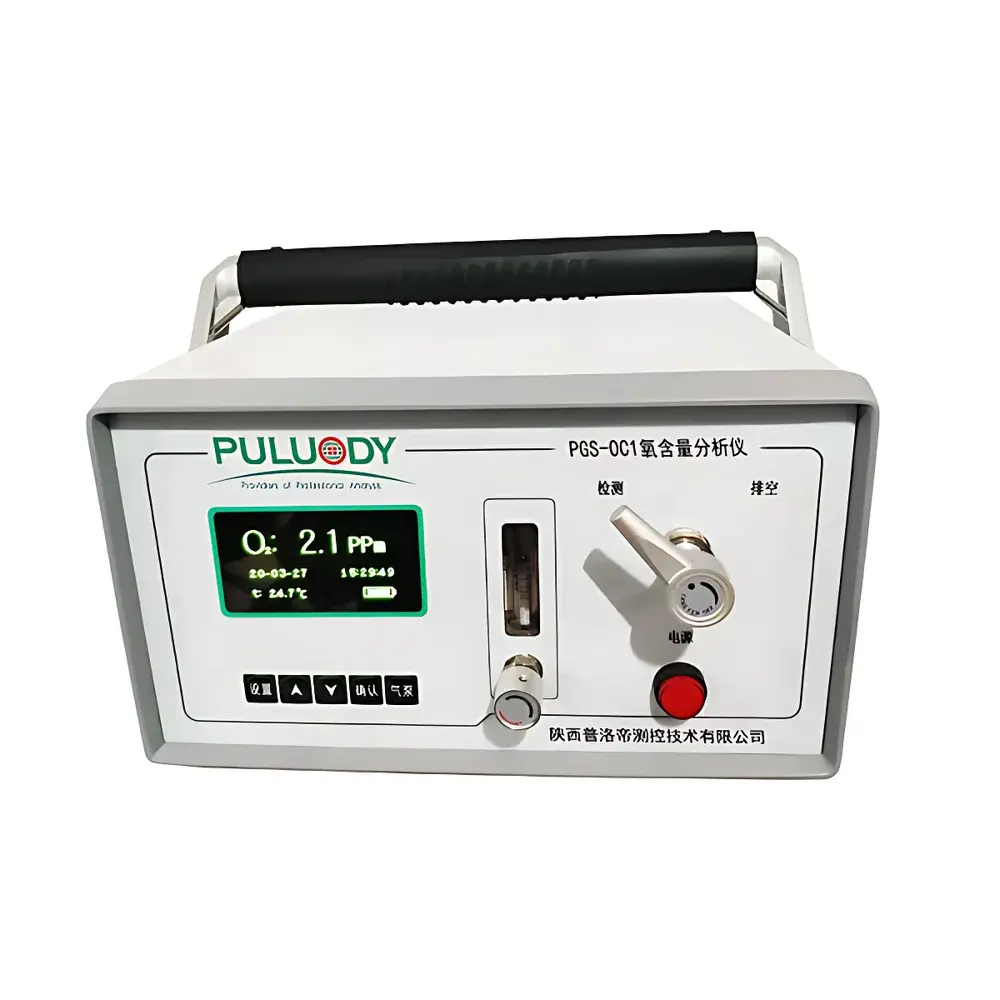
PULUODY PGS-OC1 Portable Trace Oxygen Analyzer
| Brand | PULUODY |
|---|---|
| Origin | Shaanxi, China |
| Manufacturer Type | Direct Manufacturer |
| Country of Origin | China |
| Model | PGS-OC1 |
| Price | USD 3,950 (FOB) |
| Measurement Principle | Electrochemical (Galvanic Cell) |
| Range | 0.0–10 / 100 / 1000 ppm O₂ (selectable) |
| Accuracy | ≤ ±2% FS |
| Sample Flow Rate | 400 ± 10 mL/min |
| Inlet Pressure Range | 0.05–0.5 MPa |
| Response Time (T₉₀) | ≤ 60 s |
| Display | 128×64 OLED, monochrome, high-brightness |
| Data Storage | 3200 records with trend curve |
| Power Supply | AC 220 V ±10%, 50 Hz ±10% (charger) |
| Built-in Sampling Pump | Yes |
| Operating Temperature | –5 °C to +45 °C |
| Operating Humidity | ≤ 90% RH (non-condensing) |
| Alarm Output | User-configurable threshold (factory default: 5 ppm O₂) |
| Compliance | Designed for ISO 8573-3, ASTM D6299, and GLP-aligned field verification workflows |
Overview
The PULUODY PGS-OC1 Portable Trace Oxygen Analyzer is an engineered solution for real-time, on-site quantification of ultra-low oxygen concentrations in inert and process gases. It operates on the principle of electrochemical galvanic cell detection—where molecular oxygen diffuses through a selective membrane into an aqueous electrolyte, initiating a spontaneous redox reaction between a lead (Pb) anode and a gold (Au) cathode. This generates a diffusion-limited current linearly proportional to the partial pressure of O₂ in the sample stream. Unlike polarographic sensors requiring external bias, the PGS-OC1’s self-powered galvanic design ensures stable zero baseline, minimal drift, and extended sensor service life (>24 months typical). Its compact, ruggedized housing (IP65-rated enclosure) and integrated sampling pump enable deployment across non-ideal environments—including nitrogen blanketing lines, furnace purge zones, semiconductor fab gas cabinets, and cryogenic air separation tail-gas monitoring points—without reliance on external vacuum sources or conditioning manifolds.
Key Features
- Triple-range selectable measurement capability: 0.0–10 ppm, 0.0–100 ppm, and 0.0–1000 ppm O₂—optimized for both ultra-high-purity applications (e.g., electronics-grade N₂) and industrial safety-level monitoring.
- High-fidelity 128×64 monochrome OLED display with wide viewing angle and ambient-light readability—enabling clear visualization of real-time concentration, trend curves, and alarm status under factory floor lighting or outdoor daylight conditions.
- Onboard data logging with timestamped storage of up to 3200 measurement records; internal memory retains full traceability including date/time stamp, range setting, and alarm events—critical for audit-ready documentation per ISO/IEC 17025 and FDA 21 CFR Part 11 compliance frameworks.
- Integrated diaphragm sampling pump with flow regulation (400 ±10 mL/min), eliminating need for external flow controllers or critical-orifice assemblies—reducing system complexity and calibration dependencies.
- Dual-power architecture: Operates continuously via rechargeable lithium-ion battery (8–12 h nominal runtime) or AC mains (220 V ±10%, 50 Hz)—with intelligent charging circuitry that prevents overcharge and thermal runaway.
- Fully localized Chinese menu interface with tactile membrane keypad—designed for intuitive operation by field technicians without specialized instrumentation training.
Sample Compatibility & Compliance
The PGS-OC1 is validated for use with dry, non-corrosive, non-condensable gas matrices including nitrogen, argon, helium, hydrogen, and synthetic air. It is unsuitable for use with halogenated compounds, sulfur-containing gases, or vapors containing >10 ppm total hydrocarbons—due to potential electrolyte poisoning and irreversible sensor degradation. The instrument meets mechanical and environmental requirements outlined in IEC 61000-6-2 (immunity) and IEC 61000-6-3 (emissions), and its measurement methodology aligns with reference test standards including ASTM D6299 (precision and bias of trace oxygen analyzers) and ISO 8573-3 (compressed air purity classes for gaseous contaminants). For regulated industries, the device supports ALCOA+ data integrity principles through immutable timestamped logs and user-accessible configuration history—facilitating GLP/GMP audits and validation protocols.
Software & Data Management
While the PGS-OC1 operates autonomously without PC dependency, optional USB-C interface enables direct data export to CSV format for post-processing in Excel, LabVIEW, or LIMS platforms. Firmware updates are performed via secure signed binary upload—preserving cryptographic integrity of embedded control logic. All stored records include metadata fields: measurement epoch (UTC), active range index, pump status flag, battery voltage, and alarm trigger state. No cloud connectivity or remote telemetry is implemented—ensuring full data sovereignty and compliance with industrial cybersecurity policies (e.g., ISA/IEC 62443 Level 1).
Applications
- Verification of nitrogen purge efficacy in pharmaceutical fluid bed dryers and reactor blanketing systems.
- In-process monitoring of protective atmospheres in sintering furnaces for soft magnetic alloys (e.g., Fe-Si, Ni-Fe).
- Quality assurance testing of electronic specialty gases prior to cylinder filling—per SEMI F57 specifications.
- Leak detection support in insulated piping networks carrying high-purity inert gases.
- Field validation of oxygen scavenger performance in modified atmosphere packaging (MAP) production lines.
- Commissioning support for on-site gas generation systems (PSA, membrane separators) where lab-based GC analysis is impractical.
FAQ
What is the recommended calibration frequency for the PGS-OC1?
Annual calibration against certified zero gas (nitrogen <0.1 ppm O₂) and span gas (e.g., 10 ppm O₂ in N₂) is advised for routine QC use; more frequent calibration may be required in high-contamination-risk environments.
Can the instrument measure oxygen in humid or CO₂-rich streams?
No—water vapor condensation or elevated CO₂ partial pressures (>1%) may accelerate electrolyte depletion and cause signal drift; sample drying and CO₂ scrubbing are mandatory upstream.
Is sensor replacement user-serviceable?
Yes—the electrochemical cell is a field-replaceable module with standardized connector interface and auto-recognition firmware handshake.
Does the device support analog output for integration into DCS systems?
Not natively; however, optional 4–20 mA transmitter module (PGS-OC1-IO) is available as an accessory with isolated output and HART protocol compatibility.
How is measurement uncertainty calculated?
Uncertainty is specified as ≤±2% of full scale (FS) at 23 °C ±2 °C and 50% RH, derived from combined contributions of sensor linearity, temperature coefficient (±0.05%/°C), and ADC resolution—per ISO/IEC Guide 98-3 (GUM).






