
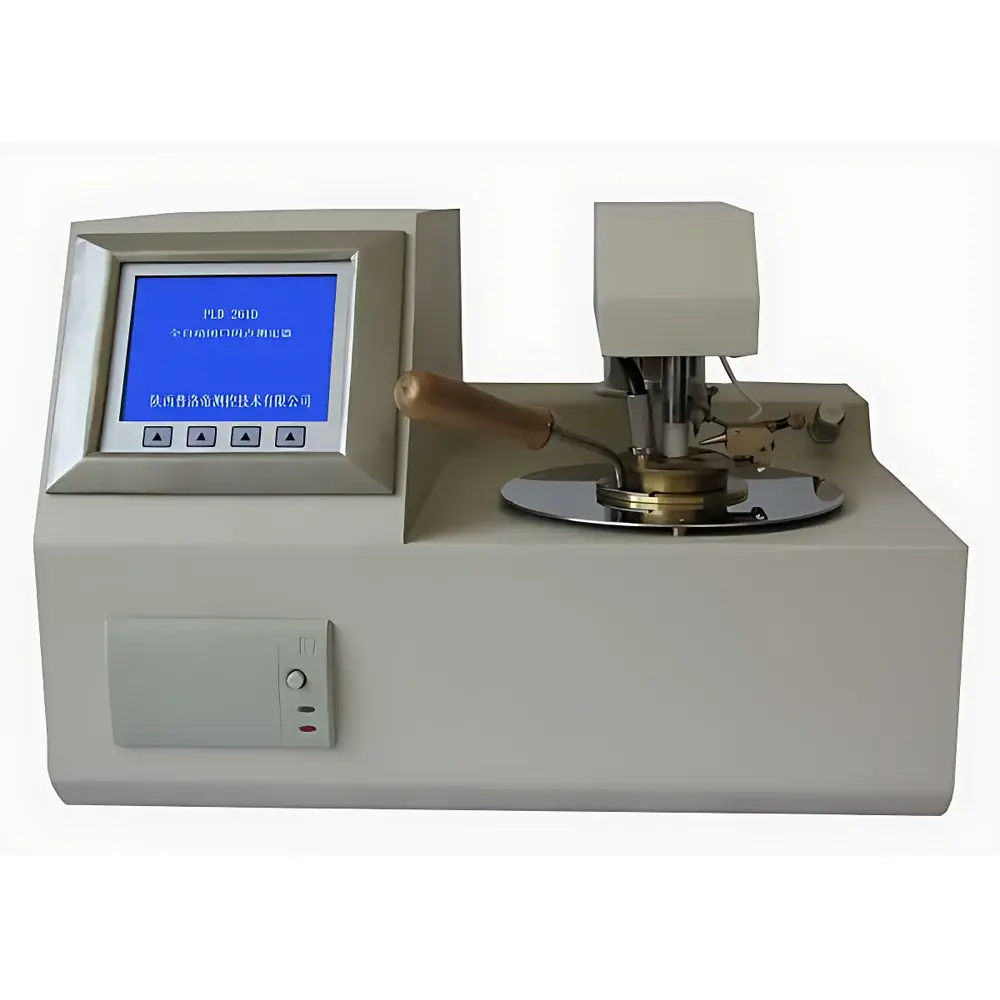
PULUODY PLD-261D Automatic Closed-Cup Flash Point Tester
| Brand | PULUODY |
|---|---|
| Origin | Shaanxi, China |
| Manufacturer Type | Direct Manufacturer |
| Country of Origin | China |
| Model | PLD-261D |
| Price | USD 7,800 (FOB) |
Overview
The PULUODY PLD-261D Automatic Closed-Cup Flash Point Tester is a fully integrated analytical instrument engineered for precision determination of flash point and fire point of petroleum products, solvents, lubricants, and other flammable liquids in accordance with internationally recognized closed-cup test methods—including ASTM D93, ISO 2719, IP 34, and GB/T 261. It operates on the principle of stepwise programmed heating under controlled atmospheric conditions, where a small sample is heated incrementally in a sealed test cup; an ignition source is automatically introduced at defined temperature intervals until volatile vapors ignite momentarily—defining the flash point. The system employs dual-core microprocessor control to synchronize thermal ramping, vapor detection, pressure compensation, and safety interlocks, ensuring high reproducibility and compliance with laboratory quality management systems.
Key Features
- Microprocessor-based dual-CPU architecture enabling real-time coordination of thermal control, vapor detection logic, and environmental parameter acquisition.
- Programmable temperature ramping profile compliant with ASTM D93 Method A (Tag Closed Cup) and Method B (Pensky-Martens Closed Cup), supporting both manual and automatic test initiation.
- Integrated barometric pressure sensor for real-time atmospheric correction—critical for trace-level flash point accuracy across varying elevation and weather conditions.
- Self-diagnostic firmware with continuous hardware health monitoring, including thermocouple validation, cup seal integrity check, and igniter functional verification prior to each test cycle.
- Automated post-test sequence: flame suppression via inert gas purge, active cooling via integrated Peltier element, and thermal stabilization before next sample loading.
- High-contrast 7-inch TFT LCD interface displaying real-time temperature curve, test stage status, detected flash event timestamp, and pass/fail indicators per regulatory thresholds.
Sample Compatibility & Compliance
The PLD-261D accommodates liquid samples ranging from low-viscosity hydrocarbons (e.g., gasoline, kerosene) to moderately viscous fluids (e.g., diesel fuel, transformer oils, hydraulic fluids) within the standard 1–10 mL volume range. Sample introduction is performed via calibrated syringe or automated pipetting module (optional). All operational parameters—including heating rate, stir speed, ignition frequency, and dwell time—are configurable to meet method-specific requirements. The instrument conforms to GLP (Good Laboratory Practice) documentation standards and supports audit-ready data output with embedded metadata (operator ID, sample ID, ambient T/P, calibration date). While not inherently 21 CFR Part 11 compliant out-of-the-box, its software architecture permits integration with validated electronic signature and audit trail modules when deployed in regulated pharmaceutical or petrochemical QA/QC environments.
Software & Data Management
The instrument is operated via PV Flash Point (Closed) Test v8.0 software—a Windows-based application supporting local and networked deployment. Software functions include multi-user role assignment (admin/operator/auditor), customizable report templates (PDF/CSV/XLSX), automated data archiving with time-stamped backups, and configurable alarm thresholds for out-of-spec results. Raw test logs contain full thermographic profiles, pressure-compensated flash point values, diagnostic event codes, and operator annotations. Data export complies with LIMS interoperability standards (ASTM E1578, ANSI/NIST ITL Bulletin 2018-1), enabling seamless ingestion into enterprise laboratory information management systems.
Applications
- Quality assurance testing of crude oil fractions and refined fuels in refinery QC laboratories.
- Regulatory compliance verification for transportation and storage classification (UN GHS Category 1–4 flammability labeling).
- Stability assessment of formulated lubricants and metalworking fluids during accelerated aging studies.
- Batch release testing of industrial solvents used in electronics cleaning, paint formulation, and adhesive manufacturing.
- Research applications involving novel biofuels and synthetic esters requiring precise volatility characterization under standardized closed-cup conditions.
FAQ
What closed-cup test standards does the PLD-261D support?
ASTM D93 (Methods A and B), ISO 2719, IP 34, DIN 51755, and GB/T 261—fully configurable via software method library.
Does the instrument require external calibration gases or reference standards?
No; calibration is performed using certified reference materials (CRM) traceable to NIST or equivalent national metrology institutes—temperature sensors are verified against ITS-90, pressure sensor against primary barometric standards.
Can test data be exported directly to a LIMS?
Yes; CSV and XML exports include structured metadata fields compatible with common LIMS APIs; optional OPC UA connectivity available for real-time integration.
Is the PLD-261D suitable for testing high-boiling-point samples such as bitumen or heavy fuel oil?
No; it is designed for samples with initial boiling points below 400 °C and flash points between 40 °C and 370 °C—high-boiling materials require open-cup or Pensky-Martens high-range variants.
How is instrument maintenance tracked and documented?
Built-in maintenance scheduler logs service events (e.g., cup cleaning, igniter replacement, sensor recalibration); all entries are digitally signed and archived with tamper-evident timestamps.



