
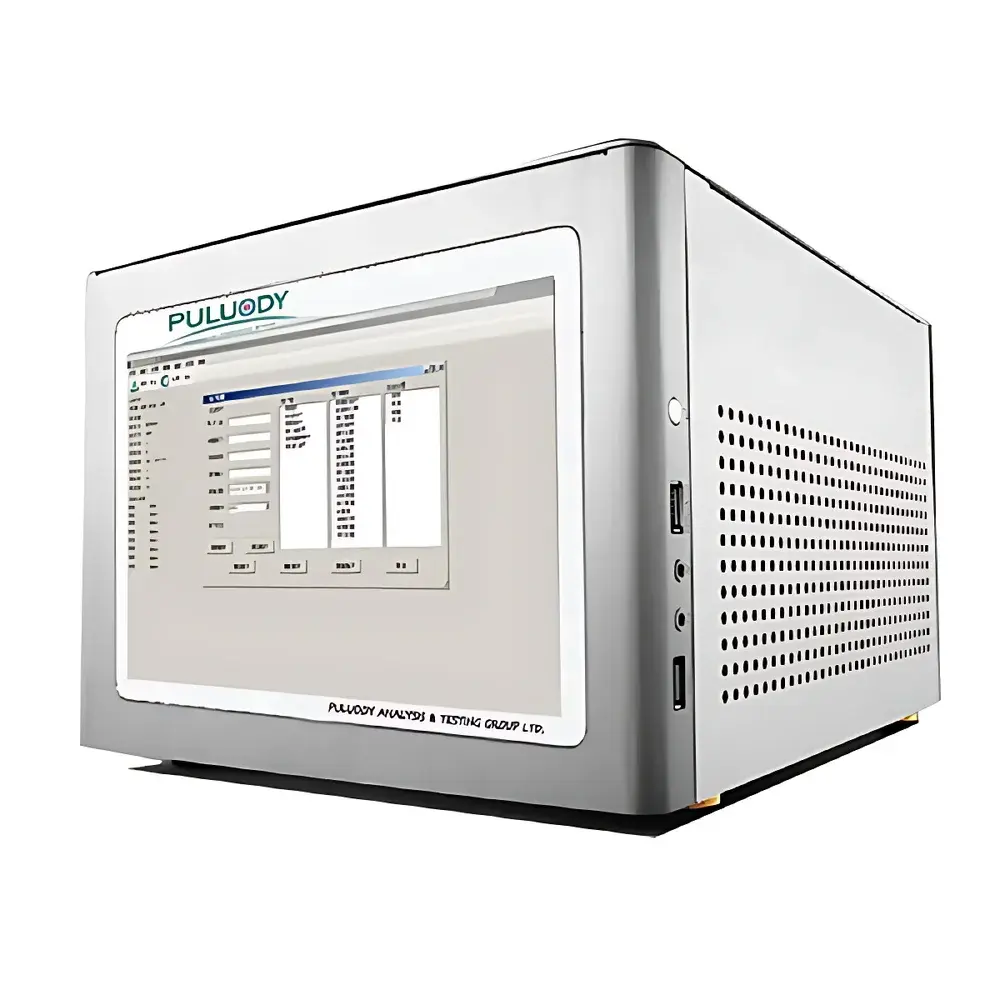
PULUODY PMT-2CC Ultra-Pure Water Nanoparticle Counter (50 nm Detection Limit)
| Brand | PULUODY |
|---|---|
| Origin | Shaanxi, China |
| Manufacturer Type | Authorized Distributor |
| Instrument Type | Optical Particle Counter |
| Detection Principle | Dual-Laser Narrow-Beam Light Scattering |
| Sensor Generation | 8th-Generation Dual-Laser Sensor |
| Measurement Range | 0.05–0.2 µm (with customizable ranges: 1–100 µm or 4–70 µm(c), and 0.1 µm(c) selectable) |
| Sampling Method | Precision Metering Piston Pump + Electromagnetic Flow Control |
| Sample Volume Accuracy | < ±1% |
| Counting Accuracy | < ±3% (typical) |
| Coincidence Limit | ≤2.5% error at 1000 particles/mL |
| Output Interface | 4–20 mA analog output with configurable alarm trigger |
| Calibration Standards | JJG 1061, ISO 21501-4, NIST-traceable latex sphere reference |
| Software | V8.3 Integrated Analysis & Calibration Software (PC + touchscreen GUI) |
| Display | Color LCD touchscreen + optional wireless keyboard/mouse |
| Power Input | 100–265 VAC, 50–60 Hz |
| Compliance Support | Designed for GLP/GMP-aligned workflows |
Overview
The PULUODY PMT-2CC Ultra-Pure Water Nanoparticle Counter is an optical particle counter engineered for high-sensitivity detection and quantification of sub-100 nm particulate contaminants in ultra-pure water (UPW) and low-conductivity process liquids. Operating on the principle of dual-laser narrow-beam light scattering—where two spatially offset laser sources illuminate the sample stream simultaneously—the instrument achieves enhanced signal-to-noise ratio and improved resolution for particles as small as 50 nm (0.05 µm). This eighth-generation sensor architecture mitigates Mie scattering artifacts common in single-beam systems and enables robust discrimination between true particulates and refractive index fluctuations in ultrapure matrices. The PMT-2CC is specifically designed for use in semiconductor front-end fabrication, flat-panel display manufacturing, pharmaceutical water-for-injection (WFI) systems, and advanced nanofiltration validation—where real-time, trace-level particle monitoring directly impacts yield, defect control, and regulatory compliance.
Key Features
- Dual-laser narrow-beam optical detection system with independent wavelength alignment and synchronized pulse timing for improved counting fidelity below 100 nm
- Precision metering piston pump combined with electromagnetic flow regulation ensures repeatable volumetric sampling (< ±1% volume accuracy) across variable viscosity and conductivity conditions
- Modular hardware architecture supports both online (in-line or side-stream) and offline (portable or benchtop) configurations without recalibration
- Real-time alarm logic with programmable thresholds and 4–20 mA analog output for integration into SCADA or DCS platforms
- Touchscreen HMI with intuitive workflow navigation and optional PC-based remote operation via V8.3 software suite
- Calibration traceability to ISO 21501-4 (Light Scattering Liquid-Borne Particle Counters) and national metrological standard JJG 1061
Sample Compatibility & Compliance
The PMT-2CC accommodates a broad range of low-particulate, low-conductivity media including UPW (resistivity ≥18.2 MΩ·cm), semiconductor cleaning solvents (e.g., SC1, SC2, DHF), photoresist developers, and polymer solutions. Its fluidic path employs chemically inert, low-adsorption materials (e.g., fused silica capillaries, PFA tubing, and electropolished 316L stainless steel wetted surfaces) to minimize surface-induced artifact generation. The system meets essential requirements for ISO 14644-1 Class 1–3 cleanroom environments and supports documentation practices aligned with ICH Q5C, USP , and ASTM F3232 for liquid-borne particle characterization. While not inherently 21 CFR Part 11–certified, its software architecture allows deployment with validated electronic signature and audit trail modules under qualified IT infrastructure.
Software & Data Management
The V8.3 analysis platform separates calibration management from routine testing—a design choice that prevents accidental parameter drift during operational use. It provides full spectral histogram export (particle count vs. size bin), time-series trending, batch report generation (PDF/CSV), and automated contamination grade assignment per NAS 1638, ISO 4406, or custom user-defined scales. All measurement sessions are timestamped, operator-ID tagged, and stored with metadata including environmental temperature, pressure, and flow rate. Raw scatter pulse data is retained for retrospective reanalysis. Data integrity safeguards include write-once storage options, encrypted database backups, and role-based access control (RBAC) when deployed on networked servers.
Applications
- Semiconductor wafer cleaning line monitoring: real-time detection of residual slurry, metal oxides, and polishing byproducts in megasonic rinse tanks
- UPW distribution loop surveillance: continuous verification of filter integrity and ion exchange column performance
- Pharmaceutical water systems: qualification of point-of-use filters and periodic verification of WFI/PUW purity per USP
- Nanofiltration membrane challenge testing: quantifying breakthrough of model nanoparticles (e.g., 50 nm polystyrene latex) under varying transmembrane pressures
- Flat-panel display substrate rinsing: validation of particle removal efficiency for TFT-LCD and OLED glass handling processes
- Research-grade colloidal stability studies: tracking aggregation kinetics in dilute polymer or surfactant solutions
FAQ
What is the smallest detectable particle size, and how is it verified?
The PMT-2CC achieves a verified lower detection limit of 50 nm (0.05 µm) using NIST-traceable 50 nm polystyrene latex standards under optimized flow and gain settings. Verification follows ISO 21501-4 Annex B protocols.
Can the instrument be integrated into a PLC-controlled manufacturing line?
Yes—its 4–20 mA analog output, discrete digital I/O (alarm relay), and Modbus TCP option enable direct interfacing with industrial controllers for automated shutdown or filter change alerts.
Does the system require daily recalibration?
No. Routine verification uses a stable reference suspension prior to critical batches; full calibration is recommended quarterly or after sensor maintenance, per ISO 21501-4 Clause 8.
Is the wetted path compatible with aggressive solvents like acetone or IPA?
Standard configuration supports aqueous and mildly polar solvents. For aggressive organics, optional fluoropolymer-coated flow cells and solvent-rated seals are available upon specification.
How does the dual-laser design reduce coincidence error compared to single-beam counters?
By spatially separating detection zones and applying cross-correlation algorithms, the system identifies overlapping pulses from coincident particles—enabling dynamic correction up to 1000 particles/mL with ≤2.5% residual error.



