
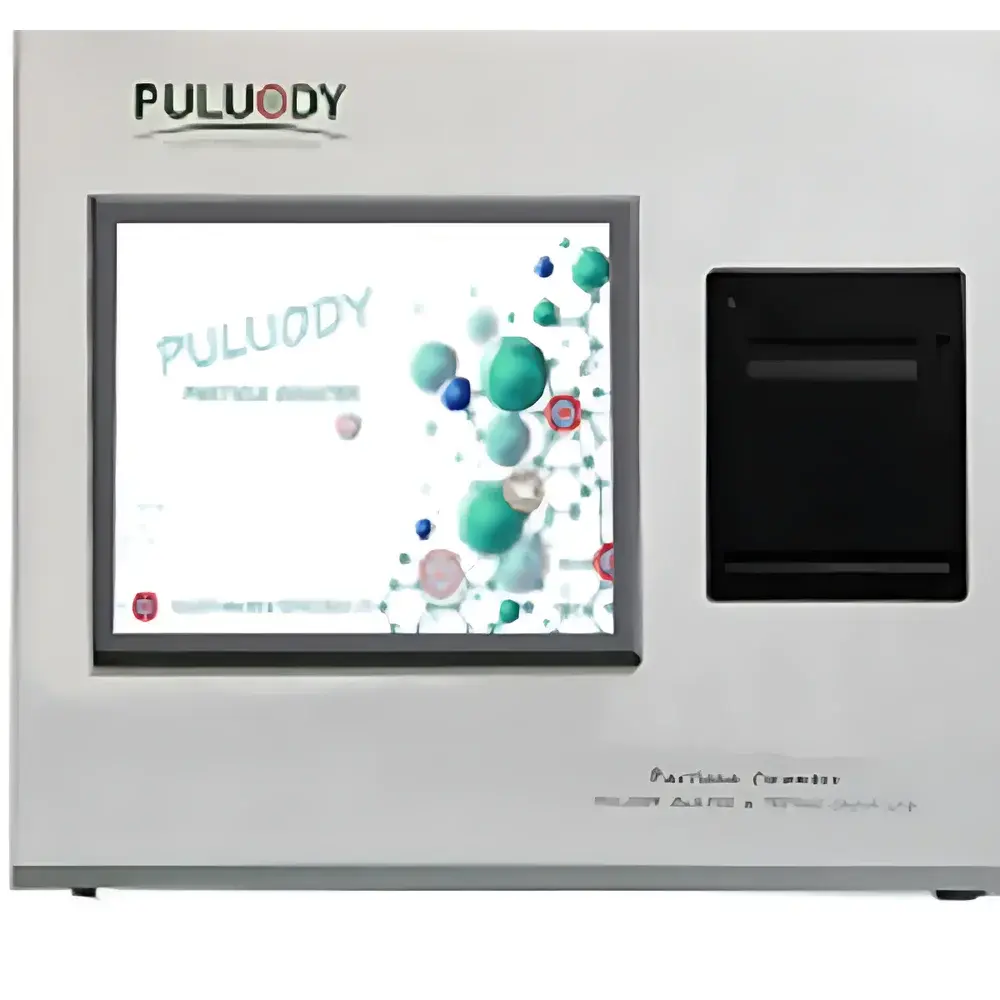
PULUODY DPC-1513-a Laser Particle Size Analyzer for Oilfield Water Re-injection
| Brand | PULUODY |
|---|---|
| Origin | Shaanxi, China |
| Manufacturer Type | Authorized Distributor |
| Regional Category | Domestic (China) |
| Model | DPC-1513-a |
| Price | USD 39,200 (approx.) |
| Dispersion Method | Dry & Wet Dispersion |
| Instrument Type | Laboratory Laser Particle Size Analyzer |
| Measurement Range | 1 nm – 2000 µm |
| Repeatability | < 1% |
| Measurement Time | 30–60 seconds per sample |
Overview
The PULUODY DPC-1513-a Laser Particle Size Analyzer is a dual-principle, high-fidelity instrumentation platform engineered specifically for particle characterization in oilfield water re-injection streams. It integrates two complementary physical measurement modalities: (1) laser diffraction/scattering—based on ISO 13320 principles—and (2) dynamic flow imaging—aligned with ISO 13321 methodology—to deliver orthogonal, cross-validated granulometric data across an unprecedented 1 nm to 2000 µm dynamic range. Unlike conventional single-mode analyzers, the DPC-1513-a enables concurrent or sequential deployment of both techniques within a single instrument architecture, ensuring robustness against optical interference, agglomeration artifacts, and refractive index bias—critical challenges in complex, high-salinity, multi-phase formation waters. Its design directly addresses regulatory compliance requirements outlined in SY/T 5329–2022 (Water Quality Specifications for Clastic Reservoir Water Flooding), SY/T 5523–2016 (Oilfield Water Analysis Methods), and Q/SY 01004–2016 (Gas Field Water Re-injection Technical Specification), while maintaining full traceability to international standards including ISO 13320 (laser diffraction) and ISO 13321 (dynamic image analysis). The system employs PULUODY’s 7th-generation dual-laser narrow-beam detector array, delivering enhanced signal-to-noise ratio, thermal stability over extended operation cycles, and long-term photodetector lifetime (>10,000 hours under nominal use).
Key Features
- Dual-measurement capability: Simultaneous or selective operation of laser diffraction and real-time flow imaging modes—enabling validation of size distribution against shape-dependent metrics (e.g., circularity, aspect ratio)
- Ultra-broad dynamic range: Seamless coverage from 1 nm (nanoparticle regime) to 2000 µm (coarse silt/sand fraction), configurable via software-selectable sensor modules
- Optimized for field water matrices: Integrated wet dispersion module with corrosion-resistant fluidic path (316L SS + PEEK), adjustable shear rate control, and auto-dilution compensation for high-TDS samples
- Automated workflow: One-touch execution of alignment, background acquisition, concentration optimization, signal capture, statistical analysis, report generation, and system rinse—reducing operator dependency and inter-lab variability
- Modular optical architecture: Interchangeable detection units for nanoscale (1–10,000 nm) or microscale (0.02–2000 µm) resolution; optional segmented range selection (e.g., 1–1000 µm for injection water QA/QC)
- Electrical–hydraulic isolation: Physically segregated electronic control unit and fluid handling manifold minimizes electromagnetic interference and improves long-term signal integrity
Sample Compatibility & Compliance
The DPC-1513-a accommodates a wide spectrum of sample types relevant to upstream production and water management operations—including produced water, treated reinjection water, polymer-flooding fluids, scale inhibitor solutions, and suspended solids suspensions. Its static cuvette and recirculating flow cell options support both low-volume (≥2 mL) and continuous-flow (≥50 mL/min) measurement protocols. All operational parameters and calibration records comply with GLP (Good Laboratory Practice) documentation requirements. Data audit trails—including user login timestamps, parameter modifications, raw intensity files, and version-controlled analysis algorithms—are retained in accordance with FDA 21 CFR Part 11 electronic record guidelines when configured with optional secure authentication and digital signature modules. Instrument performance verification follows NIST-traceable reference materials (e.g., NIST SRM 1963, SRM 2800), with lifetime third-party metrological calibration available through national accredited laboratories.
Software & Data Management
The embedded analytical suite operates natively on Windows OS (Windows 10/11 x64) and supports bilingual UI (English/Chinese) with context-sensitive help and procedural wizards. It generates standardized reports compliant with ASTM E29, ISO 9276, and API RP 14C reporting conventions. Output includes cumulative distribution curves (D10, D25, D50, D75, D90, D97), interval histograms, specific surface area estimates, and multidimensional shape descriptors (equivalent spherical diameter, projected area diameter, Feret diameter, circularity, aspect ratio). Data export formats include CSV, TXT, PNG, PDF, and XML—fully compatible with LIMS integration and enterprise-level data lakes. Version-controlled firmware updates are delivered via encrypted OTA channels, with rollback capability and change-log documentation provided for regulated environments.
Applications
- Monitoring suspended solids concentration and size distribution in produced water prior to filtration and reinjection
- Verifying compliance with SY/T 5329–2022 maximum allowable particle counts (2 µm in clastic reservoirs)
- Quantifying fines migration potential during core flood experiments and sand control evaluation
- Characterizing precipitated scales (e.g., barite, calcite, iron sulfides) in downhole sampling fluids
- Assessing colloidal stability of chemical additives (e.g., demulsifiers, biocides) under reservoir temperature/pressure conditions
- Supporting root-cause analysis of injector well plugging incidents through retrospective particle morphology correlation
FAQ
Does the DPC-1513-a meet ISO 13320 and ISO 13321 certification requirements?
Yes—the optical path geometry, detector angular resolution, and Mie theory inversion algorithms are validated against ISO 13320 Annex B and ISO 13321 Annex A reference protocols.
Can it analyze high-salinity formation water without dilution?
It supports direct analysis of TDS up to 250,000 ppm using the wet dispersion module with integrated conductivity compensation and refractive index correction tables.
Is third-party metrological calibration included with purchase?
A factory-issued calibration certificate is provided; lifetime optional traceable recalibration is available through CNAS-accredited metrology labs in China and APAC regions.
What sample volume is required for a standard test?
Minimum static mode volume: 2.5 mL; minimum recirculation mode volume: 40 mL per run with auto-refill capability.
How is data integrity ensured in regulated QA/QC workflows?
All measurements generate immutable audit logs containing operator ID, timestamp, instrument serial number, raw scatter matrix, and software version—fully compliant with 21 CFR Part 11 when paired with PKI-based user authentication.



