
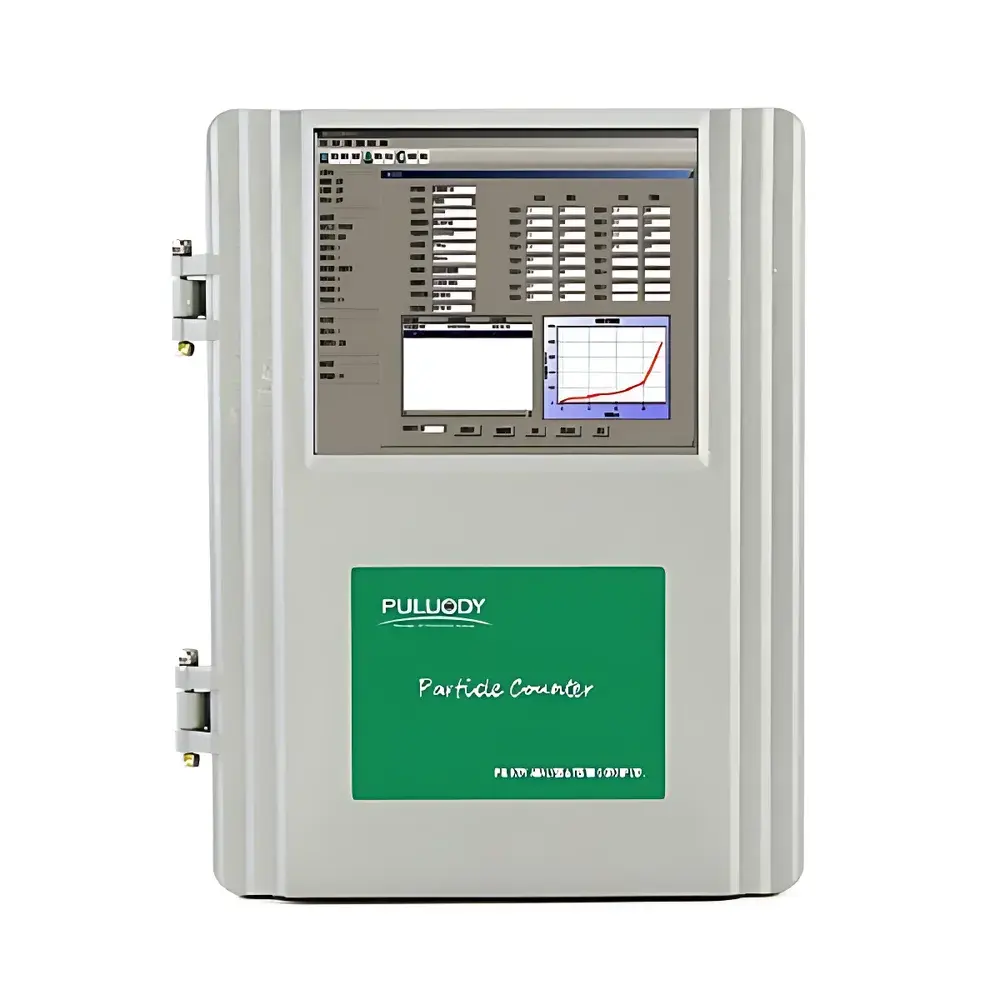
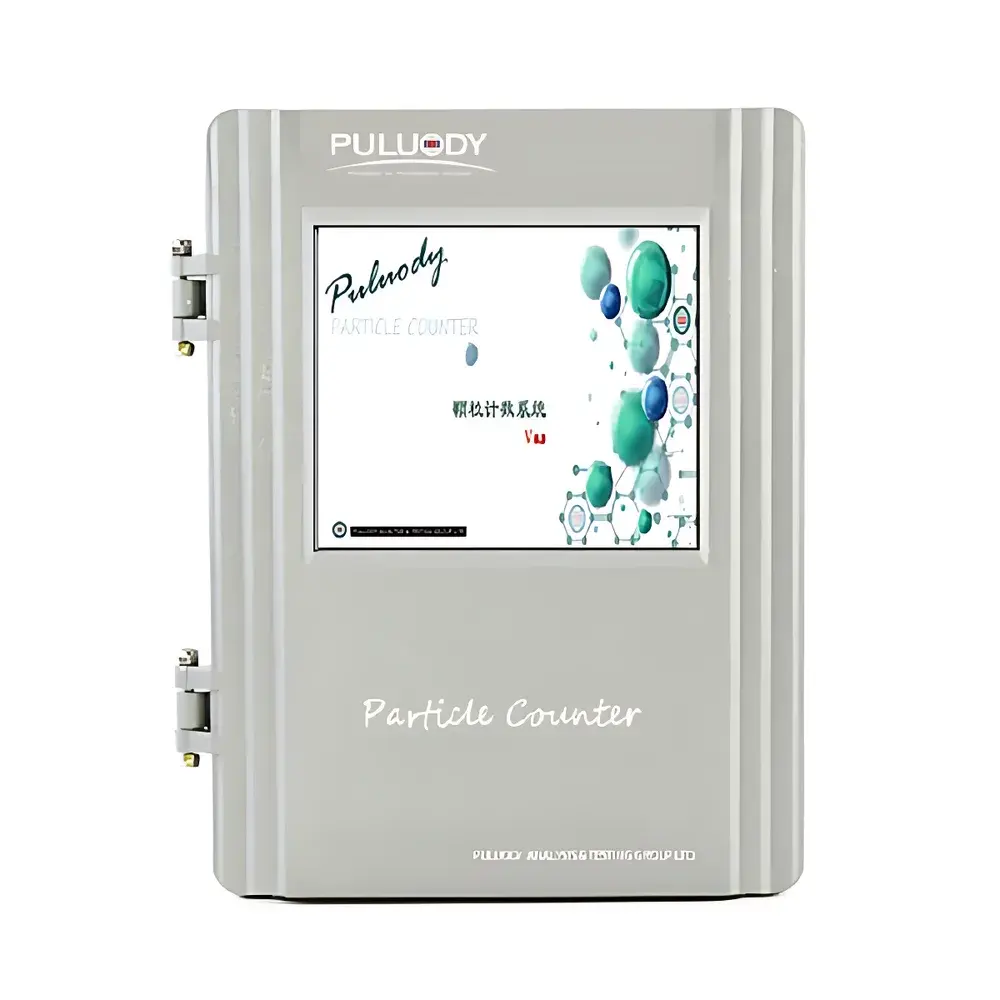
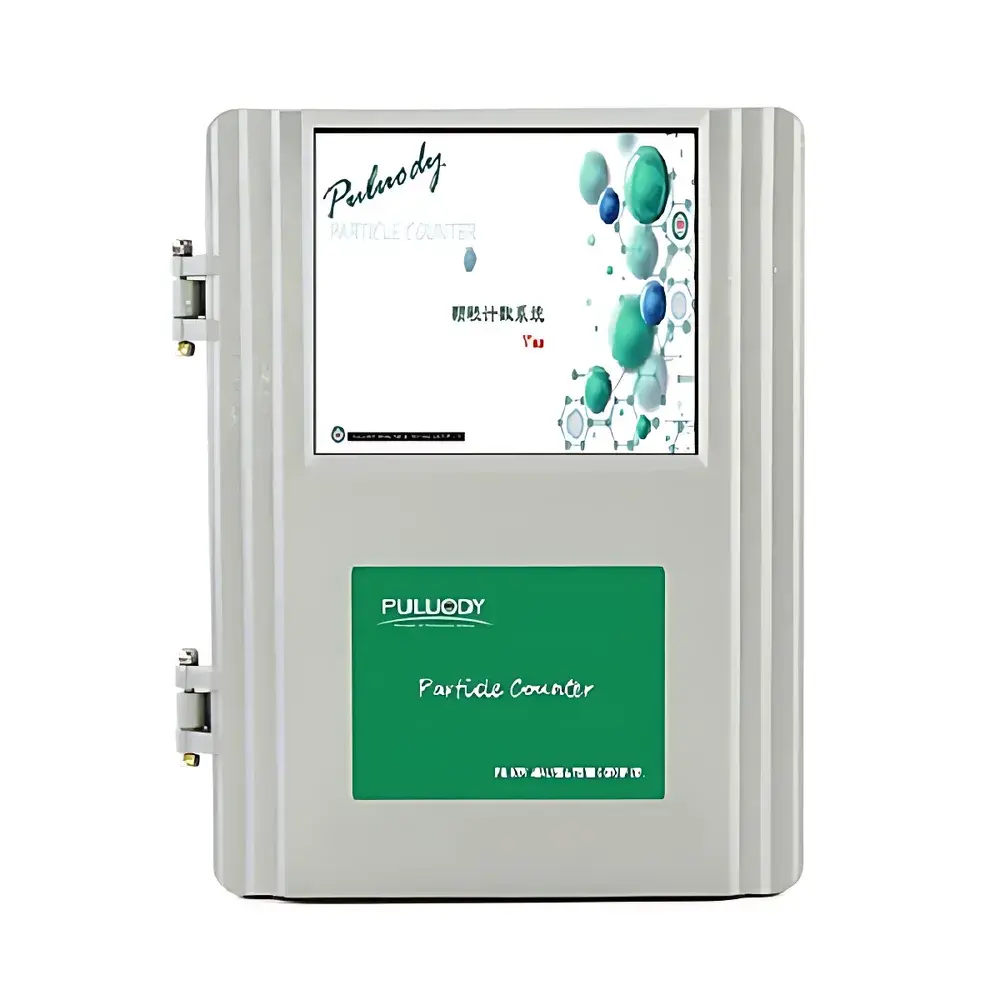
PULUODY OPC-2300B Online Waterborne Particle Counter
| Brand | PULUODY |
|---|---|
| Origin | Shaanxi, China |
| Manufacturer Type | Authorized Distributor |
| Country of Origin | China |
| Model | OPC-2300B |
| Instrument Type | Optical Particle Counter (Light Obscuration Principle) |
| Detection Principle | Seventh-Generation Dual-Laser Narrow-Beam Light Obscuration |
| Sensor Ranges | A: 2–100 µm |
| B | 1–150 µm |
| C | 1–450 µm |
| H | 0.1–1.0 µm |
| I | 0.2–2.0 µm |
| J | 0.5–50.0 µm |
| K | 2–750 µm (or up to 1000 µm / 1000 µm) |
| L | 40–1000 µm (or 10–2000 µm) |
| N | 50–1000 µm |
| M | 100–2000 µm |
| Sizing Resolution | 0.1 µm |
| Counting Accuracy | < ±3% typical |
| Coincidence Error | ≤5% |
| Maximum Detectable Concentration | 9,999,999 particles/mL |
| Sampling Interval | 5 s – 9 h |
| Calibration Standards | NIST-traceable latex spheres, AC fine test dust, MTD |
| Operating Pressure | 0–0.6 MPa (standard) |
| Flow Rate | 6–500 mL/min |
| Fluid Temperature Range | −10 °C to +80 °C |
| Output Interfaces | RS232, 4–20 mA analog, optional Ethernet/Modbus TCP |
| Housing Rating | IP65 industrial enclosure |
| Compliance | Supports ISO 21501-4, USP <788>, ASTM F312-19, ISO 4406:2017, and customizable regulatory logic for GLP/GMP environments |
Overview
The PULUODY OPC-2300B Online Waterborne Particle Counter is an industrial-grade optical particle counter engineered for continuous, real-time monitoring of suspended particulate matter in liquid process streams—specifically designed for municipal drinking water treatment plants, wastewater reclamation facilities, pharmaceutical water systems, beverage production lines, and critical filtration validation workflows. It operates on the light obscuration (LO) principle: as particles pass through a precisely collimated dual-laser beam, they generate transient shadows proportional to their cross-sectional area. The seventh-generation dual-laser narrow-beam optical architecture delivers enhanced signal-to-noise ratio, reduced thermal drift, and improved stability across extended unattended operation—enabling reliable detection down to 0.1 µm with sub-micron resolution and trace-level reproducibility. Unlike laboratory-based batch analyzers, the OPC-2300B integrates directly into pressurized water distribution loops or side-stream bypass configurations, supporting fully automated, maintenance-minimized surveillance without operator intervention.
Key Features
- Seventh-generation dual-laser narrow-beam optical sensor with independent wavelength channels for cross-validated sizing and counting
- Multi-range configurable detection modules: 11 selectable sensor configurations (H–M), each optimized for specific size domains—from submicron colloids (0.1 µm) to coarse debris (>2000 µm)
- 1000-channel high-resolution pulse-height analysis with user-definable binning (8/16/32 arbitrary size thresholds)
- Real-time concentration reporting up to 9,999,999 particles/mL with coincidence error compensation algorithm
- Industrial-grade flow cell rated for continuous operation at pressures up to 31.5 MPa (with integrated pressure regulation)
- Wide fluid temperature tolerance (−10 °C to +80 °C) and chemically resistant wetted materials (316L SS, fused silica, PEEK)
- Embedded firmware with configurable alarm logic, trend logging, and automatic zero/sensitivity verification
- RS232 serial interface plus 4–20 mA analog output; optional Modbus TCP/Ethernet for DCS/SCADA integration
- IP65-rated ruggedized enclosure suitable for outdoor or high-humidity plant-floor deployment
Sample Compatibility & Compliance
The OPC-2300B is validated for use with clarified potable water, filtered process water, ultrapure water (UPW), reverse osmosis permeate, membrane filtrate, and low-viscosity aqueous solutions (dynamic viscosity < 5 cP). It complies with core international standards governing particle measurement in water systems—including ISO 21501-4 (calibration and verification of LO instruments), USP (particulate matter in injectables), ASTM F312-19 (particle counting in aerospace fluids), and ISO 4406:2017 (fluid cleanliness coding). Firmware supports configurable pass/fail logic aligned with customer-defined acceptance criteria (e.g., “≤25 particles ≥2 µm per 100 mL” per WHO guidelines). Audit trail functionality, electronic signature support, and 21 CFR Part 11–compliant data integrity features are available via optional software licensing—meeting GLP and GMP requirements for regulated water system qualification.
Software & Data Management
The OPC-2300B ships with embedded firmware and optional PC-based PULUODY ParticleView™ software (v5.x), which provides full remote configuration, live histogram visualization, time-series trending, statistical process control (SPC) charting, and automated report generation (PDF/CSV/Excel). All raw pulse data and metadata—including timestamp, flow rate, pressure, temperature, and calibration status—are stored locally on a removable microSD card with write-protection and cyclic overwrite options. Data export supports standard protocols (OPC UA, Modbus TCP) for seamless ingestion into LIMS, MES, or cloud-based analytics platforms. Firmware updates are delivered via signed binary packages with SHA-256 hash verification to ensure integrity and traceability.
Applications
- Real-time integrity testing of microfiltration, ultrafiltration, and nanofiltration membranes
- Quantitative assessment of filter efficiency decay during service life (e.g., pre-filtration, activated carbon, cartridge filters)
- Early detection of microbial shedding or biofilm detachment events in distribution networks
- Validation of final polishing steps in pharmaceutical water-for-injection (WFI) and purified water (PW) systems
- Monitoring of backwash efficacy and sediment breakthrough in rapid sand or granular activated carbon (GAC) filters
- Supporting root cause analysis during turbidity excursions or regulatory nonconformances
- Continuous compliance tracking against local and international drinking water quality directives (e.g., EU Directive 98/83/EC, EPA 141.1)
FAQ
What particle detection principle does the OPC-2300B employ?
It uses light obscuration (also known as light blockage or optical blocking), compliant with ISO 21501-4 and USP .
Can the instrument be calibrated to NIST-traceable standards?
Yes—factory calibration utilizes NIST-traceable polystyrene latex (PSL) spheres; field recalibration supports AC fine test dust and MTD reference materials.
Is the OPC-2300B suitable for high-pressure applications such as RO feed monitoring?
Yes—when equipped with the integrated pressure regulator, it operates continuously at up to 31.5 MPa.
Does the system support regulatory audit trails for pharmaceutical water systems?
With optional ParticleView™ GxP Edition, it provides 21 CFR Part 11–compliant electronic records, user access controls, and immutable audit logs.
How is sample flow controlled and verified?
Integrated precision metering pump maintains programmable flow rates (6–500 mL/min) with real-time flow telemetry and automatic flow compensation algorithms.



