
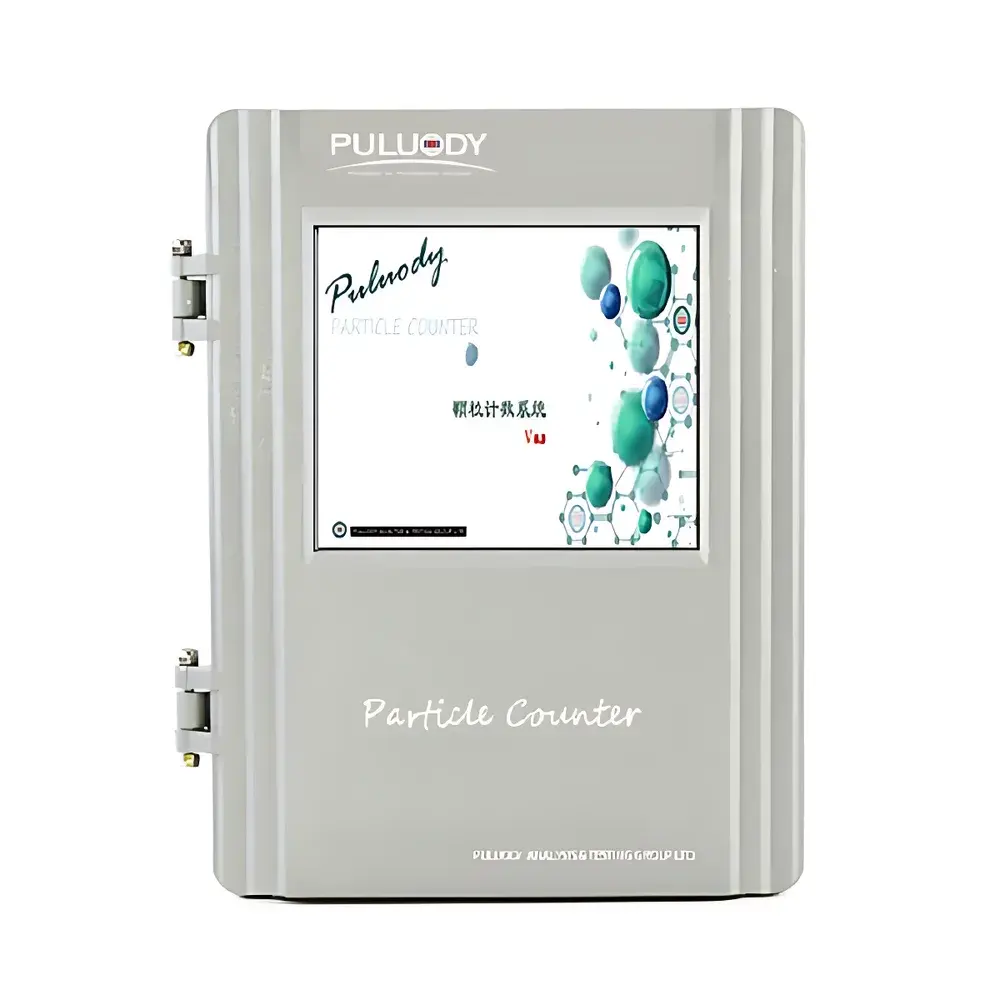
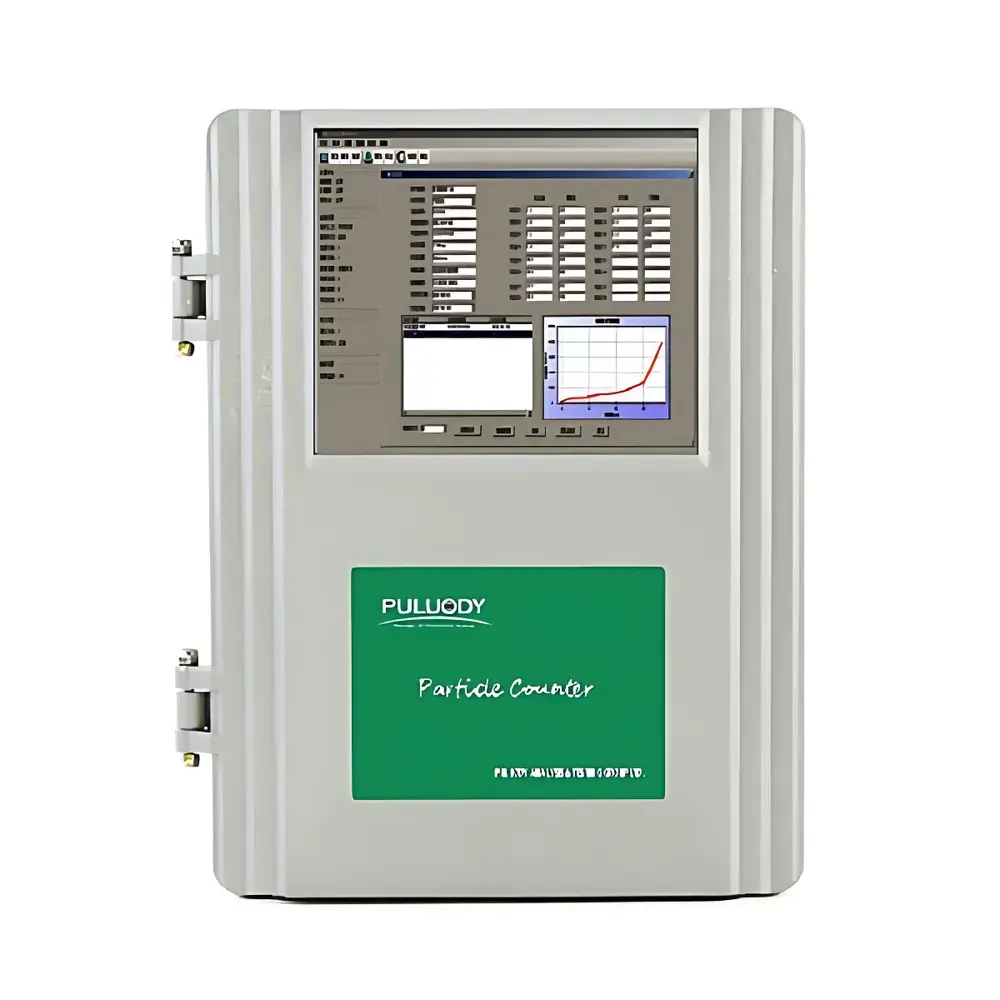
PULUODY OPC-0203A Online Waterborne Particle Counter
| Brand | PULUODY |
|---|---|
| Origin | Shaanxi, China |
| Manufacturer Type | Authorized Distributor |
| Product Category | Domestic |
| Model | OPC-0203A |
| Instrument Type | Optical Particle Counter (Light Obscuration Principle) |
| Detection Principle | Eighth-Generation Dual-Laser Narrow-Beam Light Obscuration |
| Sensor Range | 2–750 µm (configurable up to 1000 µm) |
| Size Channels | Up to 1000 user-defined bins (e.g., 8/16/32 standard channels) |
| Resolution | 0.1 µm |
| Counting Accuracy | < ±3% typical |
| Coincidence Error | ≤5% at 999,999 particles/mL |
| Maximum Concentration | 9,999,999 particles/mL |
| Sampling Flow Rate | 6–500 mL/min |
| Operating Pressure | 0–0.6 MPa (standard), 0–31.5 MPa (with pressure-reducing valve) |
| Fluid Temperature Range | −10 °C to +80 °C |
| Output Interfaces | 4–20 mA analog, RS232/RS485 digital |
| Data Storage | Unlimited local logging |
| Calibration Standards | NIST-traceable latex spheres, AC fine test dust, MTD |
| Compliance Options | Customizable to ISO 4406, NAS 1638, SAE AS4059, ASTM D7647, USP <788> & <789>, and client-specific water quality protocols |
Overview
The PULUODY OPC-0203A Online Waterborne Particle Counter is an industrial-grade optical particle counter engineered for continuous, real-time monitoring of suspended particulate matter in liquid process streams—specifically designed for municipal and industrial water treatment infrastructure. It operates on the light obscuration (LO) principle: as particles pass through a precisely collimated dual-laser sensing zone, they interrupt the beam, generating pulse signals proportional to their cross-sectional area. Leveraging eighth-generation dual-laser narrow-beam technology licensed from PULUODY Analytical Testing Group UK, the OPC-0203A delivers enhanced signal-to-noise ratio, reduced misclassification at size boundaries, and superior stability under variable flow and temperature conditions. Unlike offline laboratory counters, this instrument integrates directly into pressurized water distribution loops, filtration skids, or membrane bioreactor effluent lines—enabling uninterrupted surveillance without manual sampling or operator intervention.
Key Features
- Dual-laser narrow-beam optical sensor architecture with independent wavelength validation for improved sizing fidelity and long-term drift resistance.
- Configurable detection range: standard 2–750 µm; extended options include 5–1000 µm, with user-selectable channel binning across up to 1000 size classes (e.g., 8, 16, or 32 standardized intervals).
- High dynamic concentration capability: validated linear response up to 9,999,999 particles/mL, with coincidence error maintained ≤5% per ISO 21501-4.
- Robust process interface: stainless steel wetted parts (316L optional), pressure-rated housing (0–31.5 MPa with integrated pressure-reducing valve), and wide fluid temperature tolerance (−10 °C to +80 °C).
- Flexible connectivity: isolated 4–20 mA analog output for PLC/DCS integration, plus RS232/RS485 serial communication supporting Modbus RTU protocol.
- On-device intelligence: built-in LCD display with membrane keypad, real-time particle count/ml and ISO 4406 or NAS 1638 coding, programmable alarm thresholds (particle count, sensor fault, flow deviation).
- Modular mechanical design: available in compact inline or remote-sensor + controller configurations to accommodate space-constrained piping layouts or hazardous-area installations.
Sample Compatibility & Compliance
The OPC-0203A is validated for use with potable water, filtered process water, ultrapure water (UPW), wastewater effluent, beverage-grade liquids, and cleaning-in-place (CIP) rinse solutions. Its optical path geometry and flow cell design minimize bubble interference and sedimentation bias during continuous operation. Regulatory alignment includes configurable reporting modes compliant with ISO 4406:2017 (hydraulic fluids), ASTM D7647-10 (waterborne particle counting), USP and (injectable and ophthalmic water quality), and EU Pharmacopoeia 2.6.27. Optional firmware modules support GLP/GMP audit trails, electronic signature capability (per FDA 21 CFR Part 11), and automated calibration verification logs traceable to NIST-certified reference materials.
Software & Data Management
The embedded firmware supports autonomous data acquisition with programmable sampling intervals (5 seconds to 9 hours). All measurements—including raw pulse histograms, cumulative/differential counts, and ISO contamination codes—are stored indefinitely on internal non-volatile memory. External data retrieval is enabled via USB mass storage mode or serial command protocol. Optional PC-based software (PULUODY ParticleView™ v3.x) provides trend analysis, multi-parameter overlay (e.g., particle count vs. pressure drop across filter housings), automated report generation (PDF/CSV), and integration with SCADA historian systems via OPC UA or MQTT. Audit-ready features include timestamped event logs, user access levels, and change history for configuration parameters.
Applications
- Real-time integrity testing of microfiltration, ultrafiltration, and reverse osmosis membranes in drinking water plants.
- Early detection of filter breakthrough or media degradation in rapid sand or activated carbon filters.
- Quantitative assessment of post-disinfection turbidity surges linked to biofilm sloughing or pipe corrosion events.
- Validation of final product water quality in pharmaceutical manufacturing (WFI/PW systems) and beverage bottling lines.
- Condition-based maintenance of high-pressure pump seals and valve seats via trending of wear debris accumulation in recirculation loops.
- Regulatory compliance monitoring for EPA Clean Water Act discharge permits and ISO 22000 food safety management systems.
FAQ
What particle sizing standards does the OPC-0203A support?
It natively reports results aligned with ISO 4406, NAS 1638, and SAE AS4059. Custom calibration matrices can be loaded to match client-specific size definitions (e.g., “≥4 µm” or “≥25 µm”) per ASTM D7647 Annex A1.
Can the instrument operate unattended for extended periods?
Yes—designed for 24/7 deployment with no consumables, self-diagnostic routines, and automatic zero-check cycles triggered during low-flow intervals.
Is it suitable for hot water applications such as boiler feed monitoring?
Within its specified fluid temperature range (−10 °C to +80 °C), yes. For sustained exposure above 60 °C, optional high-temp optical window seals and cooling jacket adapters are available.
How is calibration verified in situ?
Through scheduled automated checks using onboard reference pulses or external injection of certified latex sphere suspensions (e.g., 10 µm ±3% NIST SRM 1960); full calibration certificates are exportable.
Does it meet cybersecurity requirements for OT network integration?
The RS485/Modbus interface operates at Layer 2 only; no IP stack is present. For IT/OT convergence, it connects via secure industrial gateways with TLS 1.2 encryption and role-based access control.
Related Products



