
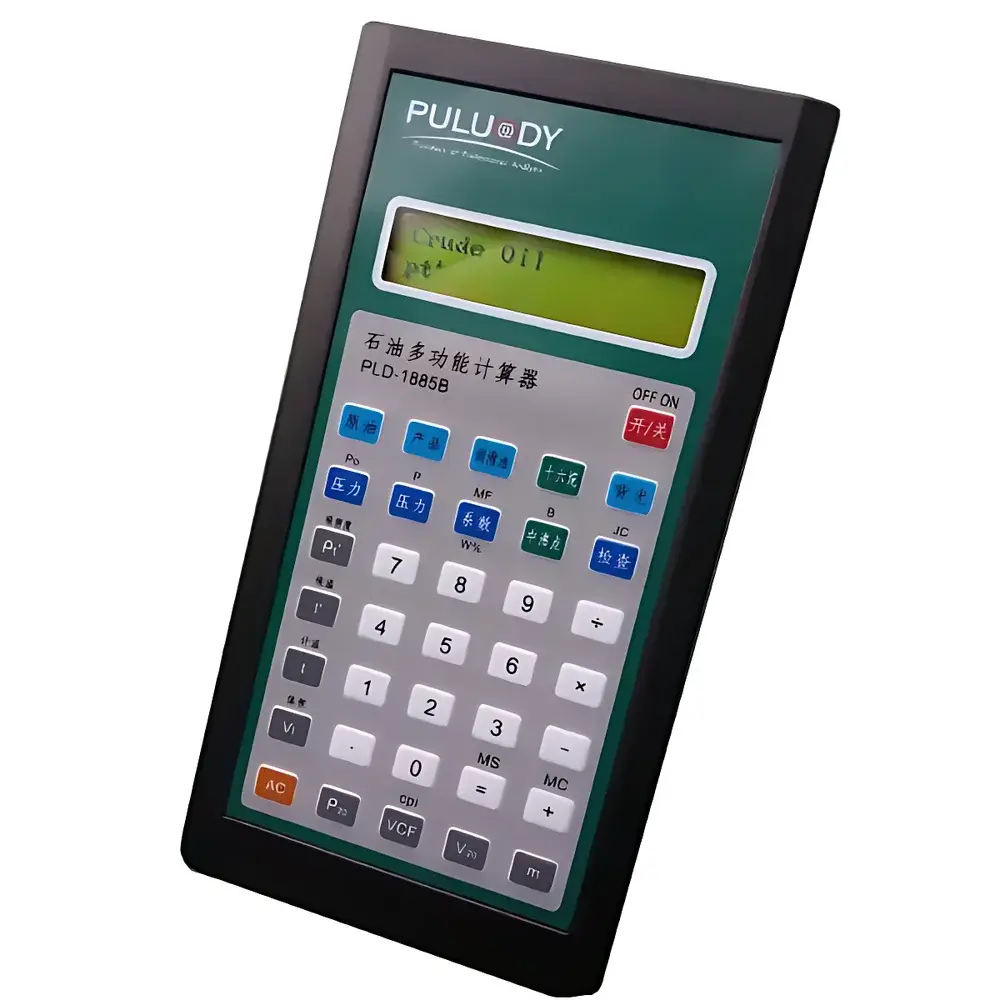
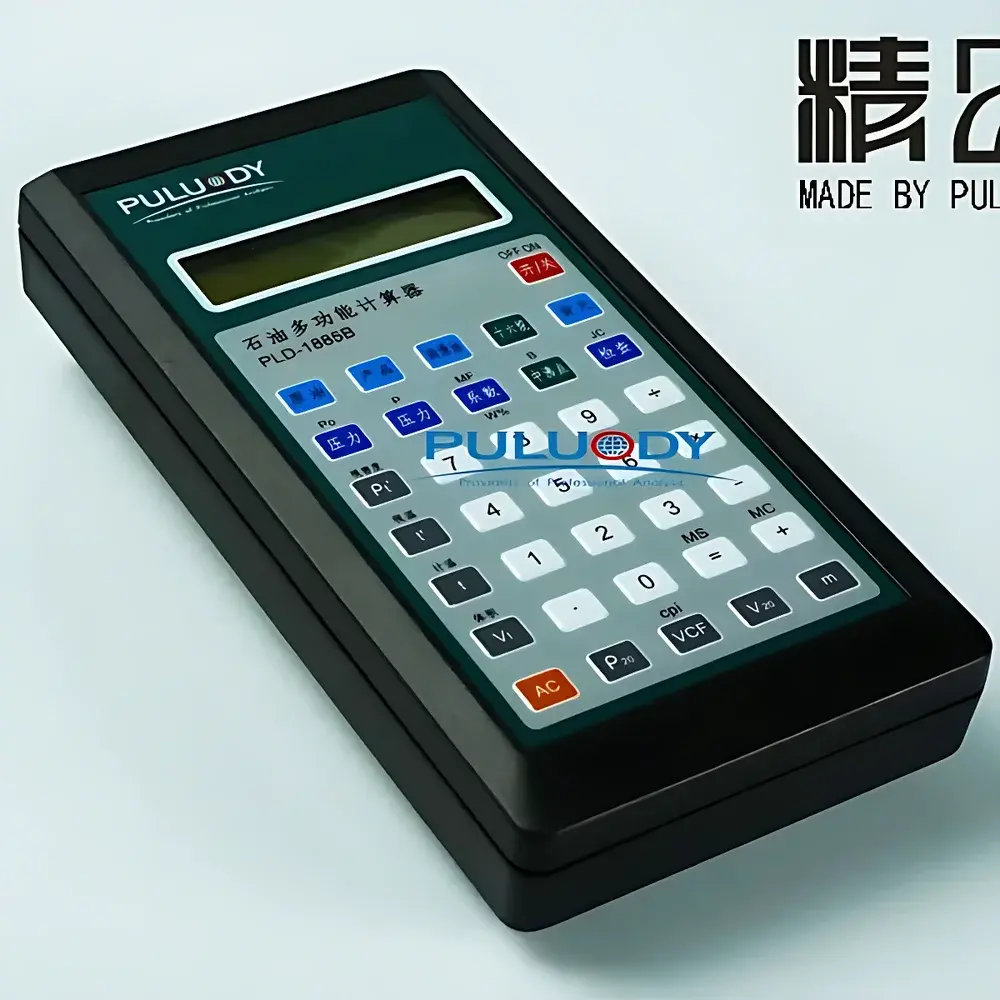
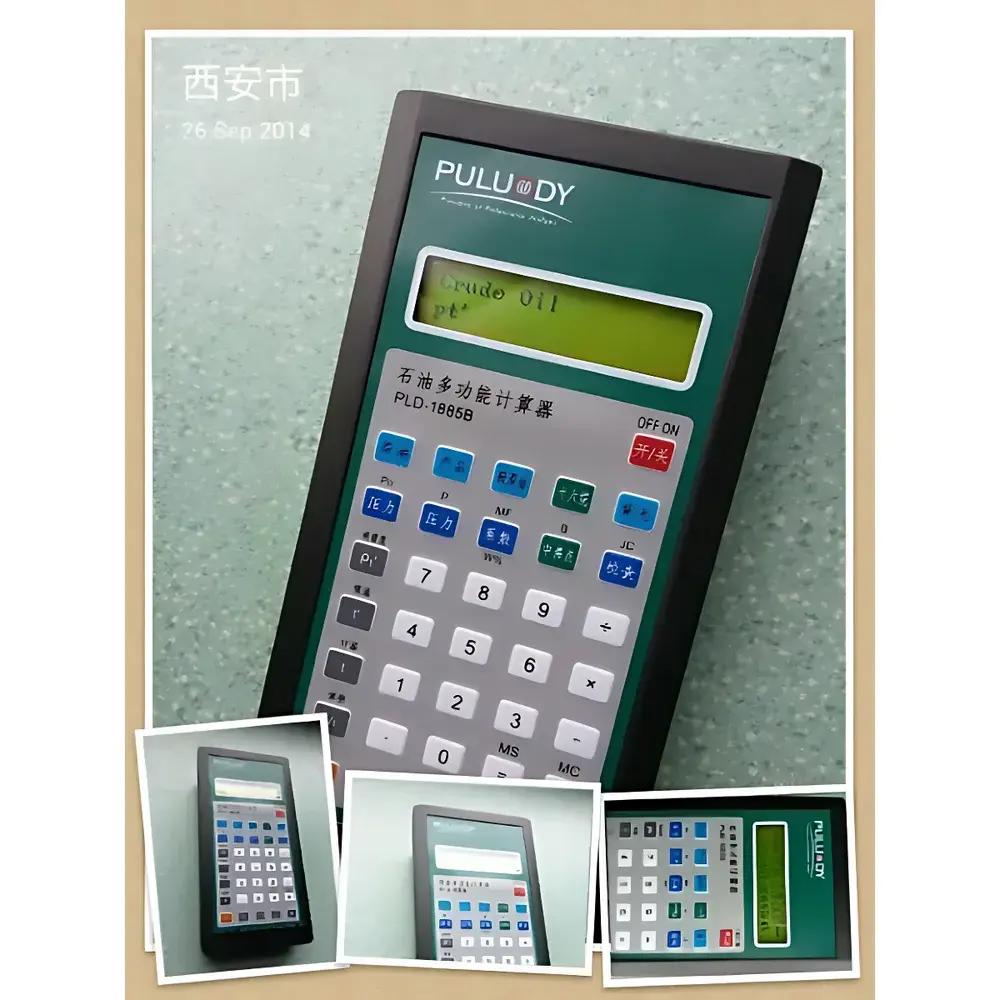
PULUODY PLD-1885A Petroleum Product Density Calculator
| Brand | PULUODY |
|---|---|
| Origin | Shaanxi, China |
| Manufacturer Type | Manufacturer |
| Origin Category | Domestic |
| Model | PLD-1885A |
| Instrument Type | True Density Calculator |
| Form Factor | Portable |
| Sample Type | Liquid |
| Density Measurement Range | 0.0005 g/mL |
| Density Accuracy | ±0.0005 g/mL |
| Compliance Standard | GB/T 1885–1998 “Petroleum Measurement Tables” |
| Application Scope | Crude oil, gasoline, diesel, lubricating oils, water content (mₛ) and net oil mass (m꜀) calculation |
| Temperature Range | –55 °C to +50 °C |
| Power Supply | Rechargeable battery or 220 V AC adapter |
Overview
The PULUODY PLD-1885A Petroleum Product Density Calculator is a dedicated handheld computational instrument engineered for precision density-based quantity determination in petroleum custody transfer, refinery accounting, and field-level quality verification. Unlike conventional densitometers that physically measure density via oscillating U-tube or hydrostatic principles, the PLD-1885A implements a standards-driven algorithmic engine rooted in GB/T 1885–1998 — the Chinese national implementation of ASTM D1250 and ISO 91–1, governing petroleum volume correction and standardization. It computes standard density at 20 °C (ρ₂₀), volume correction factor (VCF), temperature-corrected volume (Vₜ), standard volume at 20 °C (V₂₀), and mass (m) using input parameters including observed density (ρₜ), test temperature (t), metering temperature (T), and optionally, pressure and water cut data. Its architecture supports three distinct calibration regimes defined in GB/T 1885–1998: Group I (crude oils), Group II (refined products), and Group III (lubricating oils), each with unique thermal expansion coefficients and compressibility models. Designed for operational continuity in remote terminals, tank farms, and marine loading/unloading operations, it delivers deterministic, repeatable results without reliance on external connectivity or cloud infrastructure.
Key Features
- Standards-compliant computation per GB/T 1885–1998, fully aligned with ASTM D1250–22 and ISO 91–1:2022 methodologies for volume and mass conversion
- Dedicated input interface with tactile touch keys mapped directly to petroleum measurement table symbols (e.g., “ρₜ”, “t”, “VCF”, “mₛ”, “m꜀”) for intuitive operator workflow
- Extended operational temperature range from –55 °C to +50 °C, enabling use in arctic offshore environments and high-temperature refinery settings
- Modular calculation architecture: users may interrupt active computations and initiate new sequences without system reset or data loss
- Built-in verification mode: pressing the “Check” key sequentially displays all entered parameters on the LCD for traceable input validation
- Low-power design supporting dual power sources — long-life rechargeable battery pack and universal 220 V AC adapter — ensuring uninterrupted operation during extended field shifts
- Integrated four-function arithmetic engine (addition, subtraction, multiplication, division) for auxiliary calculations during manual reconciliation or audit preparation
Sample Compatibility & Compliance
The PLD-1885A is validated for use with liquid hydrocarbon phases meeting API gravity ranges from 10°API to 70°API, including crude oils, naphthas, gasoline, kerosene, diesel fuels (EN 590, ASTM D975), and mineral-based lubricating oils (ISO VG 32–680). It accommodates water-cut inputs for crude oil batches, calculating aqueous phase mass (mₛ) and net hydrocarbon mass (m꜀) per API RP 2573 and ISO 3994 procedures. All computational outputs conform to ISO/IEC 17025 documentation requirements when used within a GLP-compliant laboratory or custody transfer environment. The device itself carries no CE marking or ATEX certification, as it performs no physical sensing or hazardous-area operation; however, its output values are admissible in regulatory reporting under China’s GB 17681–2022 (Petroleum Product Measurement Management Regulations) and internationally recognized fiscal metering protocols.
Software & Data Management
The PLD-1885A operates on embedded firmware with fixed computational kernels — no user-installable software, no OS dependencies, and no firmware update capability beyond factory calibration revision. Input parameters and computed results are not stored persistently; the device maintains no internal memory log, eliminating data retention concerns under GDPR or CCPA. Each calculation cycle is stateless and auditable: operators can reproduce any prior result by re-entering identical parameters. For integration into digital workflows, users may manually transcribe V₂₀, m, VCF, and ρ₂₀ values into LIMS or ERP systems such as SAP QM or Honeywell Experion PKS. While the calculator does not support USB export or Bluetooth transmission, its deterministic output ensures full compatibility with 21 CFR Part 11–compliant electronic record systems when paired with validated transcription protocols.
Applications
- Custody transfer reconciliation at pipeline terminals, marine loading arms, and railcar unloading stations
- Refinery in-process accounting for crude charge blending, distillate yield tracking, and lube base stock inventory control
- Field verification of density-derived mass flowmeter calibration factors (e.g., Coriolis meters per API RP 561)
- Pre-shipment verification of bunker fuel compliance with ISO 8217 specifications
- Supporting ISO 4267–2022 (Petroleum and liquid petroleum products — Calculation of oil quantities) in international trade documentation
- Training tool for petroleum measurement technicians preparing for API MPMS Chapter 11 or ISO 91 certification exams
FAQ
Does the PLD-1885A physically measure density?
No. It is a dedicated computational device that requires externally measured observed density (ρₜ) and temperature inputs — it does not incorporate a sensor or transducer.
Can it compute density at temperatures other than 20 °C?
Yes. It calculates ρₜ at any user-specified temperature within –55 °C to +50 °C using group-specific thermal expansion models defined in GB/T 1885–1998.
Is it compatible with ASTM D1250–22 tables?
Yes. Its algorithms replicate the interpolation logic and coefficient sets published in ASTM D1250–22 Annex A1–A3 for Groups I, II, and III products.
Does it store historical calculation records?
No. It retains no persistent memory; all inputs and outputs exist only during active session and are cleared upon power-off.
What is the uncertainty contribution of the calculator itself to final mass determination?
The device introduces no additional uncertainty beyond the precision of user-entered inputs; its arithmetic resolution supports 0.0001 g/mL density entries, consistent with the ±0.0005 g/mL accuracy specification of compatible digital hydrometers and digital densimeters.



