
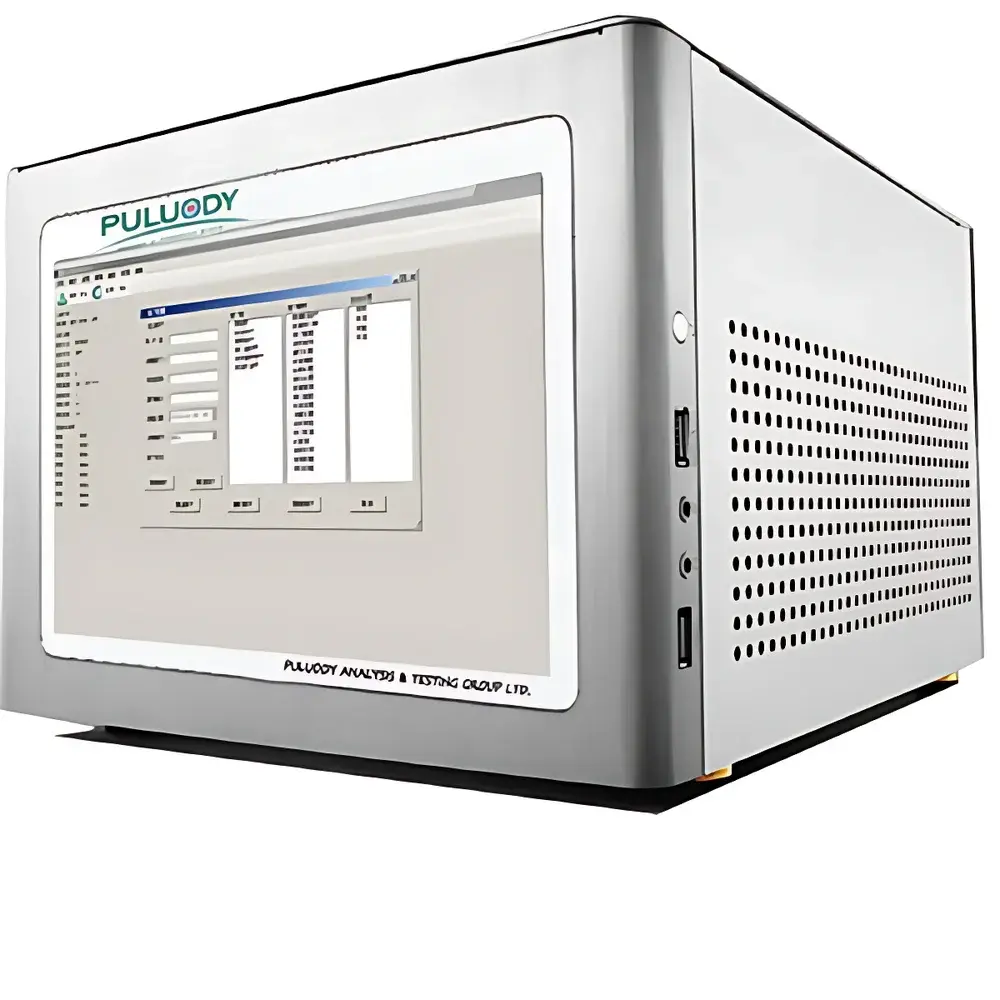
PULUODY PMT-2-13 Deionized Water Particle Counter
| Brand | PULUODY |
|---|---|
| Origin | Shaanxi, China |
| Manufacturer Type | Authorized Distributor |
| Regional Classification | Domestic (China) |
| Model | PMT-2-13 |
| Instrument Type | Optical Liquid Particle Counter |
| Detection Principle | Dual-Laser Narrow-Beam Light Scattering |
| Calibration Standards | JJG 1061, ISO 21501-2, Polystyrene Latex (PSL) Reference Spheres |
| Detection Range | 0.1–0.5 µm & 0.2–2.0 µm (standard) |
| Sampling Method | Precision Metering Piston Pump |
| Flow Control | Dual-stage electromagnetic + mechanical precision regulation |
| Sample Volume Accuracy | < ±1% |
| Counting Accuracy | ±5% typical (NIST-traceable validation) |
| Coincidence Limit | ≤5% error at 10,000 particles/mL |
| Output Interface | 4–20 mA analog output |
| Alarm Function | Configurable particle concentration threshold alert |
| Reporting | Particles per mL + ISO 4406 / NAS 1638 / SAE AS4059 contamination codes |
| Power Input | 100–265 VAC, 50–60 Hz |
| Software | PULUODY V8.3 Integrated Analysis & Calibration Suite (PC + embedded touchscreen UI) |
| Compliance | Designed for GLP/GMP environments |
Overview
The PULUODY PMT-2-13 Deionized Water Particle Counter is a high-sensitivity optical liquid particle counter engineered for ultra-pure fluid monitoring in semiconductor manufacturing, pharmaceutical water systems, microelectronics cleaning validation, and advanced materials R&D. It employs dual-laser narrow-beam light scattering technology — the eighth-generation sensor architecture developed by PULUODY Analytical Testing Group (UK) — to detect and size non-volatile particulate contaminants suspended in deionized water, ultrapure water (UPW), cleaning solvents, and low-conductivity organic liquids. Unlike conventional single-wavelength counters, the PMT-2-13 utilizes two spatially separated laser sources with optimized beam collimation and photodetector geometry to minimize Mie scattering distortion and improve resolution across sub-micron ranges (0.1 µm(c) minimum detectable). Its measurement principle adheres to ISO 21501-2:2019 for light extinction and scattering-based particle sizing in liquids, ensuring metrological traceability to national standards (JJG 1061-2010 in China; NIST SRM 1963/2806 for calibration verification).
Key Features
- Dual-laser narrow-beam optical detection system with real-time signal discrimination to reduce false counts from refractive index mismatches and bubble interference
- Precision metering piston pump combined with closed-loop electromagnetic flow control, delivering volumetric accuracy better than ±1% over extended sampling cycles
- Configurable detection thresholds: standard channels cover 0.1–0.5 µm and 0.2–2.0 µm; optional user-defined bins from 1–100 µm or 4–70 µm(c), including critical 0.1 µm(c) sensitivity mode for UPW process validation
- Embedded 7-inch color TFT touchscreen interface with intuitive icon-driven workflow, complemented by full PC-based V8.3 software for advanced histogram analysis, trend mapping, and compliance reporting
- 4–20 mA analog output with programmable alarm thresholds for integration into SCADA, DCS, or MES platforms — enabling automated shutdown or notification upon exceedance of ISO 4406 Class limits
- Robust stainless-steel wetted path (316L SS fluidic manifold) compatible with aggressive solvents (e.g., IPA, SC1/SC2), DI water, and polymer solutions up to 50 cP viscosity
Sample Compatibility & Compliance
The PMT-2-13 is validated for use with low-conductivity aqueous media (conductivity < 1 µS/cm), organic solvents (acetone, ethanol, isopropanol), and polymer solutions requiring insoluble particle assessment per USP , EP 2.9.19, and JP 6.07. Its fluidic design eliminates electrochemical interference and minimizes adsorption artifacts common in siliconized or glass capillary systems. The instrument meets mechanical and electrical safety requirements per IEC 61010-1 and is designed to support Good Laboratory Practice (GLP) and Good Manufacturing Practice (GMP) workflows. When operated with V8.3 software’s optional audit trail module, it satisfies FDA 21 CFR Part 11 requirements for electronic records and signatures, including user access control, change logging, and secure data export.
Software & Data Management
PULUODY V8.3 is a dual-mode software platform comprising an embedded firmware interface (for standalone operation) and a Windows-based desktop application (for deep analytics and regulatory reporting). The software enforces strict separation between calibration routines and routine testing sequences — preventing accidental parameter override during production runs. Data output includes raw pulse-height histograms, cumulative/differential size distributions, time-series concentration plots, and auto-generated ISO 4406, NAS 1638, and SAE AS4059 contamination codes. All reports are exportable in PDF, CSV, and XML formats with embedded metadata (operator ID, timestamp, calibration certificate ID, environmental conditions). Audit logs record every user action, including method changes, calibration events, and report generation — supporting internal quality audits and regulatory inspections.
Applications
The PMT-2-13 serves as a critical control point in multiple high-purity industrial processes: real-time monitoring of UPW loops in 300mm wafer fabs; offline cleanliness verification of photomasks and etch tools; qualification of point-of-use filters in pharmaceutical water-for-injection (WFI) distribution networks; particulate load assessment in nano-filtration membrane validation studies; and residue analysis following precision cleaning of MEMS components or display glass substrates. Its dual-mode sampling capability — fixed-installation online monitoring and portable offline verification — enables end-to-end contamination control from incoming chemical lots through final product release testing.
FAQ
What calibration standards are supported?
The PMT-2-13 accepts polystyrene latex (PSL) reference spheres per ISO 21501-2, certified NIST-traceable standards (e.g., NIST SRM 1963), and complies with Chinese national metrology verification regulation JJG 1061-2010.
Can it measure particles in organic solvents?
Yes — the fluidic path is chemically resistant to IPA, acetone, ethanol, and other common semiconductor cleaning agents; viscosity limit is 50 cP at 25°C.
Is 21 CFR Part 11 compliance available?
Full electronic record and signature functionality is enabled via optional V8.3 audit trail license, including role-based access, electronic signatures, and immutable log archiving.
What is the maximum particle concentration it can accurately resolve?
Coincidence error remains ≤5% up to 10,000 particles/mL at the 0.2–2.0 µm channel; higher concentrations require dilution per ISO 21501-2 Annex B guidance.
Does it support custom reporting formats for internal QA systems?
Yes — XML schema definitions are provided for seamless integration with LIMS and enterprise quality management systems (QMS).



