
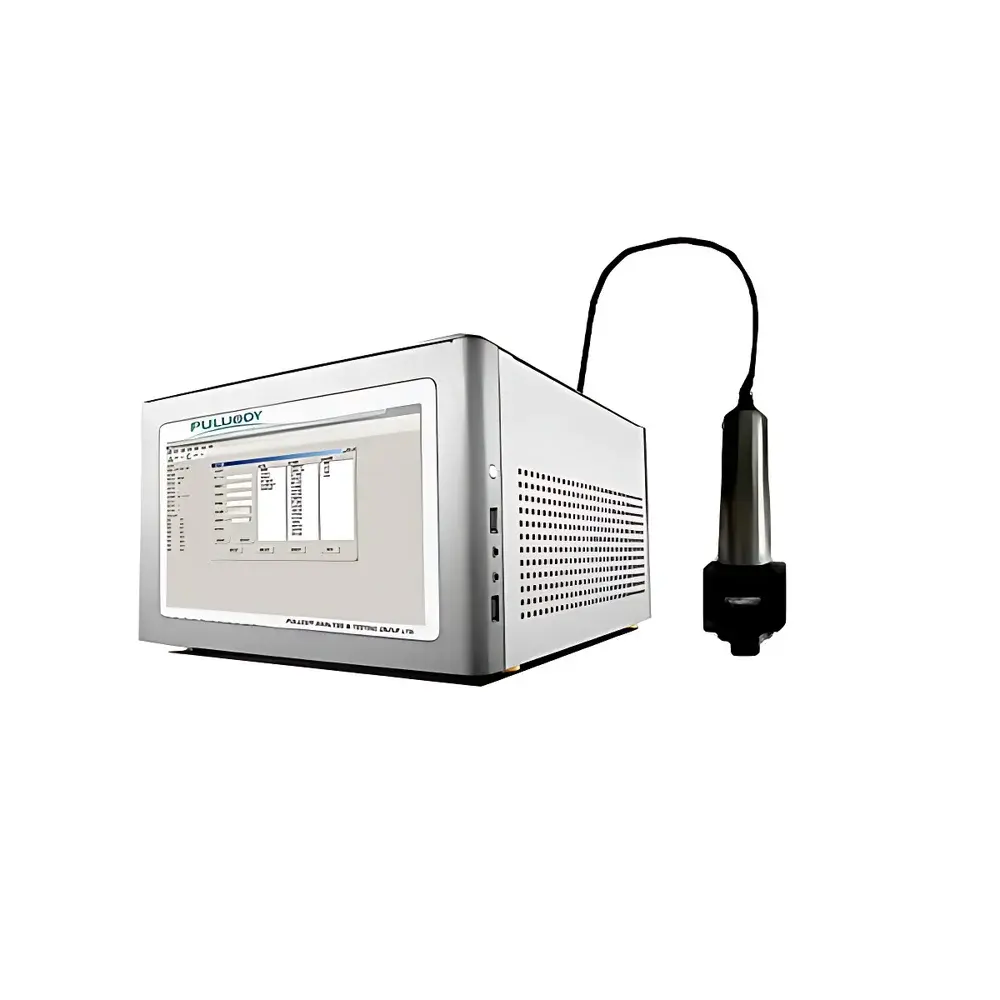
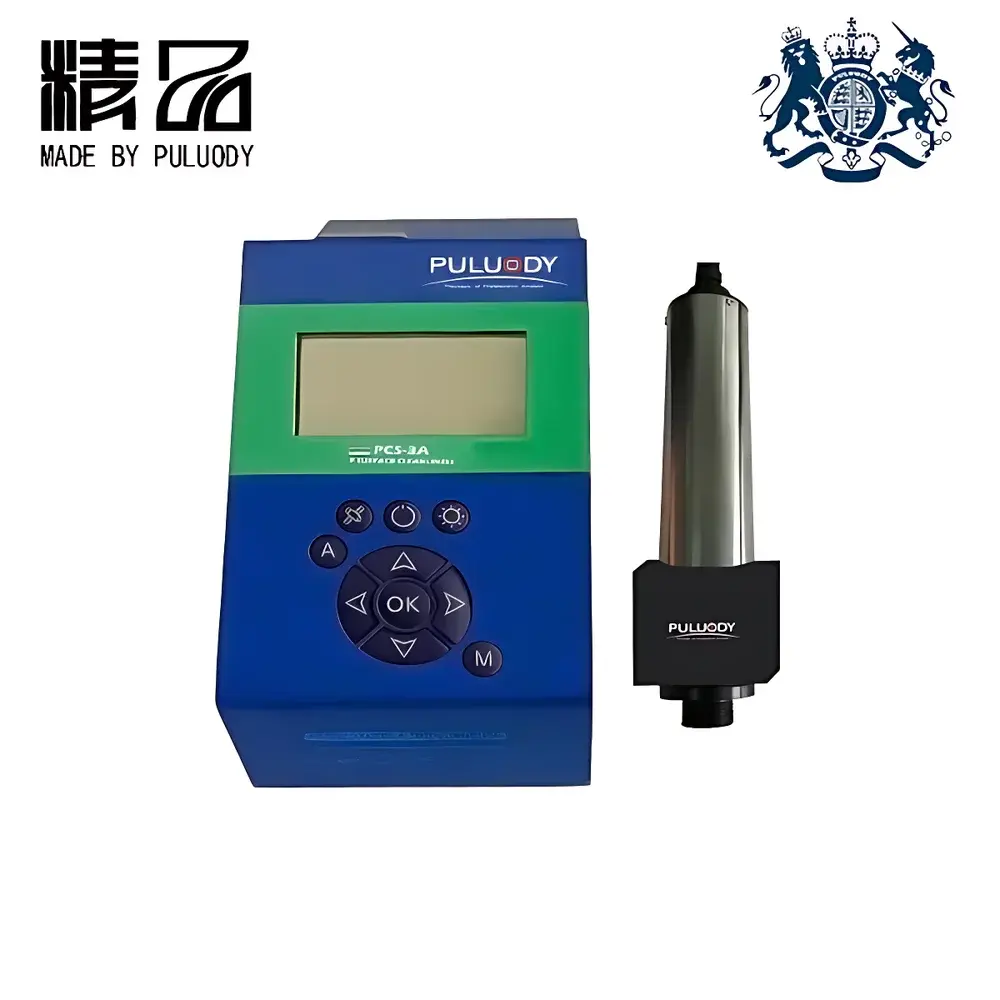
PULUODY PSC-3B Surface Contamination Analyzer
| Brand | PULUODY |
|---|---|
| Origin | Shaanxi, China |
| Manufacturer Type | Direct Manufacturer |
| Model | PSC-3B |
| Price | USD 39,800 (FOB) |
| Measurement Principle | Fluorescence Energy Spectroscopy (FES) |
| Detection Target | Hydrocarbon-based contaminants (mineral oils, synthetic lubricants, cutting fluids, greases, waxes |
| Quantification Units | % relative cleanliness, FU (Fluorescence Units), mg/mm² oil film thickness |
| Detection Limit | 1 µg/mL equivalent surface concentration |
| Resolution | 0.01% / 0.01 FU / 0.1 mg/mm² |
| Accuracy | ±0.5% of reading |
| Measurement Time | 0.1–30 s per point |
| Spot Size Options | Ø1.5 mm or Ø5 mm |
| Working Distance | 3.5–4.5 mm (standard) / 20 mm (extended) |
| Excitation Source | Dynamic X-ray fluorescence (XRF) module |
| Excitation Power | 150 µW |
| Sampling Rate | ≥50 Hz |
| Calibration Traceability | NIST-traceable or GBW-certified reference standards |
| Calibration Modes | Auto-calibration, manual zero/baseline, multi-point curve calibration |
| Data Interface | RS-485 / RS-232 |
| Control Platform | PC-based or industrial computer |
| Power Supply | Rechargeable Li-ion battery or AC adapter (100–240 VAC) |
Overview
The PULUODY PSC-3B Surface Contamination Analyzer is a benchtop and field-deployable instrument engineered for rapid, non-destructive quantification of hydrocarbon-based residues on solid surfaces. It employs proprietary Fluorescence Energy Spectroscopy (FES), a derivative technique of energy-dispersive X-ray fluorescence (ED-XRF) optimized for organic contaminant detection. Unlike conventional solvent extraction or gravimetric methods, the PSC-3B excites surface-bound hydrocarbons using a low-power dynamic X-ray source, inducing characteristic fluorescent emission in the soft X-ray to near-UV range. The emitted spectrum is captured by a high-sensitivity silicon drift detector (SDD), digitized via multi-channel pulse height analysis (MPHA), and processed using chemometric algorithms trained on certified hydrocarbon reference standards. This enables direct, trace-level quantification—without solvents, sample preparation, or surface alteration—of mineral oils, synthetic lubricants, cutting fluids, greases, and waxes (C₅–Cₙ aliphatic, aromatic, and heterocyclic compounds). Designed for integration into production line QC, aerospace component release, and precision manufacturing workflows, the PSC-3B delivers ISO/IEC 17025-aligned measurement confidence under GLP-compliant data handling protocols.
Key Features
- Non-contact, non-destructive measurement: No solvent use, no wiping, no surface modification—ensures integrity of critical components and eliminates operator exposure risk.
- Multi-parameter output: Simultaneous reporting in three standardized units—relative cleanliness (%), fluorescence units (FU), and estimated oil film thickness (mg/mm²)—enabling cross-method correlation and regulatory alignment.
- Trace-level sensitivity: Detection limit equivalent to 1 µg/mL surface concentration; validated against NIST SRM 2781 (hydrocarbon-coated stainless steel) and GBW(E) 060105 (petroleum standard).
- High-speed acquisition: Full spectral capture and quantification completed in 0.1–30 seconds per measurement point; up to 50 independent readings per second for statistical mapping.
- Ruggedized field architecture: IP54-rated enclosure, shock-absorbing chassis, and temperature-compensated optics enable stable operation across -10°C to +50°C ambient conditions.
- Traceable metrology framework: Integrated calibration management supports single-point zeroing, two-point linearization, and multi-point polynomial curve fitting—all anchored to NIST-traceable or CNAS-accredited GBW reference materials.
Sample Compatibility & Compliance
The PSC-3B is validated for use on metallic (aluminum, titanium, stainless steel), ceramic, and polymer substrates commonly found in aerospace, power generation, and semiconductor manufacturing. It complies with ASTM D7687–22 (Standard Practice for Determining Surface Contamination on Metallic Surfaces Using Fluorescence Techniques) and aligns with ISO 8502-9 (Preparation of steel substrates before application of paints and related products — Tests for the assessment of surface cleanliness — Part 9: Field test method for soluble salts). Instrument firmware supports audit-ready data logging per FDA 21 CFR Part 11 requirements—including electronic signatures, immutable timestamps, and full revision history for calibration records and measurement sessions. All factory calibrations are documented with uncertainty budgets compliant with GUM (Guide to the Expression of Uncertainty in Measurement) and accredited by CNAS (China National Accreditation Service for Conformity Assessment).
Software & Data Management
The analyzer operates via PULUODY SurfaceIQ™ v4.2 software—a Windows-based application supporting both standalone operation and networked deployment. The interface provides real-time spectral visualization, auto-threshold peak identification, and batch reporting with customizable templates (PDF, CSV, XML). Raw spectral data (channel-energy histograms) and processed results are stored in encrypted SQLite databases with SHA-256 hash verification. Software modules include Statistical Process Control (SPC) charting (X-bar/R, Cpk), trend analysis across shifts or batches, and automated pass/fail flagging against user-defined limits. Data export supports LIMS integration via HL7 and ASTM E1384-compliant interfaces. Audit trails record all user actions—including parameter changes, calibration events, and report generation—with role-based access control (administrator, technician, reviewer).
Applications
- Aerospace: Final inspection of turbine blades, landing gear components, and fasteners prior to coating or assembly—ensuring compliance with SAE AMS2648 and Boeing D6-17487.
- Automotive: In-line verification of engine block, transmission housing, and brake caliper cleanliness after aqueous cleaning—supporting IATF 16949 process validation.
- Semiconductor equipment: Monitoring residual hydrocarbons on wafer chucks and chamber liners to prevent particle generation and film contamination.
- Hydraulic system manufacturing: Quantitative validation of filter housing, servo valve bodies, and pump casings to meet NAS 1638 Class 5–7 cleanliness thresholds.
- Medical device machining: Verification of implant-grade titanium and cobalt-chrome parts post-cleaning, satisfying ISO 13485 clause 7.5.10 (Contamination control).
FAQ
Does the PSC-3B require consumables or reagents?
No. The instrument uses no solvents, wipes, or chemical reagents. Routine maintenance is limited to optical window cleaning and annual detector energy calibration.
Can it distinguish between different types of oils (e.g., mineral vs. synthetic)?
While the base PSC-3B reports total hydrocarbon mass equivalence, optional spectral deconvolution firmware (PSC-3B-SPEC add-on) enables semi-quantitative differentiation of aliphatic, aromatic, and ester-based signatures using PCA-driven library matching.
Is external certification available for measurement validity?
Yes. PULUODY provides optional third-party verification reports from CNAS-accredited laboratories, including measurement uncertainty statements and inter-laboratory comparison data per ISO/IEC 17043.
How is traceability maintained across global facilities?
All instruments ship with a NIST-traceable calibration certificate. Field recalibration uses portable GBW-certified reference tiles (PULUODY RC-01 series), each accompanied by a unique COA with expanded uncertainty at k=2.
What environmental conditions affect measurement stability?
Ambient humidity >85% RH may cause condensation on the optical window; operation below -10°C requires thermal stabilization time (≤15 min). The instrument includes real-time temperature and pressure compensation in its spectral processing engine.



