
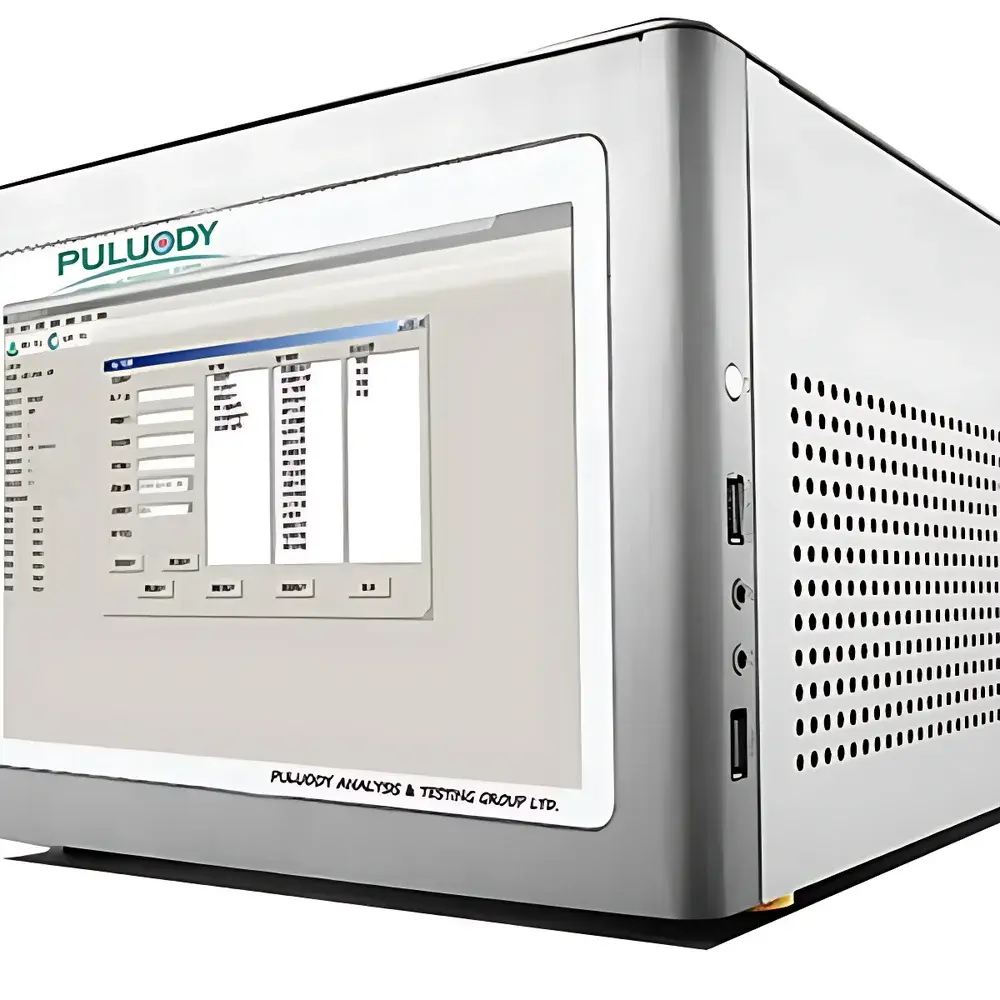
PULUODY PMT-2SY Laboratory Water Particle Counter
| Brand | PULUODY |
|---|---|
| Origin | Shaanxi, China |
| Model | PMT-2SY |
| Instrument Type | Optical Liquid Particle Counter |
| Detection Principle | Dual-Laser Narrow-Beam Light Scattering |
| Measuring Range | 0.05–0.2 µm, 0.1–0.5 µm (standard) |
| Sampling Method | Precision Metering Piston Pump |
| Sampling Accuracy | < ±1% |
| Measurement Accuracy | < ±3% (typical) |
| Coincidence Limit | 1000 particles/mL (2.5% coincidence error) |
| Output | 4–20 mA analog interface with configurable particle concentration alarm |
| Reporting | Particles per mL and ISO 4406 / NAS 1638 contamination code |
| Calibration Standards | JJG 1061, NIST-traceable latex spheres, ISO 21501-4 compliant |
| Software | V8.3 Integrated Analysis & Calibration Software (PC + touchscreen UI) |
| Interface | Color LCD touchscreen + optional wireless keyboard/mouse |
| Power Input | 100–265 VAC, 50–60 Hz |
| Compliance | Designed for GLP/GMP environments |
Overview
The PULUODY PMT-2SY Laboratory Water Particle Counter is an optical liquid particle counter engineered for high-sensitivity, trace-level particulate contamination monitoring in ultrapure water (UPW), semiconductor process chemicals, electronic cleaning agents, and other low-conductivity, low-particulate matrices. It operates on the principle of dual-laser narrow-beam light scattering—where two spatially separated laser sources illuminate a precisely defined flow path within a sapphire flow cell—enabling simultaneous detection of sub-100 nm particles with enhanced signal-to-noise ratio and minimized optical interference from refractive index fluctuations. Unlike single-laser systems, this eighth-generation sensor architecture decouples background noise from true particle events through differential signal processing, significantly improving counting fidelity at the critical 0.05–0.2 µm range—where particle-induced defects in advanced node wafer fabrication become statistically significant. The instrument supports both offline benchtop analysis and online integration via modular flow interfaces, making it suitable for QC laboratories, cleanroom monitoring stations, and real-time process control loops in semiconductor front-end manufacturing.
Key Features
- Dual-laser narrow-beam optical sensing platform with independent wavelength alignment and beam collimation—optimized for low-scatter media such as UPW and deionized solvents.
- High-precision metering piston pump with electromagnetic flow regulation ensures repeatable sample delivery (< ±1% volumetric accuracy) and eliminates pulsation-induced counting artifacts.
- Configurable detection thresholds: Standard channels cover 0.05–0.2 µm and 0.1–0.5 µm; extended ranges include user-defined bins from 1–100 µm or 4–70 µm(c), plus selectable 0.1 µm(c) resolution for critical microcontamination profiling.
- V8.3 integrated software suite with physically segregated calibration and analysis modules—preventing cross-contamination of reference standards data during routine testing.
- Real-time analog output (4–20 mA) with programmable alarm thresholds for integration into SCADA or DCS systems; supports automated shutdown or flushing protocols upon exceedance.
- Compliance-ready architecture: Audit trail logging, user access levels, electronic signatures, and data integrity controls aligned with FDA 21 CFR Part 11 when operated under validated IT infrastructure.
Sample Compatibility & Compliance
The PMT-2SY is validated for use with ultrapure water (resistivity ≥18.2 MΩ·cm), aqueous cleaning solutions (e.g., SC1, SC2), photoresist developers, CMP slurries (diluted), and polymer-based process liquids with viscosity ≤20 cP and conductivity <5 µS/cm. It meets ISO 21501-4 requirements for light extinction and light scattering particle counters and is compatible with calibration using NIST-traceable polystyrene latex (PSL) spheres per JJG 1061 national metrological verification regulations. For regulated environments, the system can be configured to comply with ISO 8573-4 (compressed air purity), ASTM D6978 (pharmaceutical water), and USP and (injectable and ophthalmic preparations), subject to site-specific validation protocols.
Software & Data Management
The V8.3 software provides dual-mode operation: a standalone PC application for deep statistical analysis (including trend charts, histogram overlays, and batch comparison) and an embedded touchscreen interface for rapid method selection and report generation. All raw pulse data—including time-stamped scatter amplitude, duration, and coincidence flags—is retained in encrypted binary format with SHA-256 hashing. Export options include CSV, PDF, and XML formats compliant with LIMS integration standards (ASTM E1482, ISO/IEC 17025). Calibration records are digitally signed and timestamped, supporting full traceability from sensor baseline to final report.
Applications
- Monitoring particle generation in UPW distribution loops prior to point-of-use filtration.
- Qualifying cleaning efficacy during photomask and wafer rinse steps in 28 nm and below semiconductor processes.
- Verifying filter integrity in pharmaceutical water-for-injection (WFI) systems per EU GMP Annex 1.
- Tracking insoluble microparticle shedding from tubing, valves, and pumps in bioprocessing skids.
- Supporting ISO 14644-1 cleanroom classification through periodic liquid sampling from critical surfaces and tools.
- Quantifying agglomerate formation kinetics in nanoparticle suspensions used in drug delivery formulation development.
FAQ
What particle size ranges does the PMT-2SY support out-of-the-box?
Standard configurations cover 0.05–0.2 µm and 0.1–0.5 µm; custom firmware enables user-defined binning from 1–100 µm or 4–70 µm(c), including 0.1 µm(c) threshold detection.
Can the instrument be integrated into an existing factory automation system?
Yes—the 4–20 mA analog output and Modbus TCP option (available on request) allow direct connection to PLCs, DCS, or MES platforms for real-time particulate trend monitoring.
Is the system compliant with FDA 21 CFR Part 11 for electronic records?
When deployed with validated V8.3 software configuration, password-controlled user roles, audit trail activation, and digital signature enforcement, it meets Part 11 requirements for closed systems.
How is calibration verified and maintained?
Calibration uses ISO 21501-4–compliant PSL standards; verification intervals follow internal SOPs or customer-defined quality plans, with full documentation exportable for regulatory review.
Does the system require periodic recalibration of the optical sensor?
No—optical alignment is factory-set and mechanically stabilized; only annual performance verification using certified reference materials is recommended per ISO/IEC 17025 guidelines.



