
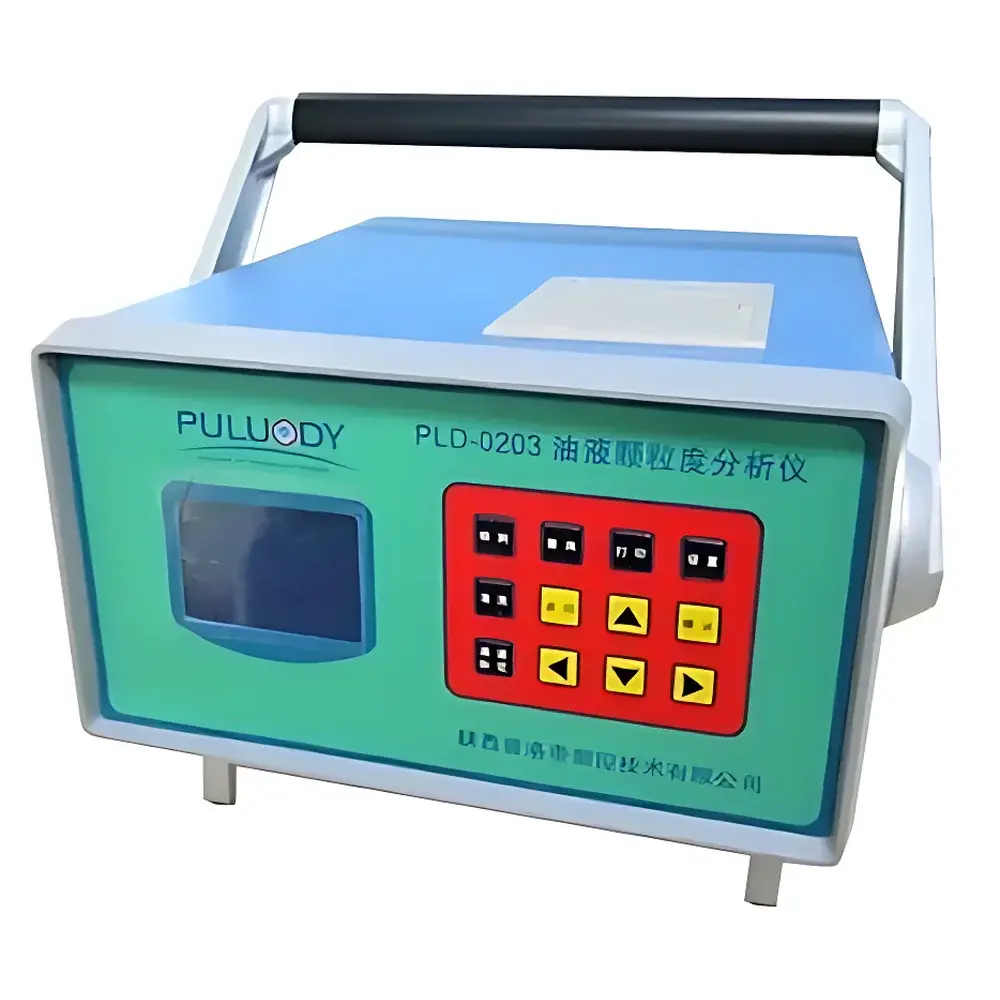
PULUODY PLD-0203-2 Portable Oil Contamination Analyzer (Optical Particle Counter)
| Brand | PULUODY |
|---|---|
| Origin | Shaanxi, China |
| Model | PLD-0203-2 |
| Instrument Type | Optical Particle Counter |
| Detection Principle | Light Obscuration (LO) |
| Laser Sensor Generation | 7th-generation dual-laser narrow-beam detector |
| Calibration Standards | ISO 11171, ISO 4402, ASTM F658-87 (PSL), GB/T 18854, MTD/ISO 11171, JJG 1061 |
| Compliance Standards | ISO 4406:1987/1999, NAS 1638, SAE AS4059F, GJB 420B, DL/T 432, GJB 380, ISO 11500 |
| Measurement Range | 0.03 µm to 3000 µm (configurable sensor modules) |
| Channel Count | Up to 1000 user-selectable size channels |
| Sensitivity | 1 µm (per ISO 4402) or 4 µm(c) (per ISO 11171 & GB/T 18854) |
| Coincidence Limit | ≤5% at 10,000 particles/mL |
| Resolution | ≥90% at 60 mL/min |
| Volumetric Accuracy | ±1% |
| Sample Volume | 1–200 mL (programmable) |
| Flow Rate | 5–60 mL/min (test), 5–150 mL/min (cleaning) |
| Max. Online Pressure | 0.6 MPa (standard), 31.5 MPa (with pressure regulator) |
| Viscosity Range | Offline ≤99 mm²/s |
| Operating Temperature | Sample inlet 20–65°C |
| Power Supply | 220 V AC, 50 Hz, <80 W |
| Data Output | RS232, RS485, USB, 4–20 mA, 0–5 V, MODBUS |
| Storage Capacity | Up to 6000 test records (200 tests × 30 results each) |
| Self-cleaning Function | Yes |
| Software | P6.4 Analysis & Testing Software (Integrated & PC Edition) |
| Control Interface | Industrial-grade color touchscreen LCD |
| Regulatory Certification | Calibrated per national military metrology standards (CNSA Defense Science & Technology Commission Level-1 Particle Metrology Station) |
Overview
The PULUODY PLD-0203-2 Portable Oil Contamination Analyzer is an ISO-compliant optical particle counter engineered for field-deployable, high-fidelity assessment of particulate contamination in liquid media—primarily aviation fuels, hydraulic fluids (including corrosive phosphate ester types), turbine oils, and lubricants used in critical defense, aerospace, and power generation systems. It operates on the light obscuration (LO) principle: as particles suspended in a flowing liquid stream pass through a focused laser beam, they attenuate the incident light proportionally to their cross-sectional area. This signal is converted into pulse amplitude data, enabling precise sizing and counting across up to 1000 discrete size channels. Unlike static sedimentation or filtration-based methods, LO provides real-time, statistically robust quantification of insoluble particulates without sample dilution or pre-filtration—making it suitable for both offline laboratory analysis and online monitoring with optional pressure-rated flow cells.
Key Features
- Seventh-generation dual-laser narrow-beam detection architecture ensures stable signal-to-noise ratio and minimizes false counts from bubble interference or refractive index mismatch.
- Modular sensor configuration supports 13 interchangeable optical detection units (A–N), covering particle sizes from 0.03 µm to 3000 µm—enabling application-specific optimization for ultrafine wear debris (100 µm), or full-spectrum profiling.
- Programmable volumetric sampling (1–200 mL) with ±1% volumetric accuracy, validated per JJG 1061 and traceable to national metrology institutes.
- Onboard industrial touchscreen interface with embedded P6.4 software for immediate visualization of particle size distribution histograms, cumulative counts, and ISO/NAS/GJB contamination codes.
- Integrated self-cleaning cycle using programmable reverse-flow rinsing (5–150 mL/min), eliminating manual disassembly and reducing cross-sample carryover risk.
- Compliance-ready data management: timestamped test logs, audit trails, and exportable CSV/Excel reports compatible with LIMS integration.
Sample Compatibility & Compliance
The PLD-0203-2 is validated for use with low- to medium-viscosity transparent or semi-transparent liquids—including Jet A-1, MIL-PRF-23699, MIL-PRF-83282, Skydrol® LD-4, and deionized water—without solvent conditioning or centrifugation. Its pressure-tolerant flow path (up to 31.5 MPa with integrated regulator) permits direct integration into hydraulic test benches or fuel recirculation loops. The instrument meets metrological traceability requirements under Chinese national standards (GB/T 18854, JJG 1061) and aligns with international regulatory frameworks: ISO 4406:1999 for reporting code format; NAS 1638 for aerospace fluid grading; SAE AS4059F for modern hydraulic system specifications; and GJB 420B for People’s Liberation Army equipment maintenance protocols. Calibration verification follows ISO 11171 (MTD reference materials) and ASTM F658-87 (monodisperse PSL spheres), supporting GLP/GMP-aligned validation documentation.
Software & Data Management
The P6.4 Analysis & Testing Software suite—available in embedded firmware and standalone Windows editions—provides comprehensive post-acquisition processing. Users may define custom size bins (e.g., 1–5 µm, 5–15 µm), apply multiple contamination standards simultaneously, generate trend charts across sequential samples, and export raw pulse data for third-party statistical analysis. All measurement sessions include mandatory metadata capture: operator ID, sample ID, ambient temperature, viscosity input, and calibration certificate number. Audit trail functionality complies with FDA 21 CFR Part 11 requirements when deployed in regulated environments—supporting electronic signatures, immutable log files, and role-based access control via optional network authentication.
Applications
- Aerospace maintenance: Wear debris monitoring in engine oil sumps, hydraulic reservoirs, and fuel filter bypass streams per SAE ARP598 and MIL-HDBK-344.
- Military readiness: Rapid contamination screening of ground support equipment fluids prior to deployment; compliance verification against GJB 420B Class 5–12 thresholds.
- Power generation: Turbine oil cleanliness verification per ISO 4406 and DL/T 432 for steam and gas turbine applications.
- R&D laboratories: Quantitative evaluation of filter efficiency, additive degradation kinetics, and tribological wear mechanisms under controlled benchtop conditions.
- Pharmaceutical manufacturing: Ultra-pure water (UPW) and cleaning-in-place (CIP) solution particulate verification per USP and ISO 8573-4.
FAQ
What particle size ranges does the PLD-0203-2 support out-of-the-box?
Standard configurations include sensors covering 0.03–0.10 µm (4-channel), 1–150 µm (1000-channel), and 2–750 µm (800-channel). Custom sensor combinations are available upon order.
Can the instrument be used for online monitoring in high-pressure hydraulic systems?
Yes—when equipped with the optional pressure regulator module, it operates continuously at line pressures up to 31.5 MPa, meeting ISO 11500 requirements for in-service fluid analysis.
How is calibration traceability maintained?
Each unit ships with a calibration certificate issued by either the CNSA Defense Science & Technology Commission Level-1 Particle Metrology Station (for military contracts) or the Northwest National Metrology & Testing Center (civil applications), referencing ISO 11171 MTD and NIST-traceable PSL standards.
Does the system support automated reporting for quality management systems?
Yes—P6.4 software generates ISO/NAS/GJB-coded reports with embedded pass/fail flags, printable thermal output, and structured CSV exports compatible with SAP QM, TrackWise, and other QMS platforms.
Is method validation support available for regulated industries?
PULUODY provides IQ/OQ documentation templates, installation qualification checklists, and protocol development assistance aligned with ASTM E2911 and ISO/IEC 17025 requirements.



