
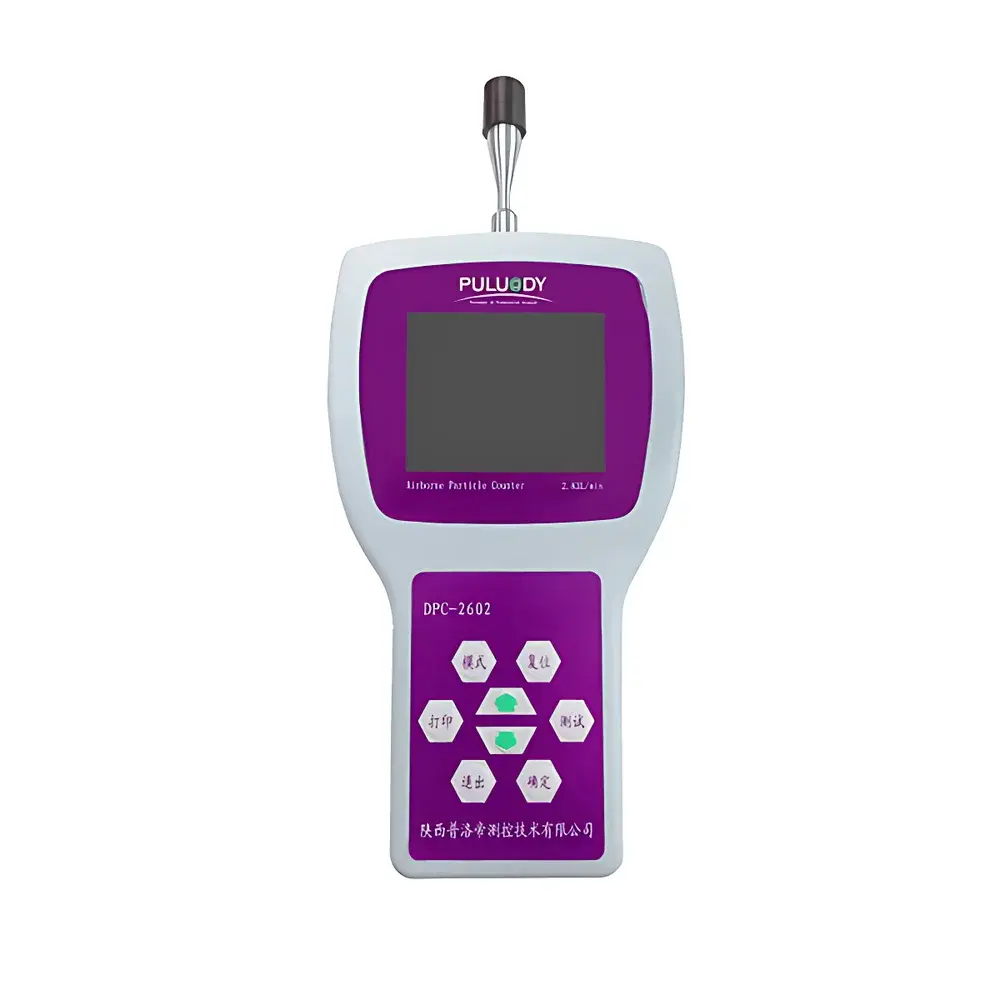
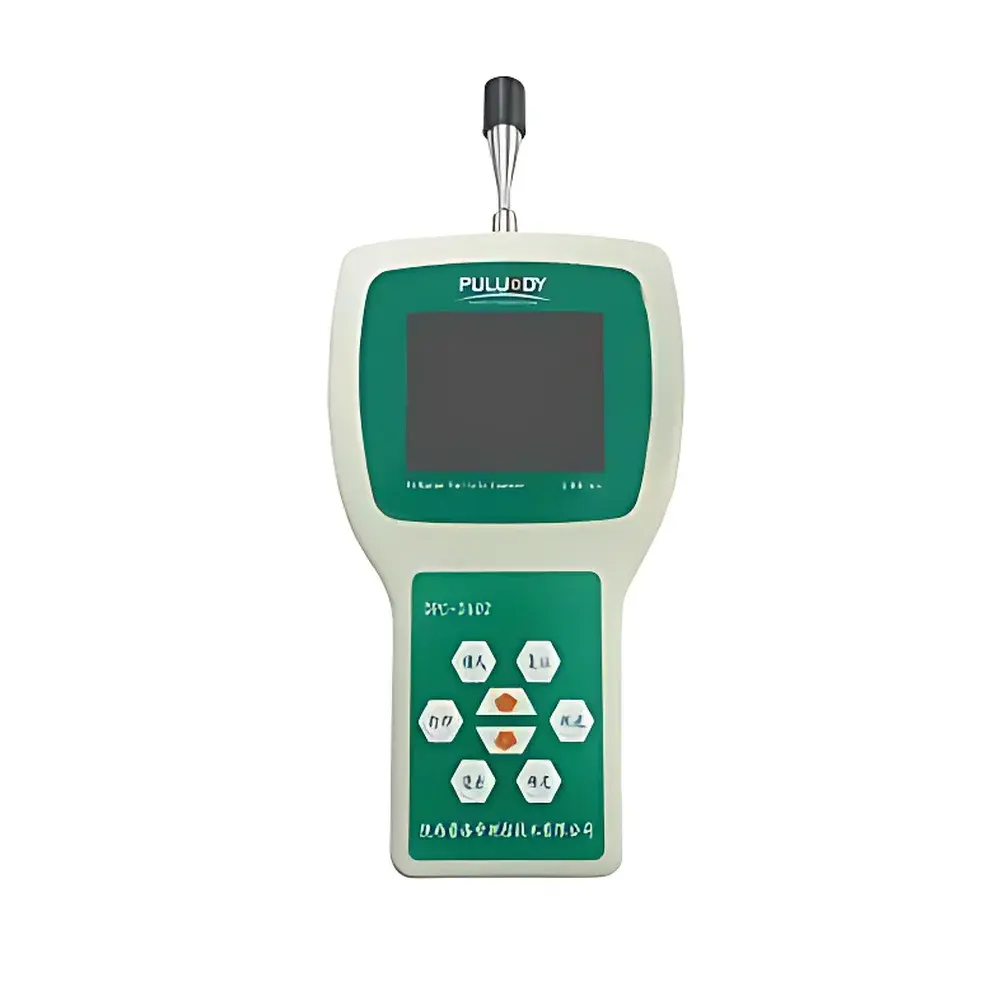
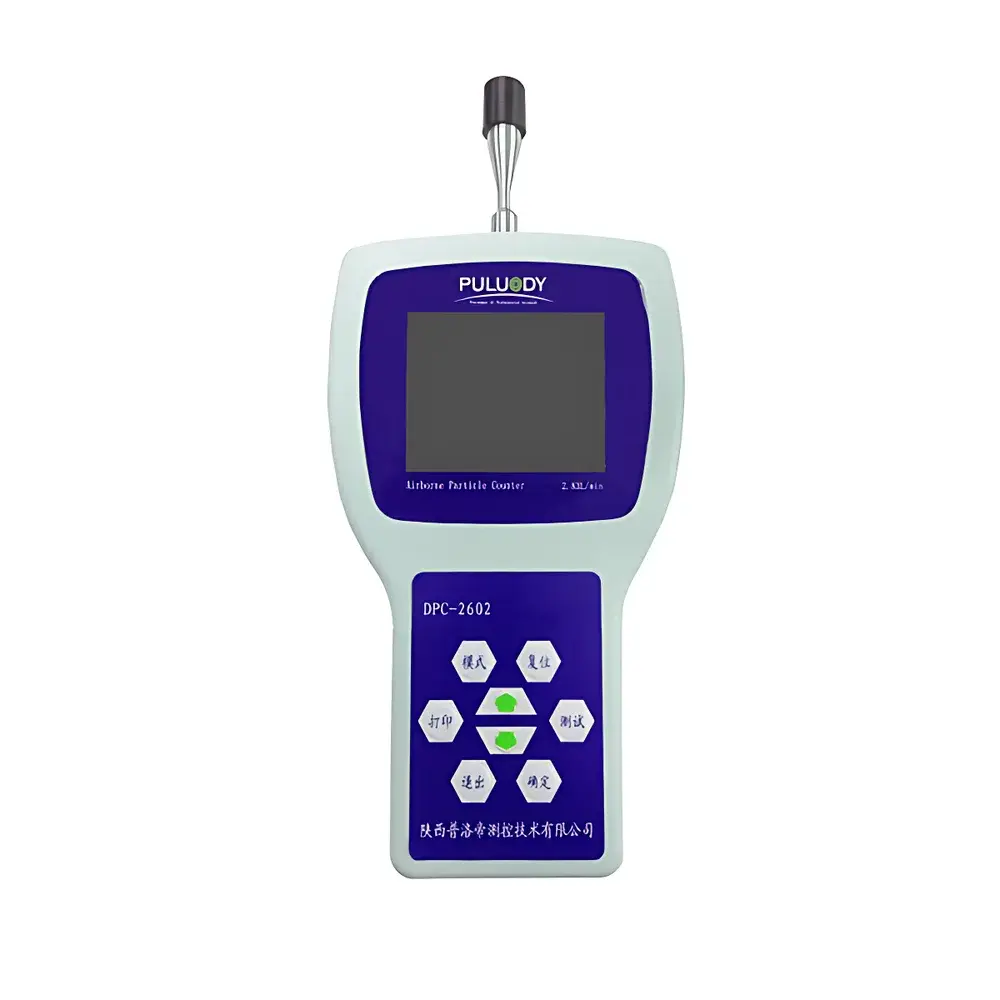
PULUODY DPC-2602 Handheld Optical Airborne Particle Counter
| Brand | PULUODY |
|---|---|
| Origin | Shaanxi, China |
| Model | DPC-2602 |
| Instrument Type | Optical Particle Counter |
| Sensor Technology | 7th-Generation Dual-Laser Narrow-Beam Detection |
| Particle Size Channels | Configurable Sets Including 0.3/0.5/1.0/2.5/5.0/10.0 µm |
| Counting Accuracy | <5% coincidence error at 2,000,000 particles/ft³ |
| Flow Rate | 2.83 L/min (0.1 cfm) |
| Sampling Time | Programmable (default 60 s) |
| Operating Temperature | 5–45 °C |
| Relative Humidity | ≤90% RH (non-condensing) |
| Battery | Rechargeable 4100 mAh polymer lithium-ion |
| Data Storage | Up to 10,000 measurement records |
| Display | 3.45-inch industrial-grade full-view color LCD |
| Compliance | ISO 14644-1:2015, GB/T 16292–1996, GMP Annex 1 (2022), USP <788> (particle counting in compressed gases) |
Overview
The PULUODY DPC-2602 Handheld Optical Airborne Particle Counter is a portable, real-time aerosol monitoring instrument engineered for precision and field adaptability in cleanroom validation, HVAC system verification, pharmaceutical manufacturing environments, and indoor air quality (IAQ) assessment. It operates on the principle of light scattering—specifically, dual-laser narrow-beam optical detection—where airborne particles passing through intersecting laser beams generate scattered photons proportional to their size and refractive index. This seventh-generation sensor architecture enables high-fidelity discrimination across multiple calibrated size bins (e.g., 0.3, 0.5, 1.0, 2.5, 5.0, and 10.0 µm), supporting both discrete count mode and mass concentration estimation via size-bin weighting algorithms. Designed to meet stringent regulatory expectations for environmental monitoring, the DPC-2602 delivers traceable, repeatable particle counts with <5% coincidence error at high concentrations (up to 2×10⁶ particles/ft³), ensuring data integrity during critical qualification activities such as ISO 14644-1 Class 5–8 cleanroom certification or GMP Annex 1-compliant viable/non-viable particle surveillance.
Key Features
- Modular multi-parameter sensing platform: Simultaneous particle counting, temperature/humidity logging (with optional probe), dew point calculation, and optional electrochemical gas detection (CO, HCHO, etc.) via plug-in sensor modules.
- Configurable particle size channel sets: Four predefined configurations (A–D) allow user-selectable binning strategies aligned with application-specific standards—e.g., PM2.5/PM10 compliance per EPA and WHO guidelines, or ISO 21501-4-compliant calibration protocols.
- Robust embedded architecture: Industrial-grade 3.45-inch color LCD with anti-glare coating; IP54-rated enclosure for dust and splash resistance; ESD- and EMI-hardened circuitry compliant with IEC 61326-1 for electromagnetic compatibility in laboratory and production floor settings.
- Regulatory-ready data handling: On-device timestamped storage of up to 10,000 complete sampling records (including raw channel counts, environmental metadata, and operator ID); configurable auto-save intervals and real-time USB/RS232 export for audit trail generation.
- Extended operational autonomy: Integrated 4100 mAh rechargeable polymer lithium-ion battery supports >8 hours continuous operation at 1 cfm flow rate; built-in overvoltage, overcurrent, short-circuit, and thermal protection circuits per UL 62368-1.
Sample Compatibility & Compliance
The DPC-2602 is validated for use with ambient air, compressed medical air, nitrogen, and filtered process gases in non-explosive environments (ATEX Zone 2 not applicable). Its 2.83 L/min (0.1 cfm) volumetric flow is calibrated per ISO 21501-4 Annex B and traceable to NIST-traceable reference aerosols (e.g., PSL, DEHS). All particle count reports conform to ISO 14644-1:2015 statistical sampling requirements—including minimum sample volume calculations, spatial distribution mapping guidance, and uncertainty budget documentation. The instrument satisfies GMP Annex 1 (2022) Section 8.43 for “continuous monitoring of non-viable particles in Grade A/B zones” when deployed with appropriate sampling manifolds and alarm thresholds. Calibration certificates issued by accredited third-party labs (e.g., CNAS ISO/IEC 17025) are accepted for IQ/OQ/PQ documentation; field recalibration using certified reference aerosols is supported without firmware reset.
Software & Data Management
Data retrieval and reporting are managed via PULUODY’s PC-based ParticleView™ Desktop Suite (v4.2+), which imports .csv/.txt logs directly from the device or micro-USB interface. The software enables batch analysis, trend charting (e.g., 24-hr particle drift vs. humidity), automated report generation per ISO 14644-2 Annex D templates, and PDF export with digital signature fields. Audit trail functionality complies with FDA 21 CFR Part 11 requirements: all user actions (e.g., parameter changes, record deletions, calibration events) are logged with immutable timestamps, operator IDs, and reason codes. Optional cloud synchronization (via secure TLS 1.3 API) supports centralized fleet management for multi-site pharmaceutical QA teams operating under GLP/GMP-aligned data governance policies.
Applications
- Cleanroom classification and routine monitoring per ISO 14644-1 and EU GMP Annex 1 in pharmaceutical fill-finish suites, biotech isolators, and semiconductor fabrication fabs.
- Compressed gas purity verification for medical air systems (ISO 8573-1 Class 2:2:2), nitrogen purge lines, and instrument air networks in API manufacturing.
- Indoor air quality assessment in hospitals, laboratories, and data centers—supporting ASHRAE Standard 62.1 particulate exposure thresholds and WHO PM2.5/PM10 annual mean guidelines.
- Filter integrity testing and HEPA/ULPA efficiency validation using upstream/downstream particle challenge methods per IEST-RP-CC001.4.
- Environmental monitoring during facility commissioning, change control assessments, and post-maintenance requalification.
FAQ
Does the DPC-2602 support ISO 21501-4 calibration traceability?
Yes—the optical sensor module is factory-calibrated using NIST-traceable polystyrene latex (PSL) spheres and certified reference aerosols; calibration certificates include uncertainty budgets and measurement repeatability data per ISO/IEC 17025.
Can the instrument perform simultaneous PM2.5 and PM10 mass concentration estimation?
Yes—by selecting Channel Set C (0.3/0.5/1.0/2.5/5.0/10.0 µm), the firmware applies Mie theory-based conversion factors to derive mass concentrations compliant with EPA EQPM-0899-059 and ISO 12103-1 A2 test dust references.
Is remote firmware update supported?
Firmware updates require local USB connection and authenticated access via ParticleView™ Desktop Suite; no over-the-air (OTA) capability is implemented to maintain data security and regulatory compliance.
What is the recommended recalibration interval?
Annual recalibration is advised per ISO 17025-accredited laboratories; however, user-performed functional checks using zero-air filters and reference aerosol challenges are recommended before each critical monitoring campaign.
Does the device meet FDA 21 CFR Part 11 requirements for electronic records?
When used with ParticleView™ Desktop Suite v4.2+, the system provides role-based access control, electronic signatures, and immutable audit trails—fully satisfying Part 11 Subpart B technical controls for closed systems.



