
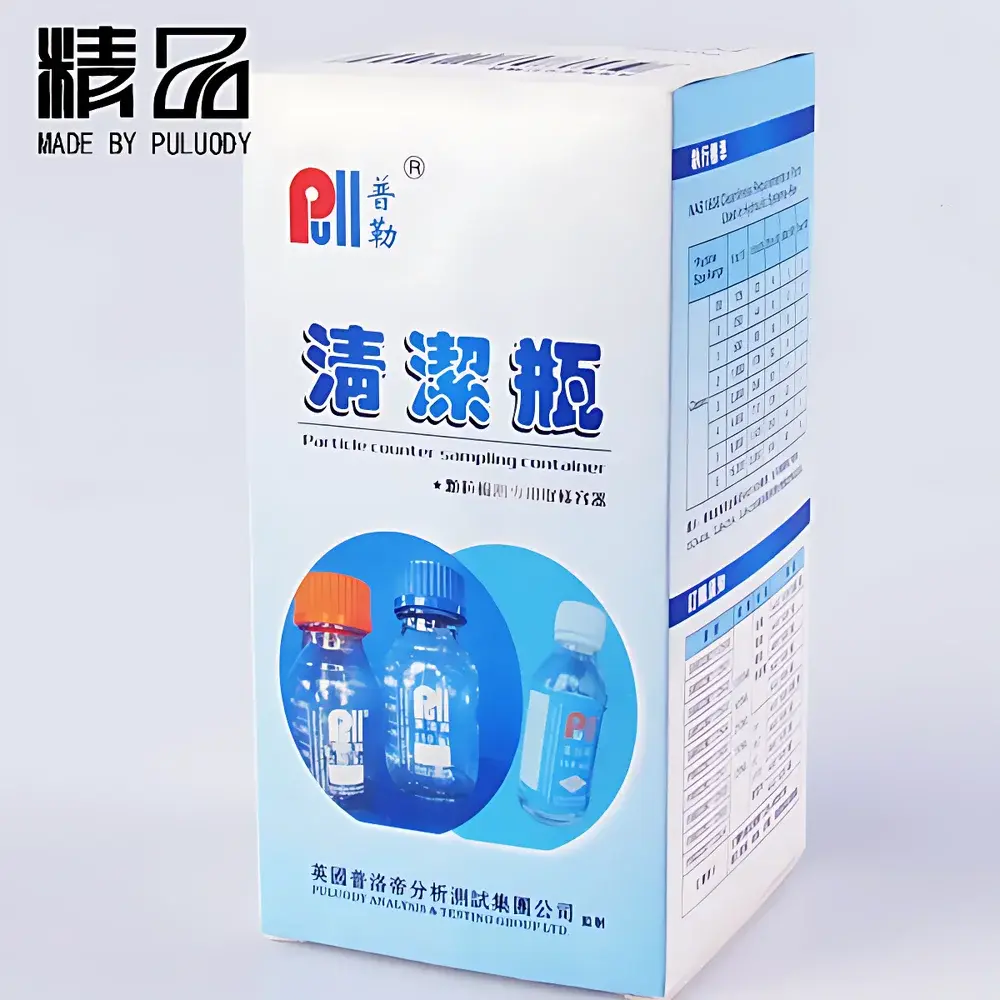
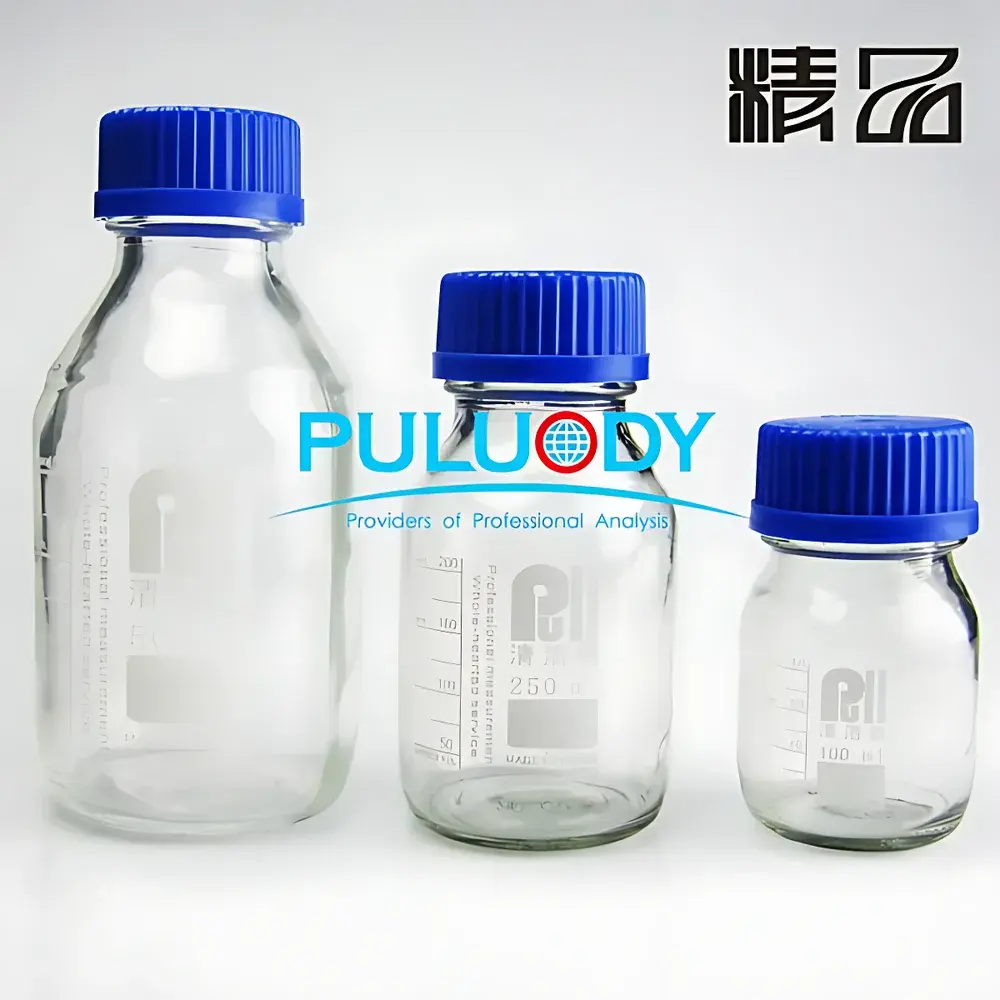
PULUODY PS8011 Optical Particle Counter Sampling Vial
| Brand | PULUODY |
|---|---|
| Origin | Xi’an, Shaanxi, China |
| Manufacturer Type | OEM/ODM Producer |
| Instrument Category | Domestic |
| Model | PS8011 |
| Instrument Type | Optical Particle Counter Sampling Vial |
| Capacity | 220 mL / 250 mL |
| Material | High-Silica Borosilicate Glass |
| Max. Temperature Resistance | 150 °C |
| Max. Pressure Resistance | 0.1 MPa |
| Cleanliness Grade | NAS 00–4 (per 100 mL) |
| AOQL (Average Outgoing Quality Limit) | 0.5% |
| RCL (Residual Contamination Level) | ≤15 particles ≥4 µm per 100 mL |
| Validated Standards | ISO 3722, GB/T 17484, NAS 1638, ISO 4406, SAE AS749D, ISO 16232, GJB 420A/B, GB/T 14039, DL/T 427, DL/T 1096 |
| Cleaning Process | Ultrasonic cleaning (high-precision), Class 100,000 cleanroom air shower, hot-air drying & hermetic sealing, UV sterilization, cleanliness verification |
| Seal | External-thread cap with O-ring drip-proof gasket |
| Compatibility | Fully compatible with HIAC ROYCO 8000A/8011/8012, PALL HPCA-Kit-O/HPCA-2/PIM400/PCM400/PFC400, SBSS, S40, and all ISO/NAS-compliant optical particle counters |
Overview
The PULUODY PS8011 Optical Particle Counter Sampling Vial is a certified ultra-clean container engineered for precision liquid contamination analysis in hydraulic, lubricating, transformer, and turbine oils. Designed in strict accordance with ISO 3722 (“Hydraulic fluid power — Validation of cleaning procedures for sampling containers”), this vial serves as the foundational sampling medium for quantitative particulate contamination measurement via light extinction or laser-based optical particle counting. Its function is not passive containment but active metrological integrity assurance: any residual particles introduced by the container itself would directly bias the measured particle concentration—particularly critical when assessing NAS 00–4 cleanliness levels (i.e., <20 particles ≥4 µm per 100 mL). The PS8011 eliminates this uncertainty through a rigorously controlled, multi-stage manufacturing process conducted in Class 100,000 cleanroom environments, including high-frequency ultrasonic cleaning, nitrogen-purged hot-air drying, hermetic sealing under laminar flow, and post-processing UV-C sterilization. Each batch undergoes independent cleanliness validation per NAS 1638 and GJB 420B protocols to confirm AOQL ≤0.5% and RCL ≤15 particles ≥4 µm per 100 mL.
Key Features
- High-silica borosilicate glass construction ensures thermal stability up to 150 °C and chemical resistance to concentrated sulfuric acid–potassium dichromate cleaning solutions, organic solvents, and alkaline reagents.
- Externally threaded cap with integrated elastomeric O-ring forms a leak-proof, drip-resistant seal—critical for maintaining sample integrity during transport and handling.
- Optimized wall thickness and optical clarity support consistent light transmission in optical particle counters, minimizing signal scatter artifacts during detection.
- Manufactured via fully automated production lines to guarantee dimensional repeatability and batch-to-batch consistency—eliminating manual variability inherent in hand-assembled alternatives.
- Available in two standardized volumes: 220 mL and 250 mL—both calibrated to meet volumetric tolerances specified in ISO 3722 Annex B.
- Pre-validated for direct compatibility with major global particle counter platforms, including HIAC ROYCO 8000A/8011/8012, PALL HPCA series, SBSS laboratory systems, and S40 field-deployable units.
Sample Compatibility & Compliance
The PS8011 is validated for use with mineral oils, synthetic esters, phosphate esters, polyalphaolefins (PAO), and water-glycol fluids across viscosity ranges from ISO VG 10 to VG 680. It complies with international cleanliness standards required for regulatory and quality audit readiness: ISO 3722 (sampling container qualification), ISO 16232 (road vehicle fluid cleanliness), ISO 4406 (fluid contamination coding), NAS 1638 (aerospace hydraulic fluid cleanliness), and GJB 420B (Chinese military specification for aviation oil cleanliness). All validation documentation—including AOQL reports, RCL test certificates, and cleanroom environmental logs—is traceable to PULUODY’s accredited internal lab (CNAS-certified testing scope: PLDMC-LAB-2023-087). The vials are supplied sterile and sealed; opening initiates a defined shelf-life window governed by ISO 8573-7 for compressed air purity—ensuring no ambient particulate ingress prior to first use.
Software & Data Management
While the PS8011 itself is a passive consumable, its integration into digital workflows is supported through full traceability metadata. Each carton includes a QR-coded label linking to a secure cloud portal containing batch-specific validation data: particle count histograms (per ISO 11171 reference), AOQL calculation worksheets, cleanroom environmental monitoring records (temperature, humidity, airborne particle counts per ISO 14644-1 Class 8), and sterilization cycle logs. This enables seamless alignment with FDA 21 CFR Part 11-compliant LIMS environments and GLP/GMP audit trails. For laboratories operating under ISO/IEC 17025, the PS8011’s documented chain-of-custody satisfies Clause 7.7.1 (Sampling) and Clause 7.8.2 (Reporting of Results).
Applications
The PS8011 is deployed across critical asset reliability programs: hydraulic system commissioning and periodic contamination monitoring (per ISO 4406 code reporting); gearbox and transmission oil health assessment in wind turbines and marine propulsion; transformer oil particulate trending per IEEE C57.106; turbine lube oil analysis in power generation; and clean-in-place (CIP) rinse water validation in pharmaceutical manufacturing. It is routinely specified in OEM maintenance manuals for Caterpillar, Siemens Energy, GE Power, Parker Hannifin, Bosch Rexroth, and Rolls-Royce. Field technicians use it for grab sampling at pressure taps, reservoir ports, and filter bypass lines—while laboratory analysts rely on it for calibration verification, method blank analysis, and inter-laboratory comparison studies under ASTM D7690.
FAQ
What is the maximum allowable storage time after opening the vial?
Once opened, the vial must be used within 2 hours under ISO Class 8 (100,000) ambient conditions. For ISO Class 5 (100) or better environments, the window extends to 4 hours—documented in the Certificate of Analysis for each batch.
Can the PS8011 be autoclaved?
No. While the glass withstands 150 °C, the O-ring material is not autoclave-rated. Sterilization is achieved solely via UV-C (254 nm, 40 mJ/cm² dose) during final packaging.
Is third-party certification available?
Yes. Independent verification per ISO 3722 is offered through PULUODY’s partner lab—SGS Shanghai (Report No. GZ23-XXXXX)—with NIST-traceable particle reference standards.
How does the PS8011 differ from generic “clean” sampling bottles?
Generic bottles lack AOQL/RCL quantification, cleanroom processing, and multi-standard validation. The PS8011 provides metrologically defensible evidence that container contribution to total particle count is ≤0.5% of the measured value—required for ISO/IEC 17025 accreditation.
Do you supply custom labeling or barcoding?
Yes. Custom GS1-128 or DataMatrix labels with customer-defined lot hierarchies (e.g., site ID + date + analyst code) are available under OEM agreements.



