
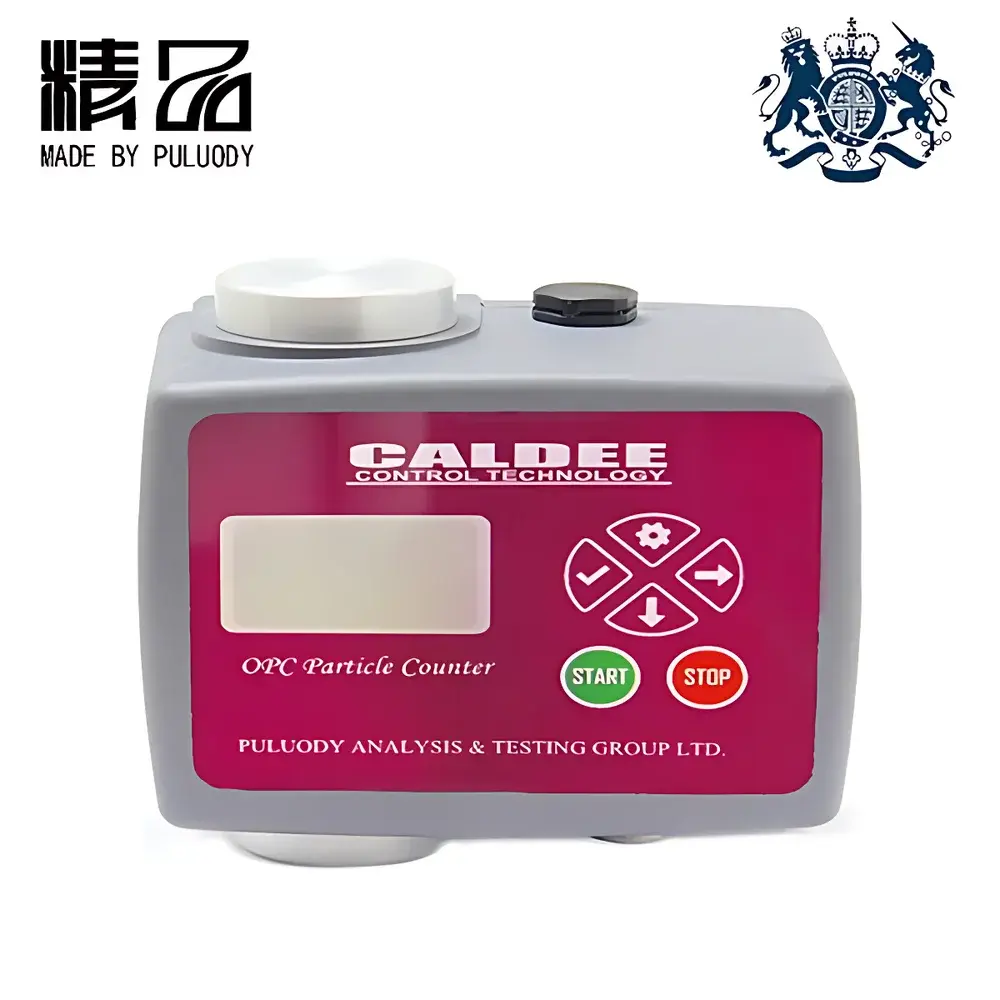
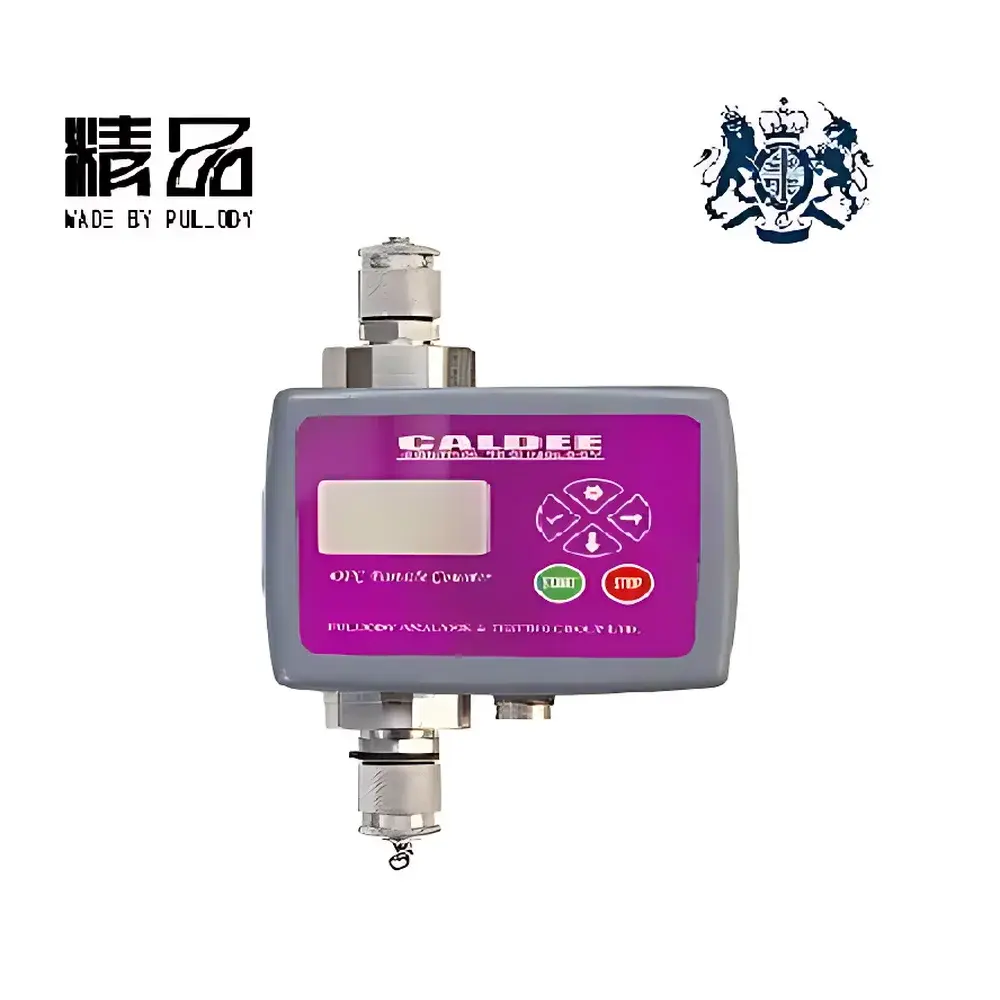
PULUODY OPC-1 Online Optical Particle Counter
| Brand | PULUODY |
|---|---|
| Origin | Shaanxi, China |
| Manufacturer Type | Authorized Distributor |
| Product Category | Domestic |
| Model | OPC-1 |
| Instrument Type | Optical Particle Counter |
| Detection Principle | Dual-Laser Narrow-Beam Light Scattering (7th Generation) |
| Measurement Range | 1–150 µm |
| Channel Count | 8 |
| Standards Compliance | NAS 1638 (00–>12), ISO 4406 (00–>28), GJB 420B (00–>12), GOST 17216 (00–>17), GB/T 14039, ISO 11171, SAE AS4059, MIL-STD-1246, IP 564/565, JIS B 9933, DL/T 432 & 1096, JB/T 9737, GB/T 18854 |
| Pressure Rating | 0–1.0 MPa (direct), 0–31.5 MPa (with integrated pressure reducer) |
| Flow Rate | 15–500 mL/min |
| Fluid Temperature Range | −10 °C to +80 °C |
| Viscosity Limit | ≤500 cSt (online mode) |
| Output Interfaces | RS232, RS485, optional 4–20 mA / 0–5 V analog |
| Power Supply | 9–30 VDC |
| Enclosure Rating | IP65-rated rugged housing |
| Calibration Support | Traceable to ISO 21501-4 and ISO 11171 reference materials |
Overview
The PULUODY OPC-1 Online Optical Particle Counter is an industrial-grade, real-time fluid contamination monitoring instrument engineered for continuous in-line measurement of particulate contamination in hydraulic oils, lubricants, turbine oils, aviation fuels, and ultra-pure process fluids. Based on the 7th-generation dual-laser narrow-beam light scattering detection principle, the OPC-1 delivers high reproducibility and long-term stability under dynamic operating conditions. Unlike laboratory-based particle counters requiring offline sampling, the OPC-1 integrates directly into pressurized fluid loops—enabling uninterrupted, flow-through analysis without bypass or dilution. Its optical architecture complies with ISO 21501-4 for light extinction and scattering-based particle sizing, and its calibration traceability aligns with ISO 11171 reference emulsions and NIST-traceable standards. Designed for integration into plant-wide condition monitoring systems, the OPC-1 supports predictive maintenance strategies by delivering time-synchronized particle count data (per mL) and standardized cleanliness codes—critical for early detection of component wear, filter breakthrough, and system degradation.
Key Features
- Real-time online operation: Continuous sampling at flow rates from 15 to 500 mL/min, compatible with high-pressure hydraulic circuits up to 31.5 MPa (with integrated pressure reduction module)
- Dual-laser narrow-beam optical sensor: Minimizes coincidence error and improves resolution across the full 1–150 µm detection range with eight user-configurable size channels
- Multi-standard compliance engine: On-device calculation and display of cleanliness grades per NAS 1638, ISO 4406:2017, GJB 420B, GOST 17216, SAE AS4059, and 12 additional international and national standards
- Ruggedized industrial enclosure: IP65-rated housing with thermal stability from −10 °C to +80 °C ambient; resistant to electromagnetic interference, vibration, and mechanical shock
- Flexible connectivity: Standard RS232 and RS485 serial outputs; optional analog outputs (4–20 mA or 0–5 V) with programmable alarm thresholds for DCS/SCADA integration
- Embedded calibration management: Supports field verification using ISO 11171-compliant reference particles; documentation assists annual metrological recalibration per ISO/IEC 17025 requirements
Sample Compatibility & Compliance
The OPC-1 is validated for use with mineral oils, synthetic lubricants, phosphate esters, water-glycol fluids, aviation hydraulic fluids (MIL-PRF-5606, MIL-PRF-83282), and deionized water. It meets ISO 4406:2017 Annex A for particle counting methodology and conforms to the optical calibration framework defined in ISO 11171:2010. For regulated environments—including aerospace MRO facilities, power generation turbine lube systems, and naval propulsion hydraulics—the device supports audit-ready data logging aligned with GLP principles. While not FDA 21 CFR Part 11–certified out-of-the-box, its timestamped binary output and configurable audit trail features enable validation for GMP-aligned applications when deployed with compliant data acquisition software.
Software & Data Management
The OPC-1 operates with embedded firmware supporting local display of real-time counts, differential/ cumulative histograms, and multi-standard grade conversion. Raw pulse data and event logs are exportable via serial interface for post-processing in third-party platforms (e.g., MATLAB, LabVIEW, or custom SCADA historians). Optional PC-based analysis software provides trend visualization, statistical process control (SPC) charting, and automated report generation compliant with ISO 4406 and NAS 1638 reporting formats. All stored data include metadata: timestamp (UTC), flow rate, temperature, pressure, and operator ID—facilitating root-cause analysis during failure investigations and regulatory audits.
Applications
- Hydraulic system health monitoring on construction equipment, wind turbine pitch/yaw systems, and marine drilling rigs
- Filter performance validation in offline filtration test benches per ISO 16889 and ISO 11171
- Wear debris trending in gearboxes and servo-valve test stands
- Contamination control in aviation ground support equipment and military vehicle fleets
- In-process monitoring of ultra-pure water in semiconductor tool cooling loops and pharmaceutical clean steam systems
- Condition-based maintenance scheduling for hydroelectric turbine governors and nuclear reactor control hydraulics
FAQ
Does the OPC-1 require periodic recalibration?
Yes. Annual recalibration against ISO 11171 reference materials is recommended to maintain measurement integrity. PULUODY’s certified service centers provide traceable recalibration with ISO/IEC 17025-compliant certificates.
Can the OPC-1 operate in high-viscosity fluids?
It supports online measurement in fluids up to 500 cSt at operational temperatures; higher viscosities require inline heating or pre-dilution—consult application engineering prior to deployment.
Is analog output configurable for alarm signaling?
Yes. The 4–20 mA output can be mapped to any particle size channel or composite count threshold, with programmable hysteresis to prevent nuisance alarms.
What is the minimum detectable particle size?
The lower detection limit is 1 µm per ISO 21501-4, verified using polystyrene latex (PSL) reference particles with ±5% sizing uncertainty.
How is data integrity ensured during power interruption?
The device includes non-volatile memory that retains configuration, calibration coefficients, and the last 72 hours of sampled count data—even during unexpected power loss.



