
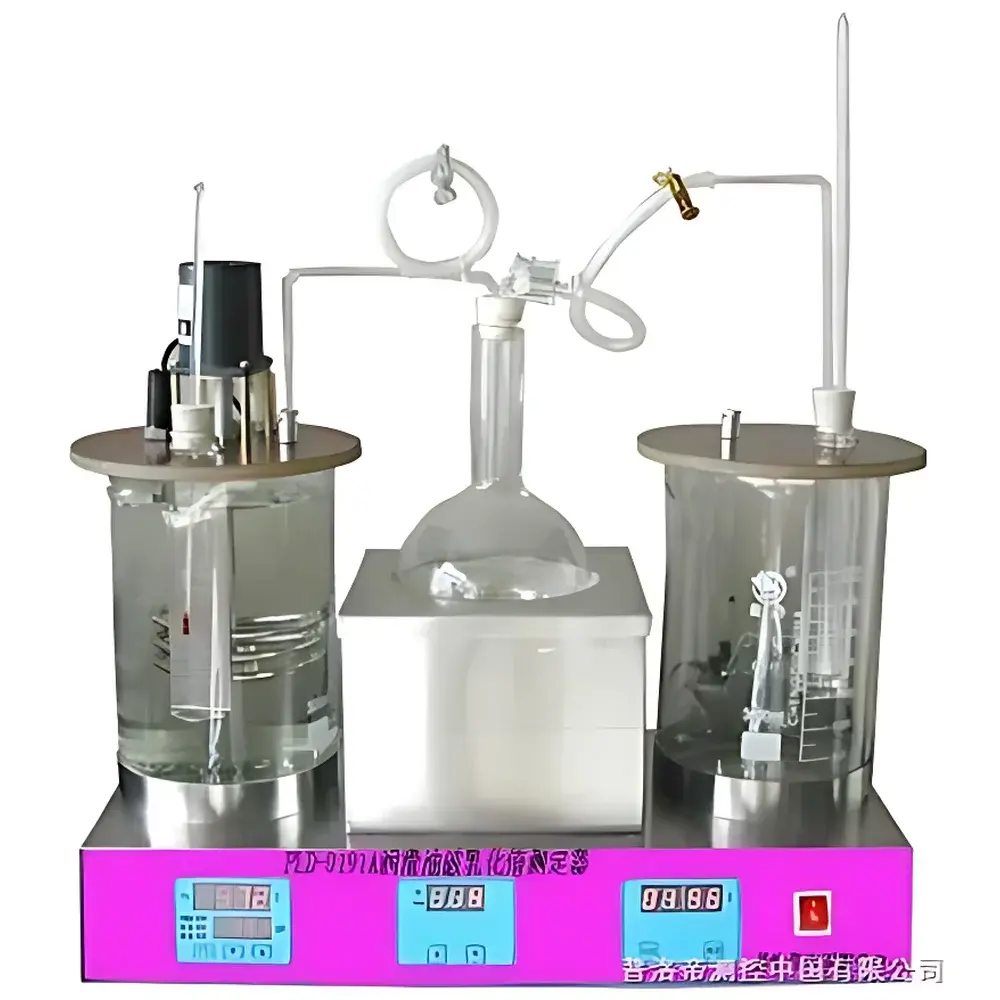
PLD-0191A Petroleum Demulsibility Tester
| Origin | Shaanxi, China |
|---|---|
| Manufacturer Type | Authorized Distributor |
| Origin Category | Domestic (China) |
| Model | PLD-0191A |
| Power Supply | AC 220 V ±10%, 50 Hz |
| Emulsification Bath Temp. Range | 19–26 °C |
| Separation Bath Temp. Range | 94 °C ±1 °C |
| Separation Bath Heating Power | 400 W |
| Steam Generator Heating Power | 1000 W (adjustable) |
| Test Capacity | 1 station |
| Sample Volume | 20 mL |
Overview
The PLD-0191A Petroleum Demulsibility Tester is a precision-engineered instrument designed to determine the demulsibility value of lubricating oils—specifically turbine oils and other industrial lubricants—in strict accordance with SH/T 0191–92, the Chinese national standard equivalent to ASTM D1401 for oil-water separation behavior. Demulsibility quantifies an oil’s ability to separate from water under controlled thermal and mechanical conditions, a critical performance indicator for turbine systems where water ingress can accelerate oxidation, promote rust formation, and impair film strength. The instrument replicates the standardized test protocol: a 20 mL oil sample is emulsified with steam at approximately 90 °C, then transferred to a precisely maintained 94 °C separation bath; the time required for 20 mL of clear oil to separate from the emulsion is recorded as the demulsibility value (reported in minutes). This measurement directly reflects interfacial stability, surfactant contamination level, and additive degradation—key parameters monitored during routine condition-based maintenance and new oil qualification.
Key Features
- Metallic steam generator with integrated water-level gauge and safety pressure relief valve, ensuring consistent steam delivery and operational safety during prolonged testing cycles.
- Dual-bath architecture: independently controlled emulsification bath (19–26 °C) and high-precision separation bath (94 °C ±1 °C), both utilizing PID-regulated digital temperature controllers for repeatability across environmental fluctuations.
- Robust heating system: 400 W immersion-type metal-sheathed heating element in the separation bath; 1000 W adjustable power output for the steam generator, enabling fine-tuned vapor generation rate to meet SH/T 0191–92’s steam flow consistency requirements.
- Single-station design optimized for laboratory workflow efficiency—minimizes footprint while maintaining full compliance with standard geometry and timing specifications.
- Stainless steel construction of critical wetted components and thermal zones, resistant to corrosion from repeated exposure to steam, condensate, and hydrocarbon residues.
Sample Compatibility & Compliance
The PLD-0191A is validated for use with new and in-service turbine oils (including ISO VG 32, 46, and 68 grades), hydraulic oils, and other mineral- or synthetic-based lubricants where water separation performance is specified. While aged or heavily contaminated samples may yield results with reduced repeatability—as noted in SH/T 0191–92—the instrument maintains metrological integrity across the defined operating range. It supports quality control workflows aligned with ISO 55001 asset management frameworks and meets technical prerequisites for laboratories implementing GLP-compliant oil analysis programs. Though not certified to IEC 61000 or UL standards out-of-the-box, its electrical design conforms to GB/T 14048.1 (Chinese low-voltage switchgear and controlgear standard), and all thermal controls include overtemperature cut-off protection.
Software & Data Management
The PLD-0191A operates as a standalone benchtop instrument with analog/digital hybrid control: a high-resolution digital temperature display and manual timer interface ensure traceability without embedded software dependencies. For integration into LIMS or centralized QA databases, users may log test parameters—including bath temperatures, steam duration, separation time, operator ID, and sample batch number—using external electronic lab notebooks (ELNs) compliant with 21 CFR Part 11 audit-trail requirements. Optional accessories include calibrated digital stopwatches with data export (USB/Bluetooth) and temperature validation probes (NIST-traceable Pt100 sensors) for periodic verification per ISO/IEC 17025 clause 6.5.2.
Applications
- Acceptance testing of new turbine oils prior to commissioning or replenishment.
- Condition monitoring of in-service oils in power generation, marine propulsion, and industrial steam turbine installations.
- Formulation development support for additive packages targeting enhanced water rejection (e.g., demulsifier screening).
- Root-cause analysis of field failures linked to sludge formation, varnish deposition, or bearing corrosion.
- Third-party certification testing for OEM lubricant approval programs requiring SH/T 0191–92 or ASTM D1401 conformance.
FAQ
What is the primary international standard referenced by SH/T 0191–92?
SH/T 0191–92 is technically harmonized with ASTM D1401, “Standard Test Method for Determining the Demulsibility Characteristics of Turbine Oils.” Both specify identical test geometry, temperature profiles, and pass/fail criteria.
Can the PLD-0191A be used for non-turbine oils such as gear or compressor oils?
Yes—provided the application requires demulsibility assessment per SH/T 0191–92 or internal specifications; however, method applicability must be verified against the oil’s base stock and additive chemistry, as some synthetics exhibit non-linear separation kinetics.
Is calibration documentation included with the instrument?
The unit ships with factory calibration certificates for temperature sensors (traceable to national standards) and a user-accessible calibration procedure for bath uniformity verification using ASTM D5293 reference thermometers.
Does the instrument support multi-sample throughput?
No—the PLD-0191A is configured for single-test operation per cycle to ensure strict adherence to SH/T 0191–92’s sequential emulsification–separation protocol; parallel testing requires multiple units or alternative high-throughput demulsibility platforms.
What maintenance intervals are recommended for the steam generator?
Daily visual inspection of water level and safety valve function; quarterly descaling using citric acid solution (0.5% w/w); annual replacement of steam outlet gaskets and pressure seal components per manufacturer’s service bulletin.






