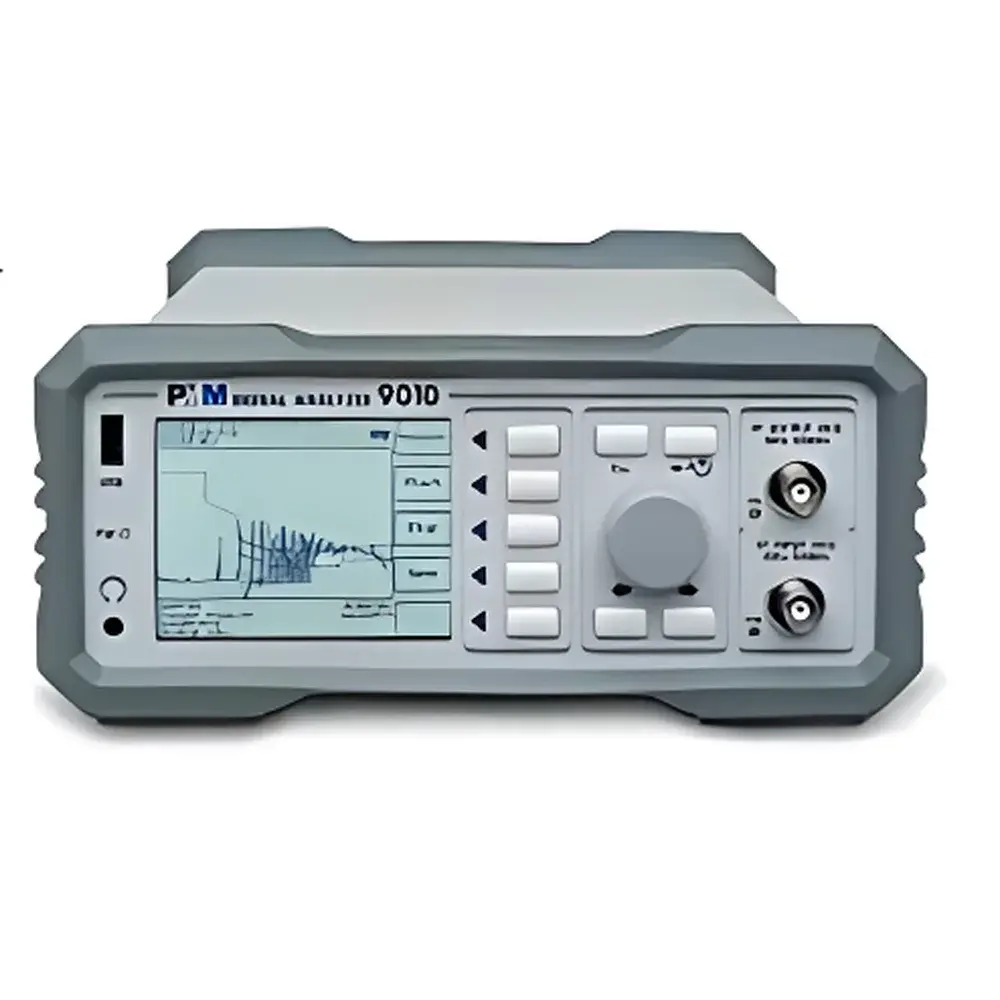
PMM 9010F Time-Domain EMI Test Receiver
| Brand | PMM |
|---|---|
| Origin | Italy |
| Model | 9010F |
| Frequency Range | 10 Hz to 30 MHz (extendable to 3 GHz / 6 GHz / 18 GHz with optional modules 9030 / 9060 / 9018) |
| Compliance | CISPR 16-1-1, MIL-STD-461, DO-160 |
| Detection Modes | Peak, Quasi-Peak, Average, RMS, RMS-Average, CISPR-Average, APD |
| IF Bandwidths | 200 Hz, 9 kHz, 1 kHz–300 kHz (6 dB) |
| Resolution | 0.1 Hz |
| Frequency Accuracy | <1 ppm |
| Input Impedance | 50 Ω (BNC-f) |
| VSWR | <1.20 @ 10 dB attenuation |
| Max. Input Level | 137 dBµV (CW), 97 dBµV/MHz (pulse spectral density) |
| Built-in Preamp | +20 dB |
| Attenuation | 0–35 dB (5 dB steps) |
| Real-time FFT Sweep Speed | <5 s for CISPR Band A, <20 s for Band B (QPK, 1 s dwell) |
| Operating Temperature | –5 °C to +45 °C |
| Weight | 4.1 kg (with integrated Li-ion battery) |
Overview
The PMM 9010F is a fully digital, time-domain EMI test receiver engineered for high-fidelity electromagnetic interference (EMI) measurement across regulatory and military compliance workflows. Unlike legacy analog receivers relying on swept-tuned superheterodyne architectures, the 9010F employs real-time Fast Fourier Transform (FFT) processing combined with digital intermediate-frequency (IF) filtering and synchronous multi-detector architecture. This enables simultaneous acquisition of peak, quasi-peak, average, RMS, CISPR-average, RMS-average, and amplitude probability distribution (APD) values — all within a single sweep cycle. Its core design adheres strictly to CISPR 16-1-1:2023, MIL-STD-461G, and DO-160G requirements, supporting both conducted and radiated emission testing from 10 Hz to 30 MHz natively. With optional fiber-optic-coupled extension modules (9030, 9060, 9018), frequency coverage extends seamlessly to 3 GHz, 6 GHz, or 18 GHz — maintaining full CISPR-compliant detection behavior across all bands.
Key Features
- Ultra-high-speed time-domain scanning: Achieves full CISPR Band A (9–150 kHz) measurement in under 5 seconds and Band B (0.15–30 MHz) in under 20 seconds using QP detection and standardized dwell times — up to 100× faster than conventional step-scan receivers.
- Digital IF architecture with no analog drift: All filtering (200 Hz, 9 kHz, 1–300 kHz 6-dB bandwidths), detection, and timing functions are implemented in FPGA-based digital signal processing — eliminating aging-related calibration drift in RBW filters, local oscillators, or counters.
- Multi-detector parallel acquisition: Simultaneous real-time computation of Peak, Quasi-Peak, Average, RMS, CISPR-Average, RMS-Average, and APD detectors ensures full compliance with both civil (CISPR, EN, FCC) and defense (MIL-STD-461G, DEF STAN 59-41) standards without sequential re-scans.
- Integrated Click (Impulse) measurement per CISPR 14-1: Automatically captures duration, interval, and overload events for impulsive disturbances; supports two-stage evaluation logic with auto-triggered data logging and pass/fail decision support in accordance with Clause 6.3.2.
- Field-deployable ruggedized design: Weighing only 4.1 kg with integrated rechargeable Li-ion battery, IP52-rated enclosure, and wide operating temperature range (–5 °C to +45 °C), it is certified for mobile, naval, aerospace, and HV substation environments — including compatibility with custom antennas for 750 kV and 1000 kV UHV power systems.
Sample Compatibility & Compliance
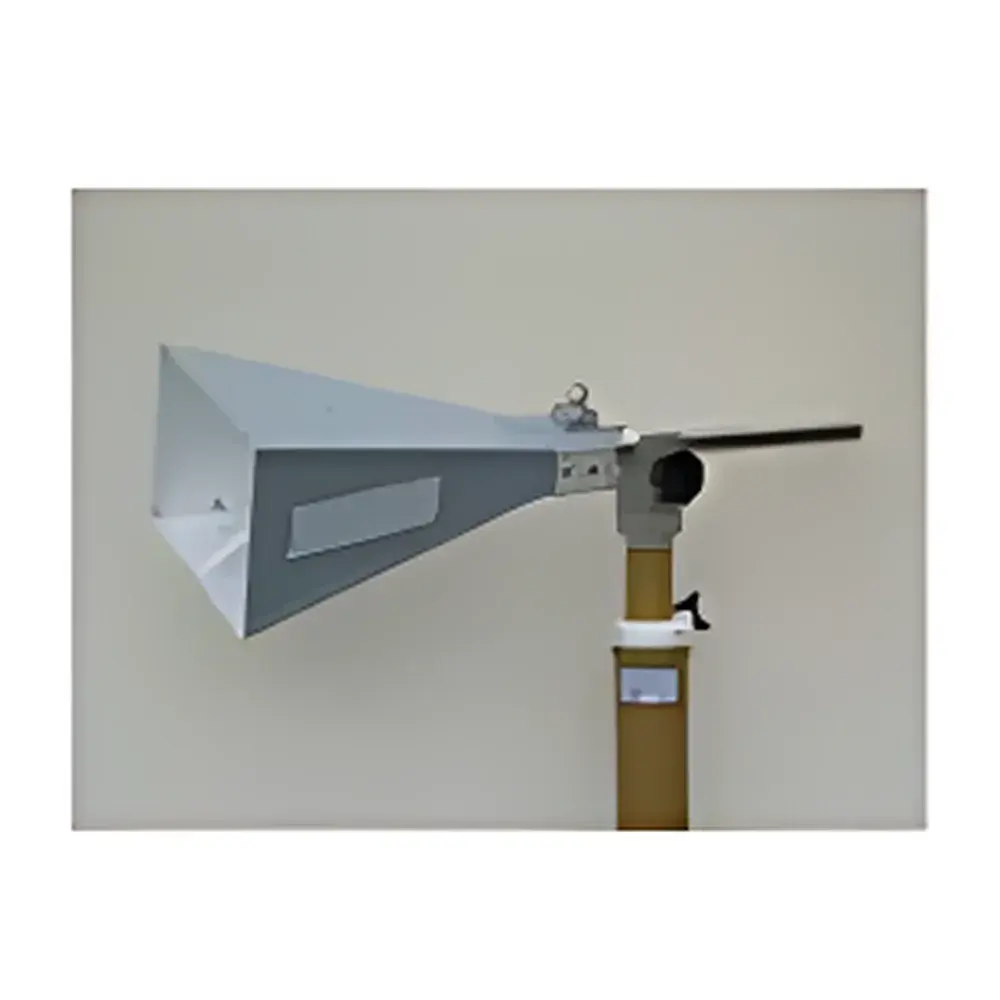
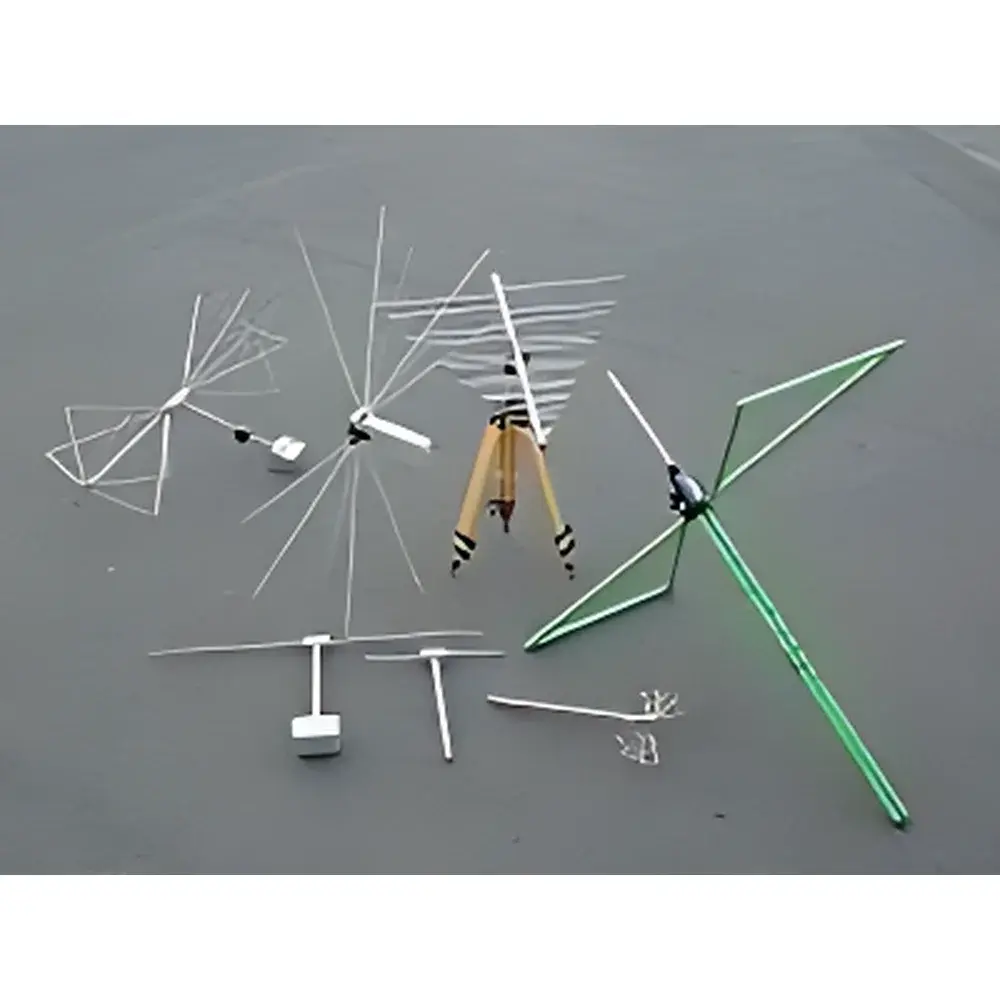
The PMM 9010F supports conducted emission measurements via direct RF input (50 Ω BNC-f), LISN-controlled voltage injection (programmable via AUX port), and radiated emission tests using calibrated antennas (e.g., biconical, log-periodic, loop). Its preselector — comprising one low-pass and six bandpass filters — ensures spurious-free operation across CISPR-defined frequency bands. The instrument satisfies mandatory traceability requirements under ISO/IEC 17025:2017 for EMC laboratories and provides audit-ready metadata (timestamp, detector settings, RBW, attenuation, preamp state) embedded in each measurement record. Firmware updates maintain alignment with evolving standards — including CISPR 16-1-1:2023 Amendment 2 and MIL-STD-461G Change 1 — without hardware modification or external recalibration.
Software & Data Management
The PMM Emission Suite (PES) software provides full remote control, automated test sequencing, report generation (PDF/CSV/XML), and deep spectral analysis. It implements GLP/GMP-compliant audit trails with user authentication, electronic signatures, and 21 CFR Part 11–ready configuration locking. Real-time spectrograms, persistence displays, and time-gated FFT enable identification of intermittent or transient emissions — critical for debugging switching power supplies, digital clock harmonics, or IoT device burst transmissions. All raw I/Q data is exportable for post-processing in MATLAB or Python-based toolchains. Firmware upgrades are delivered via secure HTTPS download from PMM’s official portal, requiring no service intervention.
Applications
- Pre-compliance and certification testing for industrial, medical, automotive (UNECE R10, ISO 11452), and consumer electronics (EN 55032, FCC Part 15).
- Military/aerospace platform qualification per MIL-STD-461G RS103, CS114, and DO-160G Section 20.
- High-voltage infrastructure EMC assessment — including UHV substations (750 kV/1000 kV), traction systems, and offshore wind converter stations.
- Research-grade EMI source characterization in time-domain and statistical domains (APD analysis for digital system susceptibility prediction).
- On-site troubleshooting of electromagnetic coupling paths in complex platforms such as naval vessels, aircraft cockpits, and railway signaling cabins.
FAQ
Does the PMM 9010F require periodic factory calibration?
No. Its digital IF architecture eliminates analog component drift; internal reference sources and self-test routines ensure metrological stability between formal calibrations. Traceable calibration is recommended every 24 months per ISO/IEC 17025 guidelines.
Can the 9010F perform real-time spectrum analysis while executing CISPR-compliant scans?
Yes. Dual-mode operation allows concurrent time-domain EMI scanning and live spectrogram display with adjustable persistence and gating — enabling correlation of transient events with regulatory limit lines.
Is MIL-STD-461G compliance supported out-of-the-box?
Full compliance requires the optional 9010/MIL firmware package, which configures 6-dB resolution bandwidths from 10 Hz to 1 MHz and implements MIL-specific detector weighting and sweep logic per RS103 and CS114.
How does the APD detector differ from standard average detection?
The Amplitude Probability Distribution (APD) detector statistically characterizes pulse density and amplitude distribution over time — essential for evaluating interference impact on modern digital receivers operating above 1 GHz, as specified in CISPR 16-1-1 Annex D.
What interfaces are available for automated test system integration?
Standard interfaces include dual high-speed optical links (for daisy-chaining with LISNs, switches, or antenna positioners), USB 2.0 (front/rear), RS-232, and optional IEEE-488 (GPIB) and Bluetooth 5.0 — all controllable via SCPI command set.