
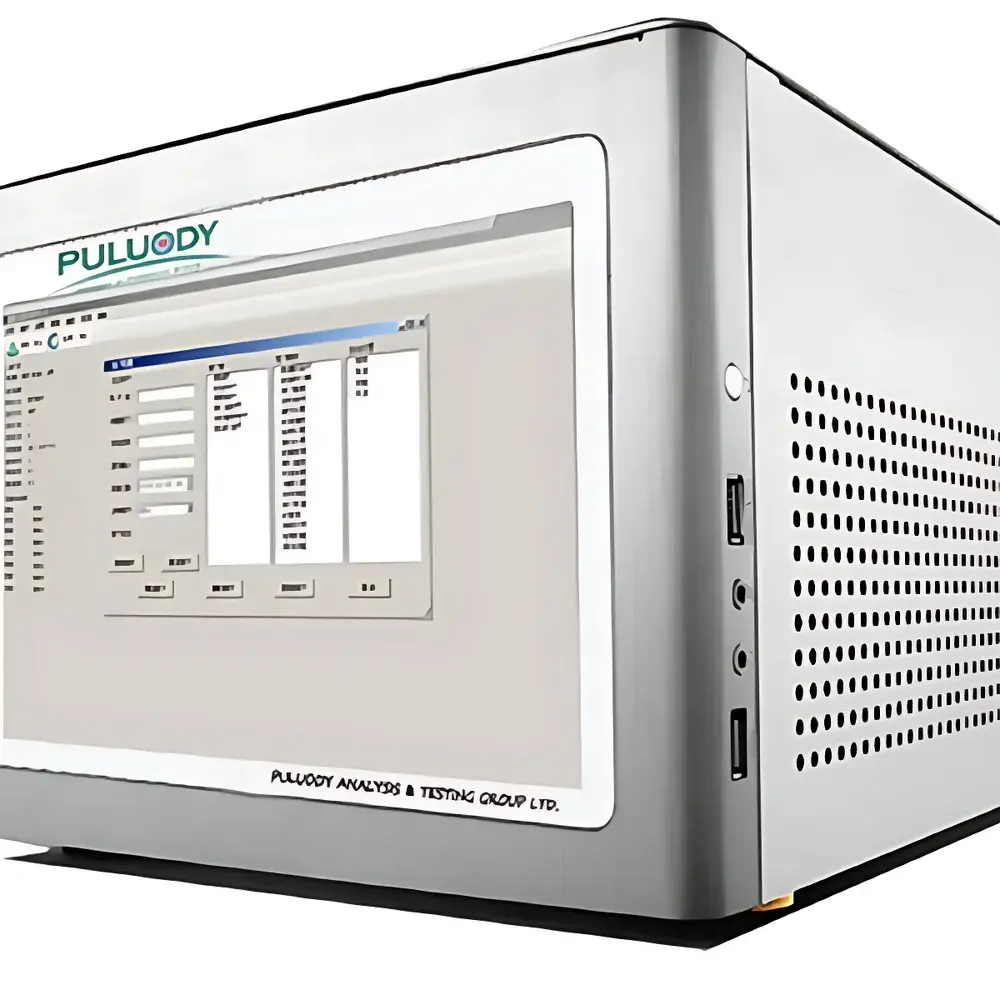
PULUODY PMT-2-O Online Integrated Ultrapure Water Liquid Particle Counter
| Brand | PULUODY |
|---|---|
| Model | PMT-2-O |
| Type | Optical Particle Counter |
| Detection Principle | Dual-Laser Narrow-Beam Light Scattering |
| Sensor Generation | 8th-Generation Dual-Laser Narrow-Beam Detector |
| Measurement Range | 0.05–0.2 µm, 0.1–0.5 µm, 0.2–2.0 µm (customizable from 0.1 µm to 100 µm) |
| Sampling Method | Precision Metering Piston Pump |
| Flow Control | Dual-Stage Electromagnetic + Precision Piston Pump |
| Accuracy | ±5% typical |
| Volume Accuracy | <±1% |
| Coincidence Limit | ≤5% error at 10,000 particles/mL |
| Output | 4–20 mA analog signal with configurable alarm thresholds |
| Calibration Standards | JJG 1061, ISO 21501-2, NIST-traceable latex spheres |
| Software | PULUODY V8.3 Integrated Analysis & Calibration Software (PC + embedded touchscreen) |
| Display | Color LCD touchscreen + optional wireless keyboard/mouse |
| Power Input | 100–265 VAC, 50–60 Hz |
| Compliance | Designed for ISO 14644-1/2 cleanroom water monitoring, SEMI F57/F63, ASTM D6978, USP <788> & <789>, and GLP/GMP-aligned data integrity workflows |
Overview
The PULUODY PMT-2-O Online Integrated Ultrapure Water Liquid Particle Counter is an engineered solution for real-time, continuous particulate contamination monitoring in critical fluid processes where sub-micron particle control defines product yield, process reliability, and regulatory compliance. Built upon the 8th-generation dual-laser narrow-beam optical detection architecture developed by PULUODY Analytical Testing Group (UK), the instrument employs orthogonal light scattering principles to resolve particles across three calibrated size channels—0.05–0.2 µm, 0.1–0.5 µm, and 0.2–2.0 µm—with optional user-defined sizing windows (e.g., 4–70 µm(c) or single-point 0.1 µm(c)). Its core measurement methodology adheres to ISO 21501-2 for light-scattering particle counters and supports traceable calibration per JJG 1061 (China National Metrology Verification Regulation) and NIST-traceable polystyrene latex standards. Unlike offline benchtop counters, the PMT-2-O integrates directly into ultrapure water (UPW) distribution loops, chemical delivery systems, and rinse stations used in semiconductor front-end manufacturing, flat-panel display fabrication, photovoltaic cell production, and high-purity pharmaceutical water systems.
Key Features
- Dual-stage flow control architecture combining a precision metering piston pump and ultra-stable electromagnetic flow regulation—ensuring volumetric accuracy better than ±1% and enabling reproducible sampling under variable backpressure conditions.
- Embedded dual-laser narrow-beam sensor with optimized optical path geometry to minimize Mie scattering distortion and enhance resolution of near-diffraction-limit particles (down to 0.05 µm).
- Real-time analog output (4–20 mA) with programmable alarm thresholds for integration into DCS/SCADA systems—supporting automated shutdown, valve actuation, or maintenance scheduling upon particle excursion events.
- Modular hardware design allowing both permanent inline installation (with sanitary tri-clamp or ISO-KF fittings) and portable offline verification mode—facilitating cross-validation between production lines and QC laboratories.
- Touchscreen HMI with intuitive icon-driven navigation and full audit trail logging—including operator ID, timestamped calibration events, parameter changes, and raw count histograms—aligned with FDA 21 CFR Part 11 and EU Annex 11 requirements.
Sample Compatibility & Compliance
The PMT-2-O is validated for use with ultrapure water (resistivity ≥18.2 MΩ·cm), deionized rinse solutions, photoresist developers, etchants, CMP slurries, and polymer-based coating fluids. It meets material compatibility requirements for wetted components constructed from 316L stainless steel, fused silica flow cells, and fluoropolymer seals (FFKM/PFA). Regulatory alignment includes support for ISO 14644-1 Class 1–5 cleanroom UPW monitoring, SEMI F57 (particle counting in UPW), SEMI F63 (chemical purity specifications), ASTM D6978 (particle counting in pharmaceutical waters), and USP and for injectable-grade water quality assessment. Data integrity features—including electronic signatures, immutable event logs, and calibration lockout—enable qualification under GLP and GMP environments.
Software & Data Management
PULUODY V8.3 software operates in two synchronized modes: embedded firmware for real-time acquisition and PC-hosted application for advanced statistical analysis, trend reporting, and compliance documentation. The architecture enforces strict separation between measurement execution and calibration configuration—preventing operational interference during validation cycles. All particle count data are stored with ISO/IEC 17025-compliant metadata: temperature, pressure, flow rate, sensor status, and calibration certificate references. Export formats include CSV, PDF e-signature reports, and OPC UA-compatible structured data streams for LIMS or MES integration. Audit trails retain full history of user actions, including method modifications and report generation—meeting ALCOA+ (Attributable, Legible, Contemporaneous, Original, Accurate, Complete, Consistent, Enduring, Available) data governance criteria.
Applications
Primary deployment contexts include UPW loop monitoring in 300 mm semiconductor fabs; real-time particle trending during wafer cleaning and spin-rinse-dry (SRD) stages; contamination forensics in TFT-LCD and OLED panel manufacturing; validation of nano-filtration and ultrafiltration membrane integrity; and routine surveillance of purified water systems compliant with pharmacopeial monographs. Secondary applications extend to monitoring organic solvents (e.g., PGMEA, acetone), polymer solutions (photoresists, dielectrics), and nanoparticle suspensions used in advanced packaging and MEMS fabrication—where insoluble micro-contaminants directly impact defect density and device reliability.
FAQ
What particle size ranges does the PMT-2-O support out-of-the-box?
Standard configurations cover 0.05–0.2 µm, 0.1–0.5 µm, and 0.2–2.0 µm; custom sizing windows (e.g., 0.1 µm(c), 4–70 µm(c)) are available via firmware configuration.
Can the instrument be validated per ISO 21501-2?
Yes—the sensor design, calibration protocol, and uncertainty budget comply with ISO 21501-2 Annex B for light-scattering liquid particle counters.
Is 21 CFR Part 11 compliance supported?
Full electronic signature, role-based access control, and immutable audit trail functionality are implemented in V8.3 software to satisfy FDA 21 CFR Part 11 requirements.
How is flow rate stability maintained during pressure fluctuations?
Dual-stage flow control—mechanical precision piston pumping combined with closed-loop electromagnetic regulation—maintains volumetric consistency within ±1% across operating pressures up to 6 bar.
Does the system support remote diagnostics and firmware updates?
Yes—Ethernet connectivity enables secure remote access for health monitoring, diagnostic log retrieval, and over-the-air firmware upgrades under IT-controlled network policies.



