
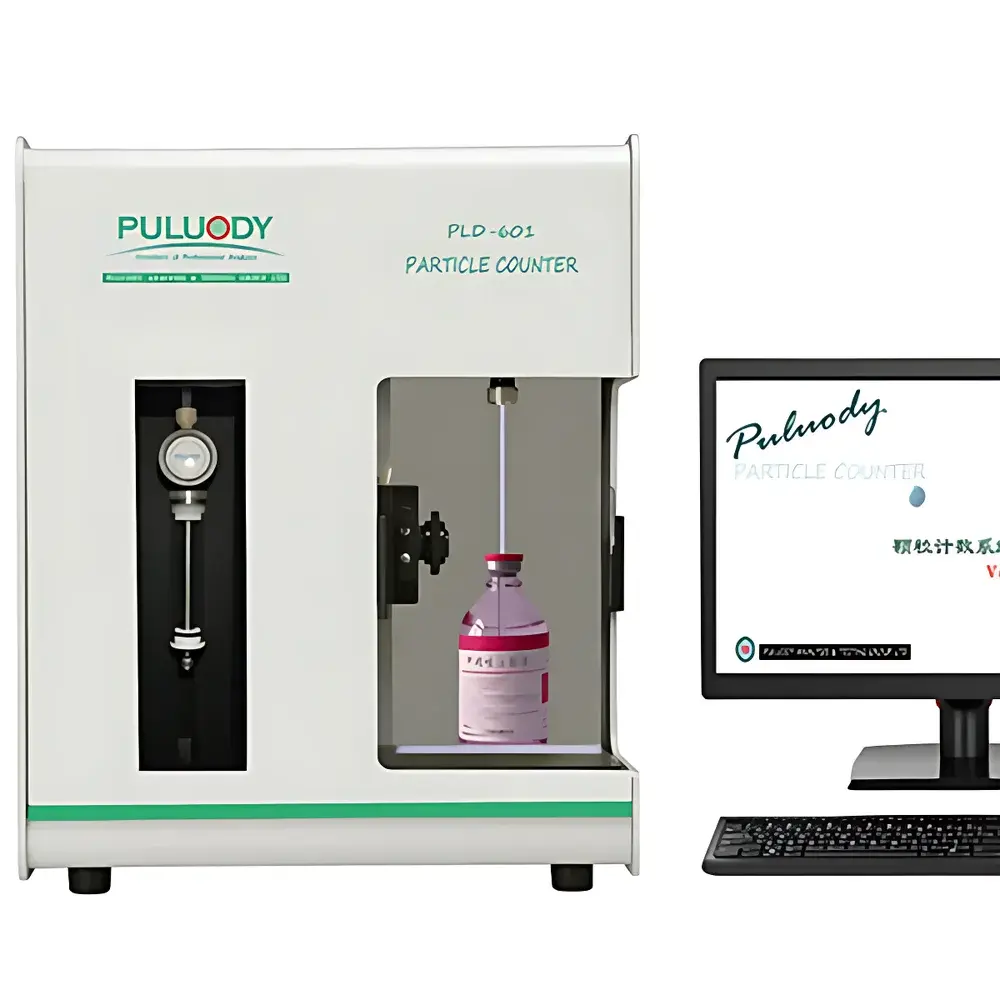
PULUODY PLD-601M Intravenous Infusion Insoluble Particle Analyzer
| Brand | PULUODY |
|---|---|
| Origin | Shaanxi, China |
| Manufacturer Type | Authorized Distributor |
| Product Category | Domestic |
| Model | PLD-601M |
| Instrument Type | Optical Particle Counter |
| Sensor | 8th-Generation Dual-Laser Narrow-Beam Particle Detection Sensor |
| Software | V8.9 Integrated Analysis & PC Software |
| Detection Principle | Light Obscuration (LO) / Single-Particle Optical Sizing (SPOS) |
| Calibration Standards | JJG1061, ISO 21501-4, USP <788>, EP 10.0, ChP 2020 <0903> |
| Measurement Range | 1–450 µm (customizable sub-ranges: 1–100 µm or 4–70 µm(c) |
| Sampling Flow Rate | 5–150 mL/min |
| Rinse Flow Rate | 5–500 mL/min |
| Sample Temperature Range | 0–80 °C |
| Ambient Operating Temperature | 0–50 °C |
| Accuracy | ±5% typical |
| Volume Precision | <±1% |
| Coincidence Limit | 1000 particles/mL (≤5% coincidence error) |
| Resolution | >95% (ChP 2015/2020 calibrated), <10% (USP/ISO 21501 calibrated) |
| Channel Count | 1000 user-definable channels (4/6/8/16/32/64/128 bin configurations supported) |
| Compliance | FDA 21 CFR Part 11 (audit trail, electronic signature, role-based 5-level access, data backup/recovery, power-fail protection), GLP/GMP-ready |
Overview
The PULUODY PLD-601M Intravenous Infusion Insoluble Particle Analyzer is a high-precision optical particle counter engineered for regulatory-compliant particulate contamination assessment in parenteral drug products and critical fluid systems. It operates on the light obscuration (LO) principle—also known as single-particle optical sizing (SPOS)—where particles suspended in a liquid stream pass through a focused laser beam, generating transient light-blocking pulses proportional to their cross-sectional area. Each pulse is digitized and classified into user-defined size channels, enabling quantitative determination of particle concentration per unit volume across 1000 discrete size bins from 1 µm to 450 µm. Designed specifically for pharmacopeial compliance, the instrument meets the stringent requirements of USP , , , EP 10.0, ChP 2020 , JP XVII, BP 2019, and WHO International Pharmacopoeia IV. Its dual-laser narrow-beam sensor architecture minimizes refractive index dependency and enhances signal-to-noise ratio, ensuring robust performance across diverse sample matrices—including low-conductivity ultrapure water, viscous concentrates, and protein-containing biologics.
Key Features
- 8th-generation dual-laser narrow-beam detection sensor with enhanced sensitivity and reduced optical noise
- Dual-flow precision control system: high-accuracy metering piston pump + ultra-stable electromagnetic flow regulation (±1% volumetric repeatability)
- 1000-channel size classification capability with customizable binning (4–128 user-defined ranges), supporting over 510 international standards
- FDA 21 CFR Part 11-compliant software suite (V8.9) featuring five-tier role-based access control, full audit trail, electronic signatures, automated data backup/recovery, and uninterruptible power loss protection
- Integrated touchscreen interface with bilingual (English/Chinese) operation and wireless keyboard/mouse support for flexible lab deployment
- Wide operational temperature range (0–80 °C sample; 0–50 °C ambient) and programmable flow rates (5–150 mL/min sampling; 5–500 mL/min rinse)
- Traceable calibration using NIST-traceable latex standards, ISO 21501-4 reference materials, or JJG1061-certified verification protocols
Sample Compatibility & Compliance
The PLD-601M is validated for direct analysis of pharmacopeially defined preparations including aqueous injectables, sterile powders for reconstitution, concentrated solutions, ophthalmic solutions, vaccines, Water for Injection (WFI), and pharmaceutical excipients. It supports evaluation of filtration efficiency for terminal sterilizing filters (e.g., 0.22 µm PVDF membranes) via pre- and post-filter particle counting, enabling quantitative calculation of particle removal efficiency (PRE) and log reduction values (LRV). The system complies with ISO 21510 (pharmaceutical particulate contamination), ISO 11171 (calibration standards), NAS 1638 and ISO 4406 (fluid cleanliness grading), and GJB/T 420A/B (military-grade fluid purity). All measurement outputs are fully traceable to national metrology institutes—including the National Institute of Metrology (NIM) Northwest Center and the Defense Science & Technology Commission Level-1 Particle Metrology Station (No. 116).
Software & Data Management
The V8.9 analysis platform provides comprehensive data lifecycle management aligned with GLP and GMP practices. Raw pulse data, channel histograms, cumulative distributions, and statistical summaries (mean, median, SD, CV%) are stored in encrypted, tamper-evident binary archives. The software enforces ALCOA+ principles: Attributable, Legible, Contemporaneous, Original, Accurate, Complete, Consistent, Enduring, and Available. Audit logs record every user action—including method edits, result approvals, and report exports—with timestamps and operator IDs. Electronic signatures conform to 21 CFR Part 11 Subpart B requirements. Export formats include CSV, PDF, XML, and LIMS-compatible ASTM E1382-compliant structured reports. Optional integration with enterprise LIMS or MES platforms is supported via OPC UA or RESTful API interfaces.
Applications
- Pharmaceutical QA/QC: Routine testing of injectables per USP , ChP , and EP 2.9.19; raw material release testing; container-closure integrity validation
- Medical device evaluation: Particulate shedding from IV sets, syringes, stoppers, and elastomeric closures per GB 8368 and YBB 00272004-2015
- Water system monitoring: WFI, purified water, and ultrapure water (UPW) qualification per ASTM D5127 and SEMI F63
- Semiconductor process fluids: CMP slurries, etchants, and photoresist carriers per SEMI C37 and ISO 14644-1 Class 5–8 cleanroom specifications
- Advanced materials R&D: Nanoparticle dispersion stability, inkjet ink fidelity, lubricant wear debris analysis, and catalyst slurry homogeneity assessment
- Food, cosmetics & personal care: Emulsion stability, preservative suspension uniformity, and microplastic screening in rinse-off formulations
FAQ
Does the PLD-601M comply with FDA 21 CFR Part 11 requirements for electronic records and signatures?
Yes—the V8.9 software implements full Part 11 functionality including role-based authentication, audit trail generation, electronic signature capture, and secure data archiving.
Can the instrument measure particles below 1 µm, such as submicron aggregates in monoclonal antibody formulations?
While the primary calibrated range begins at 1 µm, an optional 0.1 µm(c) mode is available for qualitative trend analysis; however, quantitative reporting below 1 µm requires orthogonal validation per ICH Q5A(R2) and USP Annex.
Is third-party metrological verification available for IQ/OQ/PQ protocols?
Yes—certified calibration and verification services are provided by the National Institute of Metrology (NIM) Northwest Center and the Defense科工委 Level-1 Particle Metrology Station (No. 116), with documented traceability to SI units.
How does the dual-laser sensor improve measurement robustness compared to single-beam systems?
Dual-laser alignment enables simultaneous signal validation, reducing false counts from bubble interference, refractive artifacts, or transient flow disturbances—critical for high-viscosity or protein-rich samples.
Can the system be integrated into an automated production line for real-time process monitoring?
Yes—via optional 4–20 mA analog output, Modbus TCP, or Ethernet/IP interfaces, the PLD-601M supports continuous in-line particle monitoring with configurable alarm thresholds and SCADA integration.



