
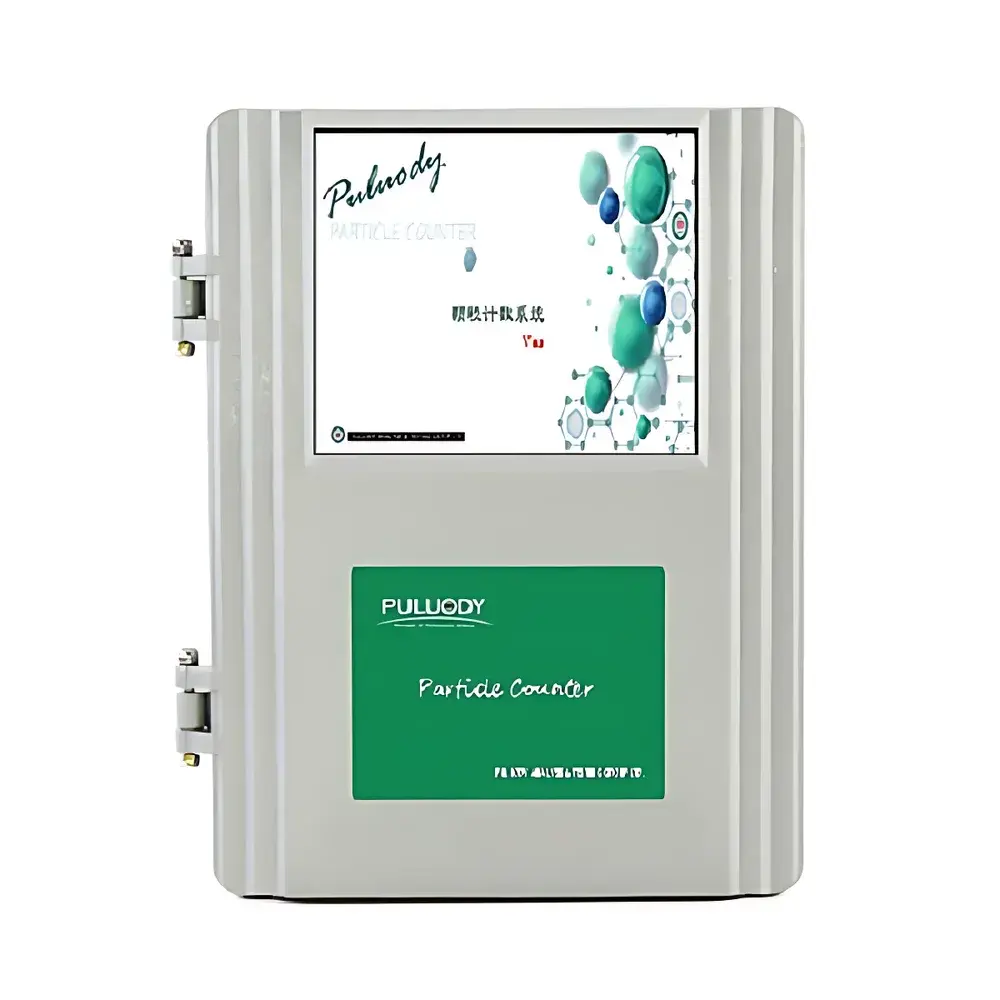
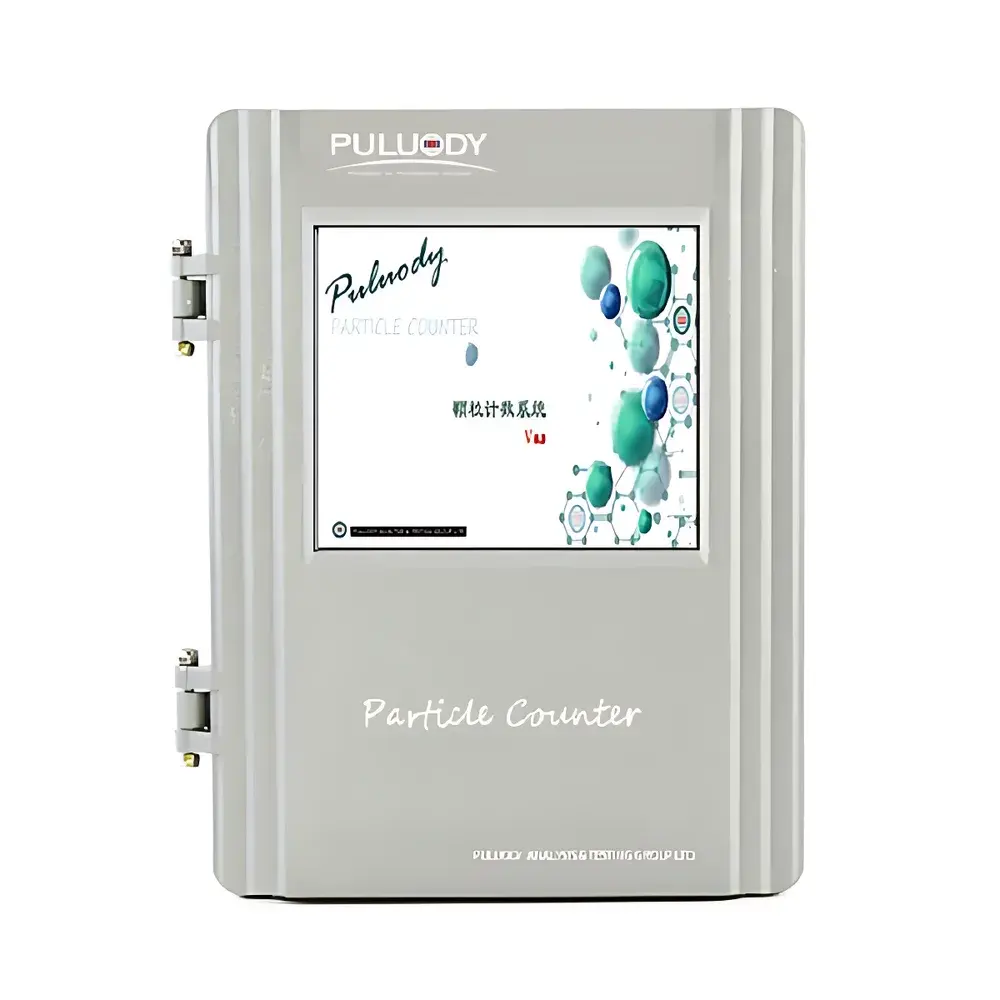
PULUODY OPC-0203 Online Liquid Particle Counter
| Brand | PULUODY |
|---|---|
| Origin | Shaanxi, China |
| Manufacturer Type | Authorized Distributor |
| Regional Classification | Domestic (China) |
| Model | OPC-0203 |
| Instrument Type | Optical Particle Counter |
| Detection Principle | Light Obscuration (LO) with Dual-Laser Narrow-Beam Technology |
| Sensor Range | 2–750 µm (configurable up to 1000 µm) |
| Size Channels | Up to 1000 user-defined bins (e.g., 8/16/32 standard channels) |
| Resolution | 0.1 µm |
| Accuracy | < ±3% typical |
| Counting Precision (Coincidence Error) | ≤5% at 999,999 particles/mL |
| Maximum Detectable Concentration | 9,999,999 particles/mL |
| Sampling Flow Rate | 6–500 mL/min |
| Operating Pressure | 0–0.6 MPa (standard), 0–31.5 MPa (with pressure-reducing valve) |
| Fluid Temperature Range | −10 °C to +80 °C |
| Output Interfaces | 4–20 mA analog, RS232/RS485 serial |
| Data Storage | Unlimited local logging |
| Alarm Functions | Particle count threshold, sensor health diagnostics |
| Power Supply | 9–30 VDC or 220 VAC |
| Compliance Basis | Configurable to ISO 11171, ISO 4406, NAS 1638, ASTM D6786, USP <788>, and customer-specified LO calibration protocols |
Overview
The PULUODY OPC-0203 Online Liquid Particle Counter is an industrial-grade optical particle counter engineered for continuous, real-time monitoring of suspended particulate contamination in aqueous process streams. It operates on the light obscuration (LO) principle—where particles passing through a focused dual-laser narrow-beam detection zone attenuate incident light proportionally to their cross-sectional area—enabling high-fidelity sizing and counting across a broad dynamic range. Developed under technical guidance from PULUODY Analytical Testing Group UK, the OPC-0203 implements the eighth-generation dual-laser optical architecture, delivering enhanced signal stability, reduced noise floor, and improved discrimination between adjacent size classes compared to conventional single-source LO sensors. Designed for unattended operation in critical water infrastructure and hygienic manufacturing environments, it supports fully automated sampling without manual intervention, enabling trend-based analysis of filtration performance, membrane integrity, and system wear progression.
Key Features
- Dual-laser narrow-beam optical sensor with configurable detection ranges (2–750 µm standard; optional extension to 1000 µm)
- Up to 1000 user-definable size channels—supporting standardized binning (e.g., ISO 4406, NAS 1638) or custom granulometric partitions (e.g., 1–100 µm, 2–250 µm)
- High-resolution sizing capability with 0.1 µm resolution and ≤10% differential resolution per ISO 21501-4
- Robust fluid handling design: operating pressure up to 31.5 MPa (with integrated pressure-reducing valve), temperature tolerance from −10 °C to +80 °C
- Flexible installation options: inline, bypass-loop, or portable offline configuration with dedicated sampling chamber
- Industrial-grade I/O: isolated 4–20 mA analog output, RS232/RS485 serial interface compliant with Modbus RTU protocol
- On-device LCD display with tactile membrane keypad—enabling local parameter configuration, real-time histogram visualization, and alarm acknowledgment
- Embedded data logging with unlimited storage capacity; timestamped particle count records exportable via USB or serial link
Sample Compatibility & Compliance
The OPC-0203 is validated for use with low-viscosity, optically transparent aqueous media including potable water, ultrapure water (UPW), process rinse water, beverage formulations, and filtered wastewater effluents. It complies with core international standards governing particle measurement in liquids, including ISO 11171 (calibration procedures), ISO 4406 (contamination code reporting), ASTM D6786 (particle counting in water), and USP (subvisible particle testing for pharmaceutical waters). Optional firmware modules allow direct mapping to regulatory reporting formats such as ISO 8573-4 (compressed air purity) or pharmacopeial grade classifications. All calibration traceability is maintained using NIST-traceable polystyrene latex (PSL) microspheres or Acetaldehyde (AC)-stabilized reference standards per ISO 21501-4 requirements.
Software & Data Management
The integrated firmware provides embedded control logic for scheduled sampling intervals (5 seconds to 9 hours), programmable alarm thresholds per size channel, and automatic diagnostic self-checks—including laser power monitoring, photodetector linearity verification, and flow-rate validation. Data are stored with full audit trail metadata (date/time stamp, operator ID if network-authenticated, instrument serial number, calibration status). Optional PC-based software supports advanced post-processing: cumulative/differential distribution plots, time-series trending, statistical process control (SPC) charting, and automated report generation compliant with FDA 21 CFR Part 11 requirements (when deployed with electronic signature and audit log modules). Export formats include CSV, PDF, and XML for integration into LIMS or MES platforms.
Applications
- Real-time integrity monitoring of ultrafiltration (UF), nanofiltration (NF), and reverse osmosis (RO) membranes in municipal and industrial water treatment plants
- Validation of final rinse water quality in semiconductor wafer cleaning lines and biopharmaceutical equipment CIP/SIP cycles
- Continuous assessment of filter efficiency and breakthrough events in beverage bottling and dairy processing lines
- Early detection of microbial agglomerates or biofilm shedding in recirculating cooling systems and HVAC condensate loops
- Quantitative evaluation of sediment resuspension dynamics during backwash cycles in rapid sand filters
- Supporting GLP/GMP-compliant water system qualification (IQ/OQ/PQ) and routine surveillance per EU Annex 1 and WHO TRS 970
FAQ
What calibration standards are supported?
The OPC-0203 accepts NIST-traceable PSL spheres, AC-stabilized reference particles, and MTD (Modified Tungsten Dust) standards per ISO 11171. Calibration protocols are configurable to match application-specific requirements.
Can the device operate under high-pressure conditions?
Yes—standard configuration supports up to 0.6 MPa; with optional pressure-reducing valve assembly, operational pressure extends to 31.5 MPa, suitable for high-pressure boiler feedwater or hydraulic fluid monitoring applications.
Is the instrument compliant with FDA 21 CFR Part 11?
When deployed with optional secure authentication, electronic signatures, and immutable audit logs, the system meets foundational requirements for electronic records and signatures in regulated environments.
How is particle size distribution reported?
Results are reported as particles per milliliter across user-defined size bins, with optional conversion to ISO 4406 or NAS 1638 contamination codes. Differential and cumulative histograms are available in real time and archived data exports.
What maintenance is required?
Routine maintenance includes quarterly optical window inspection, annual laser power verification, and periodic recalibration using certified reference materials—no consumables or reagents are required.



