
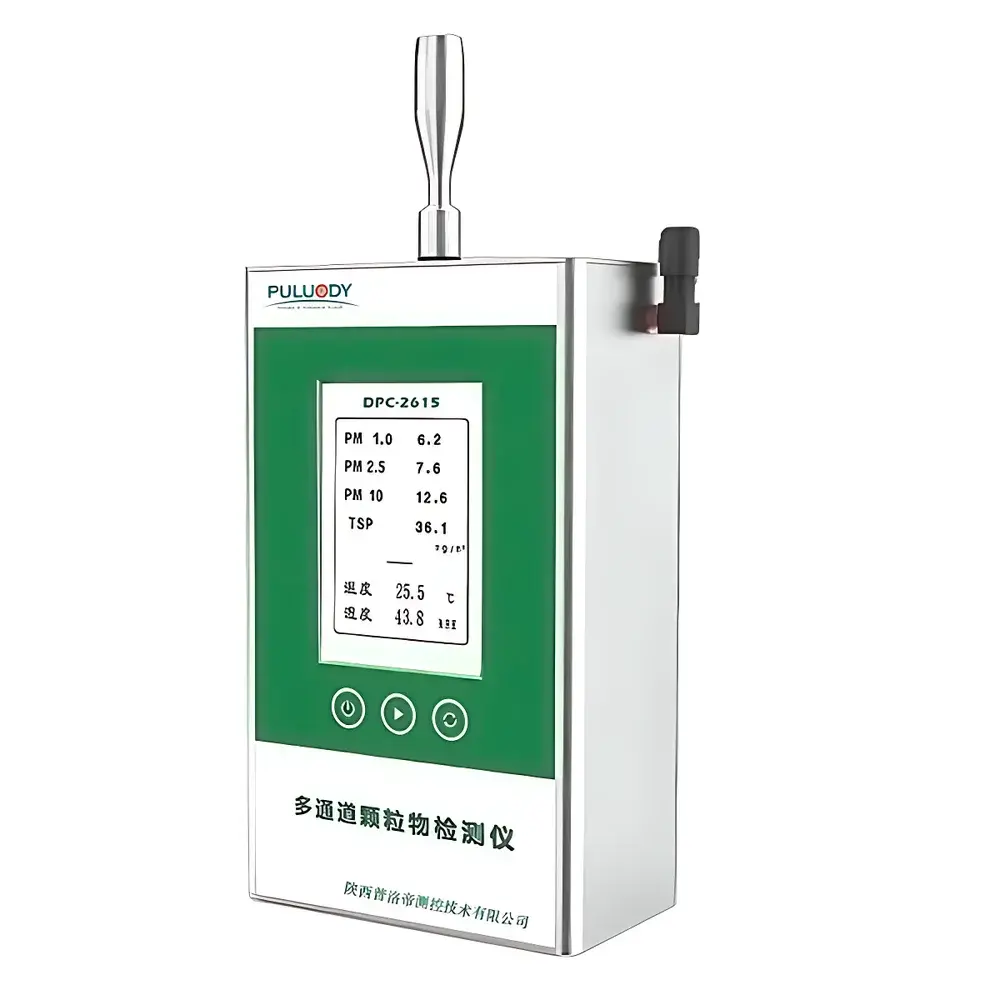
PULUODY DPC-2615A Handheld Optical Particle Counter
| Brand | PULUODY |
|---|---|
| Model | DPC-2615A |
| Instrument Type | Handheld |
| Flow Rate | 1 L/min |
| Flow Accuracy | ≤±5% |
| Timing Error | ≤±1 s |
| Repeatability | ≤±5% |
| Size Distribution Error | ≤±5% |
| Indication Error | ≤±5% |
| PM1.0 Accuracy | ±9.5% or ±7.5 µg/m³ |
| TSP Accuracy | ±15% or ±25 µg/m³ |
| Operating Temperature | −20–60 °C |
| Relative Humidity Range | 0–99% RH |
| Atmospheric Pressure Range | 86–110 kPa |
| Response Time | 1 s |
| Data Storage Capacity | ≥7,000,000 records |
| Battery Life | ≥4 h (25 °C, 50% RH) |
| Laser Source | IEC 60825-1 Class 2 |
| Compliance Standards | HJ 1263–2022, WS/T 206–2001, LD 98–1996, GB/T 45795–2025, AQ/T 4268–2015 |
Overview
The PULUODY DPC-2615A Handheld Optical Particle Counter is a battery-powered, field-deployable instrument engineered for real-time measurement of airborne particulate mass concentrations using calibrated optical scattering principles. It operates on the Mie scattering theory, where a stable Class 2 laser (IEC 60825-1 compliant) illuminates aerosol particles drawn through a precisely controlled laminar flow path. Scattered light intensity is detected and converted into quantitative mass concentration values for four standardized size fractions: PM1.0, PM2.5, PM10, and TSP (Total Suspended Particulates). Designed for environmental monitoring, occupational hygiene, indoor air quality assessment, and rapid site surveys, the DPC-2615A delivers traceable, repeatable data under variable ambient conditions — including wide temperature (−20 to 60 °C) and humidity (0–99% RH) ranges. Its compact form factor (175 × 105 × 65 mm), lightweight construction (0.89 kg), and integrated high-capacity lithium battery support extended unattended operation (>4 hours at 25 °C, 50% RH), making it suitable for mobile deployment across urban, industrial, and remote locations.
Key Features
- Optical detection system with Class 2 laser source (≥3-year operational lifetime, maintenance-free)
- Constant-flow sampling at 1.0 L/min with flow control accuracy ≤±5%
- Simultaneous real-time output of PM1.0, PM2.5, PM10, and TSP mass concentrations (0–10 mg/m³ full scale; extendable to 100 mg/m³)
- High-resolution 3.5-inch capacitive touchscreen interface with intuitive navigation and on-device data visualization
- Onboard memory capacity ≥7,000,000 records with timestamped logging and USB 2.0 export capability
- NIST-traceable calibration using certified reference aerosols (e.g., PSL, Arizona Test Dust)
- Optional desiccant-based humidity compensation module to minimize water vapor interference in high-RH environments
- Ruggedized housing rated for field use, with operating pressure range 86–110 kPa and IP54-rated ingress protection
Sample Compatibility & Compliance
The DPC-2615A is validated for ambient air, indoor air, workplace atmospheres, and filtered exhaust streams. It complies with multiple national and industry-specific standards governing optical particle measurement methodology and data integrity, including HJ 1263–2022 (TSP gravimetric reference correlation), WS/T 206–2001 (PM10 optical method for public spaces), LD 98–1996 (industrial dust monitoring), GB/T 45795–2025 (PM2.5/PM10 observational protocols), and AQ/T 4268–2015 (occupational rapid screening). While not certified for regulatory compliance reporting per EPA Method PS-11 or ISO 21501-4, its performance characteristics align with GLP-aligned field verification requirements. All calibrations are documented with traceability to NIST SRM 1963 and SRM 2877, supporting audit-ready QA/QC workflows.
Software & Data Management
Data acquisition and post-processing are supported via proprietary Windows-compatible desktop software accessible through USB 2.0 interface. The software enables batch download, time-series plotting, statistical summary (mean, min/max, standard deviation), and customizable report generation (PDF/CSV). Raw data files include embedded metadata: instrument ID, operator tag, GPS coordinates (if external module connected), ambient T/RH/pressure, and calibration history. Audit trail functionality logs all user-initiated configuration changes and data exports. For integration into centralized environmental monitoring platforms, optional 4G LTE telemetry firmware supports secure MQTT-based transmission with TLS 1.2 encryption and configurable upload intervals (1 min to 24 h).
Applications
- Ambient air quality monitoring during construction, demolition, or road resurfacing activities
- Indoor air quality assessments in schools, hospitals, offices, and cleanrooms
- Occupational exposure evaluation in mining, foundries, pharmaceutical manufacturing, and woodworking facilities
- Source identification and fugitive emission mapping via walk-through surveys
- Validation of HVAC filtration efficiency and duct leakage testing
- Emergency response screening following fire, flood, or hazardous material incidents
- Educational field studies and citizen science air quality initiatives
FAQ
What particle size channels does the DPC-2615A measure?
It reports mass concentrations for PM1.0, PM2.5, PM10, and TSP, derived from multi-angle scattering signal inversion calibrated against reference aerosols.
Is the instrument suitable for outdoor use in extreme temperatures?
Yes — it is specified for continuous operation between −20 °C and +60 °C, with internal thermal compensation to maintain optical alignment and flow stability.
How is calibration traceability ensured?
Each unit ships with a calibration certificate referencing NIST-traceable PSL and ISO-standard test dusts; field recalibration kits and certified reference generators are available upon request.
Can data be exported in machine-readable formats?
Yes — CSV and XML export options are supported, including full metadata headers compatible with EPA AirData, ENVIRO, and custom LIMS integrations.
Does the device meet FDA 21 CFR Part 11 requirements?
While the DPC-2615A itself is not Part 11–certified, its desktop software supports electronic signatures, audit trails, and role-based access control when deployed in validated GxP environments under site-specific SOPs.
Related Products







