
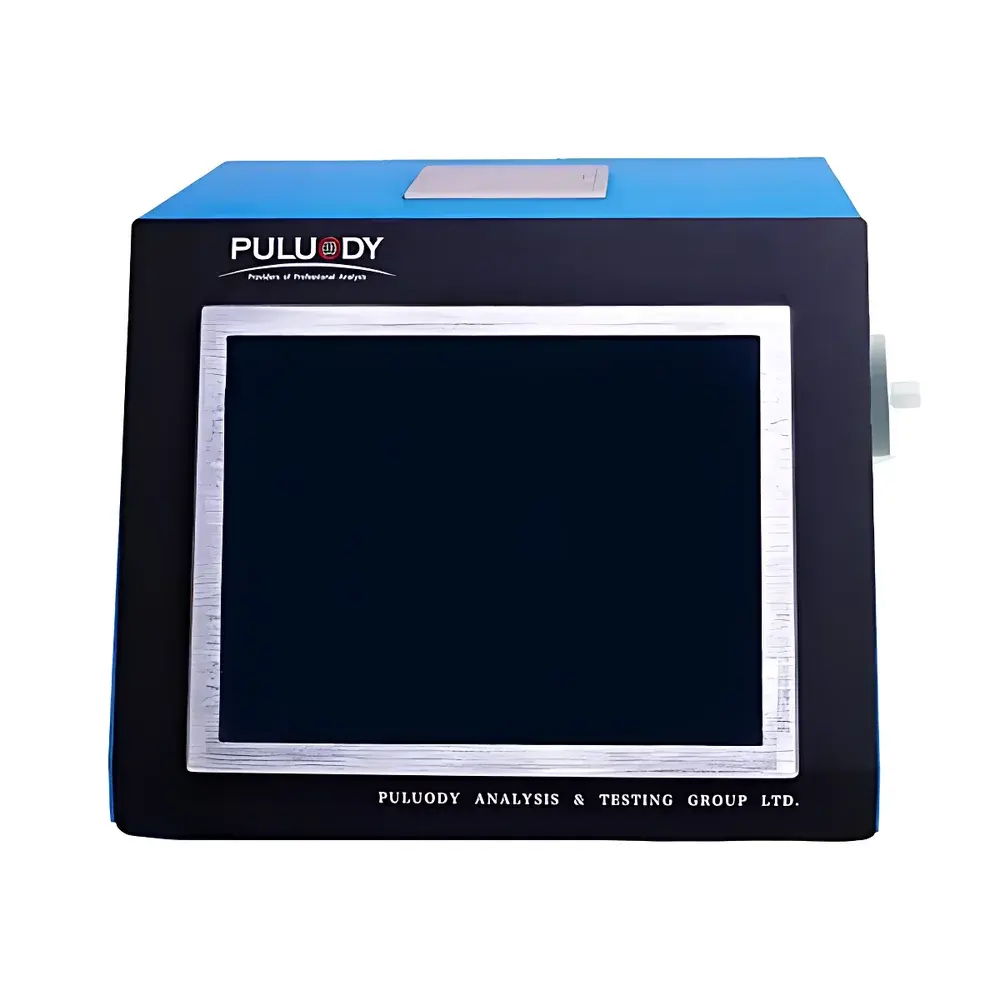
PULUODY PDM-301A Benchtop Digital Oscillating U-Tube Densimeter
| Brand | PULUODY |
|---|---|
| Origin | Shaanxi, China |
| Model | PDM-301A |
| Instrument Type | Laboratory Benchtop Digital Densimeter |
| Measurement Principle | Oscillating U-Tube Method |
| Sample Type | Liquids Only |
| Density Range | 0.0000–3.0000 g/cm³ |
| Density Resolution | ±0.0001 g/cm³ |
| Density Repeatability | ±0.0002 g/cm³ |
| Temperature Control Range | 15–30 °C |
| Temperature Stability | ±0.1 °C |
| Minimum Sample Volume | 10 mL |
| Compliance | ASTM D4052, ASTM D5002, ASTM D3505, ISO 12185, GB/T 29617, GB/T 2013, SH/T 0604, SN/T 2383, DB/T 1231, JJG 1058 |
Overview
The PULUODY PDM-301A is a high-precision benchtop digital densimeter engineered for accurate, rapid, and operator-independent density determination of homogeneous liquid samples. It operates on the oscillating U-tube principle: a precisely machined dual-U-shaped glass tube is electromagnetically excited into resonant vibration; the natural frequency of oscillation shifts predictably with the mass inertia of the sample filling the tube. This frequency shift is directly correlated to the sample’s density via a calibrated physical model rooted in fluid mechanics and harmonic resonance theory. The instrument integrates a thermally stabilized measurement cell, high-stability temperature sensing (±0.1 °C), and real-time microprocessor-based signal processing—enabling direct digital output of density (g/cm³), relative density (d20/20), and API gravity without manual interpolation or correction tables. Designed for routine laboratory use, it eliminates subjective visual reading errors inherent in hydrometers and avoids thermal drift issues common in pycnometers.
Key Features
- Integrated Peltier-based thermostatic control system with high-resolution Pt100 temperature sensor embedded directly in the oscillation cell—ensuring thermal equilibrium and minimizing axial gradients.
- Dual-U-tube quartz sensor architecture optimized for mechanical robustness, long-term stability, and resistance to chemical corrosion from organic solvents, petroleum fractions, and aqueous electrolytes.
- Microcontroller-driven frequency acquisition with 24-bit ADC resolution and floating-point arithmetic engine—preserving numerical integrity during density calculation and eliminating truncation error.
- LCD display with dual-window readout: primary density value (to 0.0001 g/cm³) and simultaneous real-time bath temperature (°C).
- Automated fluid handling module with peristaltic pump and integrated rinse cycle—reducing carryover risk and enabling unattended sequential analysis of up to 20,000 measurement records.
- Compact footprint (206 × 205 × 200 mm) and low power consumption (220 V ±10%, 50 Hz)—suitable for fume hoods, QC benches, and shared instrumentation labs.
Sample Compatibility & Compliance
The PDM-301A is validated for Newtonian and near-Newtonian liquids within viscosity limits typical of fuels, lubricants, alcohols, acids, bases, and pharmaceutical excipients (<500 mPa·s at measurement temperature). It is not intended for suspensions, emulsions, or highly viscous polymers requiring shear-rate-dependent characterization. All measurements adhere to internationally recognized standard methods including ASTM D4052-11 (density, relative density, and API gravity), ASTM D5002-13 (crude oil), ISO 12185:1996 (oscillating U-tube method), and Chinese national standards GB/T 29617–2013 and GB/T 2013–2010. The device supports GLP-compliant operation through timestamped data logging, user-accessible calibration history, and audit-ready measurement traceability—fully compatible with 21 CFR Part 11–enabled LIMS integration when paired with optional secure software modules.
Software & Data Management
The instrument stores ≥20,000 complete measurement records internally—including density, temperature, date/time stamp, operator ID (if enabled), and pass/fail status against user-defined tolerance bands. Export is supported via USB interface in CSV format for post-processing in Excel, MATLAB, or statistical process control (SPC) platforms. Optional PC software provides advanced features: multi-point calibration curve management, concentration conversion tables (e.g., ethanol/water, H₂SO₄/H₂O, NaCl/H₂O), batch report generation compliant with ISO/IEC 17025 documentation requirements, and automated deviation alerts based on ICH Q2(R2) precision thresholds. All software modules undergo functional verification per IQ/OQ protocols and maintain full revision control for regulated environments.
Applications
The PDM-301A serves as a primary density reference tool across diverse industrial and academic domains. In petrochemical QA/QC labs, it verifies fuel blending accuracy, monitors crude assay consistency, and validates distillation cut specifications. In pharmaceutical manufacturing, it supports USP density testing for liquid dosage forms, excipient qualification, and cleaning validation of solvent recovery systems. Food & beverage applications include alcohol content estimation in spirits (via density–ethanol correlation), sugar concentration in syrups (Brix conversion), and quality control of edible oils and vinegar blends. Additional use cases span electroplating bath monitoring (acid/metal salt concentration), semiconductor wet process chemistry (developer/stripper density tracking), and academic research in colloid science, solution thermodynamics, and polymer solution behavior.
FAQ
What is the minimum required sample volume for a valid measurement?
A minimum of 10 mL is required to fully fill the U-tube sensor and ensure stable thermal equilibration.
Does the instrument require daily recalibration?
No—factory calibration with certified reference standards (e.g., air and water at 20 °C) remains stable for ≥6 months under normal lab conditions; annual verification per JJG 1058–2010 is recommended.
Can it measure corrosive or volatile samples safely?
Yes—the quartz U-tube and PTFE-wetted fluid path resist attack from most mineral acids, halogenated solvents, and hydrocarbons; volatile samples must be introduced at ambient pressure with closed-loop purge capability (optional accessory).
Is temperature compensation applied automatically during analysis?
Yes—density values are reported at the measured cell temperature; optional software modules can apply standardized corrections to 15 °C, 20 °C, or 60 °F per ASTM or IP conventions.
How is compliance with FDA 21 CFR Part 11 ensured?
When used with validated PULUODY SecureLink software, the system provides electronic signatures, audit trails, role-based access control, and immutable record archiving—meeting all technical and procedural requirements for regulated GxP environments.



