
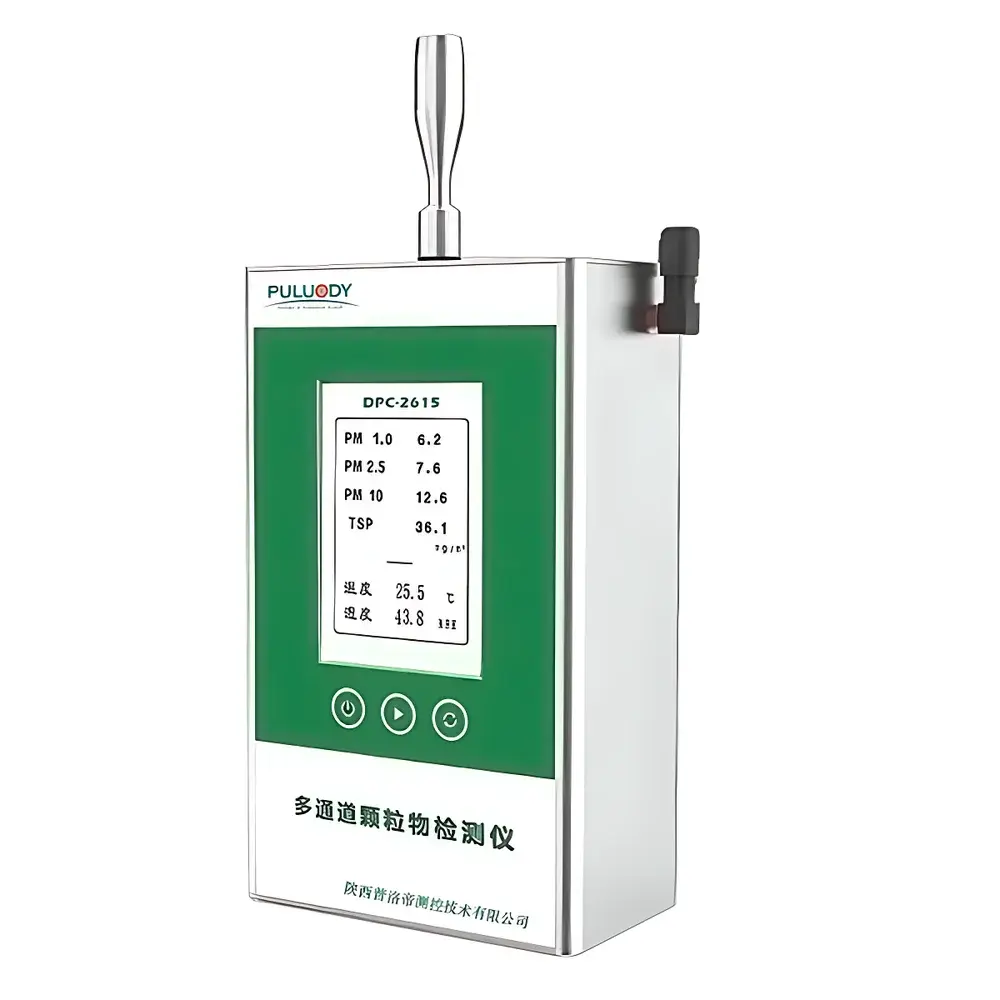
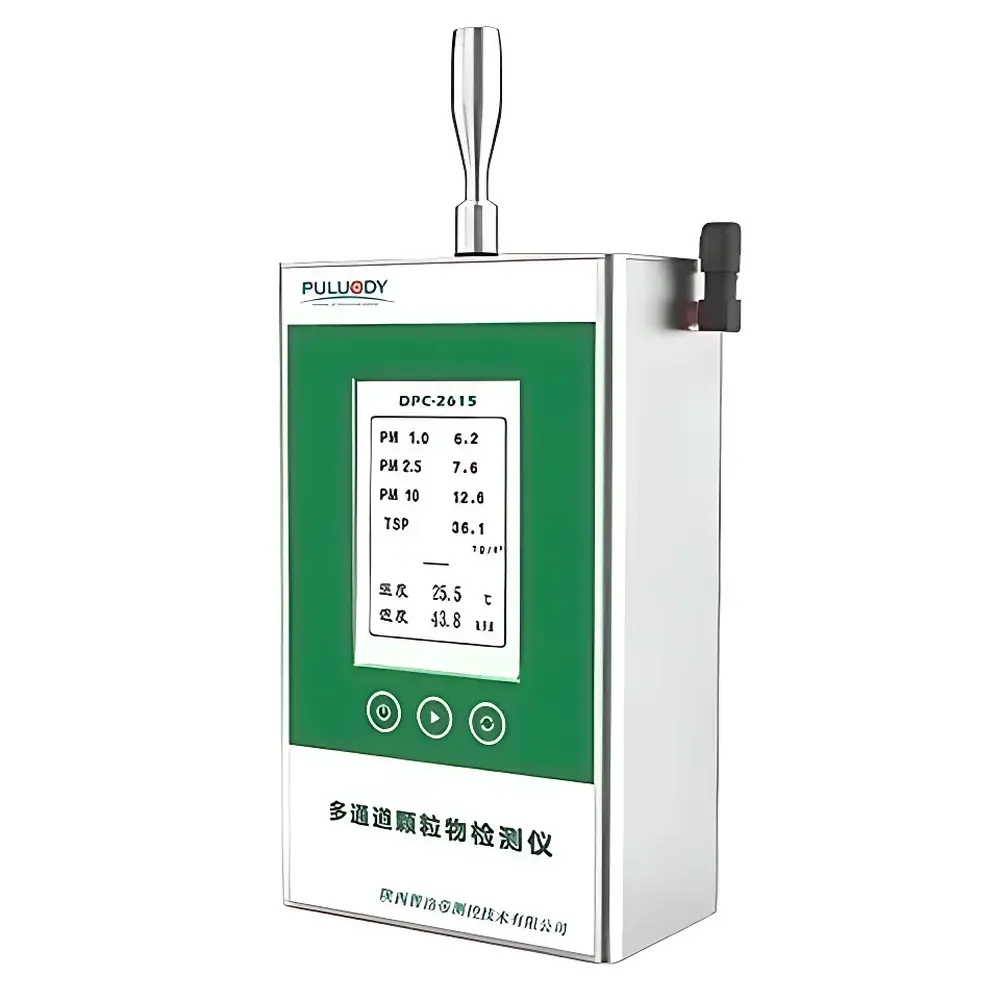
PULUODY DPC-2615 Handheld Optical Particle Counter for Ambient Air PM Monitoring
| Brand | PULUODY |
|---|---|
| Model | DPC-2615 |
| Instrument Type | Handheld |
| Flow Rate | 1.0 L/min |
| Flow Accuracy | ≤ ±5% |
| Timing Accuracy | ≤ ±1 s |
| Repeatability | ≤ ±5% |
| Size Distribution Accuracy | ≤ ±5% |
| Indication Error | ≤ ±5% |
| PM Measurement Channels | PM1.0, PM2.5, PM10, TSP |
| Mass Concentration Range | 0–10 mg/m³ (extendable to 100 mg/m³) |
| Laser Source | IEC 60825-1 Class 2 |
| Response Time | 1 s |
| Data Storage Capacity | ≥ 7,000,000 records |
| Battery Life | ≥ 4.5 h @ 25°C, 50% RH |
| Operating Temperature | −20 to +60°C |
| Relative Humidity Range | 0–99% RH |
| Atmospheric Pressure Range | 86–110 kPa |
| Power Input | DC 16.8 V / 1 A |
| Rated Power | 4.1 W |
| Display | 3.5-inch touchscreen |
| Dimensions | 175 × 105 × 65 mm |
| Weight | 0.89 kg |
| Calibration Traceability | NIST-traceable standard particles |
| Compliance Standards | HJ 1263–2022, WS/T 206–2001, LD 98–1996, GB/T 45795–2025, AQ/T 4268–2015 |
Overview
The PULUODY DPC-2615 Handheld Optical Particle Counter is a portable, battery-powered environmental monitoring instrument engineered for real-time, on-site quantification of airborne particulate mass concentrations using the principle of laser light scattering. It operates on Mie scattering theory, where incident monochromatic laser light (IEC 60825-1 Class 2 compliant) interacts with suspended particles in sampled air, generating scattered intensity signals proportional to particle size and concentration. These signals are processed through multi-channel pulse-height analysis to resolve simultaneous mass concentration outputs for PM1.0, PM2.5, PM10, and total suspended particulates (TSP), reported in µg/m³ or mg/m³. Designed for field-deployable use in ambient air quality assessment, occupational hygiene surveys, indoor air quality (IAQ) audits, and emergency response scenarios, the DPC-2615 integrates optical sensing, precision volumetric sampling, and embedded data management within a ruggedized handheld form factor.
Key Features
- Real-time, single-second response time for dynamic particulate events — optimized for transient exposure assessment and rapid site screening.
- Constant-flow sampling at 1.0 L/min, actively stabilized via integrated mass flow control to ensure metrological consistency across variable backpressure conditions.
- High-capacity onboard memory storing ≥7 million timestamped measurement records, including full channel-specific PM values, environmental metadata (temperature, RH, pressure), and operational logs.
- NIST-traceable calibration using certified polydisperse aerosol standards, supporting audit-ready traceability per ISO/IEC 17025 requirements for field instruments used in regulatory contexts.
- Optional desiccant-based humidity compensation module mitigates hygroscopic growth artifacts in high-RH environments, improving accuracy for PM2.5 and PM10 under humid conditions.
- 3.5-inch capacitive touchscreen interface with intuitive icon-driven navigation, enabling operation without external peripherals in glove-compatible field conditions.
- Integrated rechargeable lithium-ion battery (14.8 V / 1.5 Ah) delivering ≥4.5 hours of continuous operation under nominal environmental conditions (25°C, 50% RH).
Sample Compatibility & Compliance
The DPC-2615 is validated for direct aspiration of ambient, indoor, and workplace air without pre-separation or filtration. Its optical detection system is insensitive to non-spherical or irregularly shaped particles common in construction dust, biomass combustion aerosols, and industrial process emissions. The device complies with multiple national and industry-specific standards governing optical particle measurement, including HJ 1263–2022 (TSP gravimetric reference correlation), GB/T 45795–2025 (PM10/PM2.5 optical method validation protocols), and AQ/T 4268–2015 (workplace dust rapid assessment). While not a primary reference method, its performance characteristics meet the data quality objectives outlined in EPA OAQPS guidance for supplemental monitoring and trend analysis. All firmware and calibration procedures support GLP-aligned documentation practices, including user-accessible calibration history and sensor health diagnostics.
Software & Data Management
Data retrieval and post-processing are supported via USB 2.0 interface using PULUODY’s proprietary PC software suite, which provides time-series visualization, statistical summary (min/max/avg/std dev), geotagged reporting (when paired with optional GPS module), and export to CSV, Excel, or PDF formats. The software enforces structured metadata tagging (operator ID, location code, sampling duration) and maintains immutable audit trails for all configuration changes and calibration events. Though not natively 21 CFR Part 11 compliant, the system architecture supports integration into validated laboratory information management systems (LIMS) through standardized data exchange protocols. Firmware updates are delivered via signed binary packages with version-controlled release notes and backward-compatible configuration retention.
Applications
- Ambient air quality monitoring networks — deployment at temporary urban hotspots, traffic intersections, or near construction sites for short-term compliance verification.
- Indoor air quality assessments in schools, hospitals, and office buildings — identifying sources of elevated PM during HVAC commissioning or after renovation activities.
- Occupational exposure assessment per OSHA and NIOSH guidelines — real-time feedback during tasks involving grinding, sanding, or powder handling.
- Emergency response and disaster recovery — rapid characterization of airborne particulates following wildfires, structural collapses, or hazardous material releases.
- Educational and citizen science initiatives — field-based STEM instruction with immediate quantitative feedback and downloadable datasets for statistical analysis.
FAQ
What particle size ranges does the DPC-2615 resolve?
The instrument reports mass concentrations for four standardized aerodynamic diameter fractions: PM1.0 (≤1.0 µm), PM2.5 (≤2.5 µm), PM10 (≤10 µm), and TSP (total suspended particulates, nominally ≤100 µm), derived from calibrated optical scattering cross-sections.
Is the device suitable for regulatory reporting?
It is intended for indicative, supplemental, or investigative monitoring. For legally defensible compliance reporting, it should be deployed alongside or verified against reference-grade beta attenuation or gravimetric methods per local regulatory frameworks.
Can data be transmitted wirelessly?
Standard configuration includes USB 2.0; optional 4G LTE telemetry modules are available for remote data streaming and cloud synchronization under custom integration agreements.
How is humidity interference addressed?
An accessory desiccant cartridge can be installed upstream of the optical chamber to reduce water vapor-induced scattering artifacts, particularly critical when measuring fine particulates in environments exceeding 70% RH.
What maintenance is required?
The Class 2 laser source is sealed and maintenance-free for ≥3 years. Routine cleaning of the inlet nozzle and impactor plate is recommended after heavy-duty use; no optical alignment or recalibration is needed between NIST-traceable annual verifications.
Related Products







