
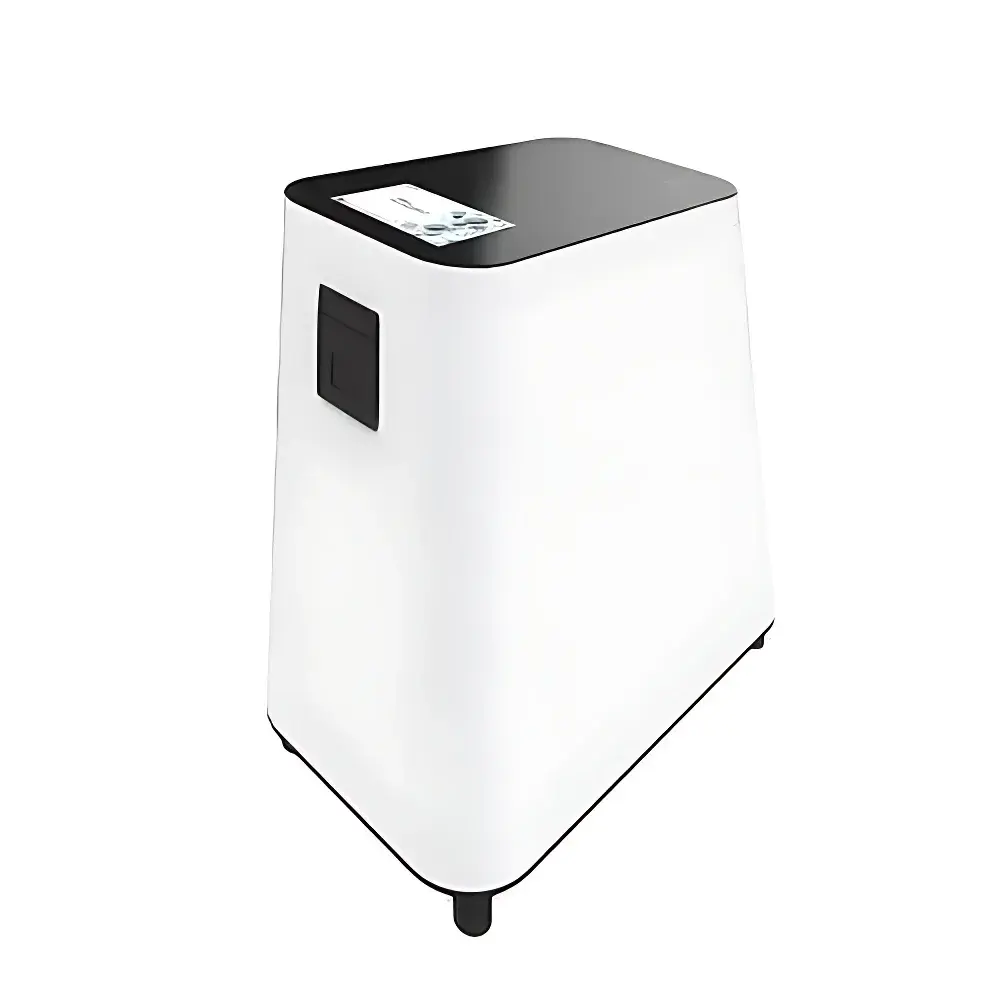
PULUODY TQ-01A Membrane-Based Online Degasser
| Brand | PULUODY |
|---|---|
| Origin | Shaanxi, China |
| Manufacturer Type | Authorized Distributor |
| Country of Origin | China |
| Model | PULUODY TQ-01A Membrane-Based Online Degasser |
| Price | USD 12,200 (FOB China) |
| Display | High-resolution LCD with capacitive touch interface |
| Heating Range | 35–42 °C (switchable to non-heating mode) |
| Volume Accuracy | ±1% (for volumes ≥2 L) |
| minimum dispensing volume | 100 mL |
| Flow Rate | 1.6 L/min |
| Degassed Dissolved Oxygen (DO) | 3.0–5.0 mg/L (upgradable to <2.8 mg/L) |
| Compatible Media pH Range | 1–14 (non-surfactant aqueous solutions only) |
| Pre-filter Options | 40 µm / 25 µm / 20 µm stainless steel mesh |
| Dimensions (L×H×W) | 500 mm × 340 mm × 295 mm |
| Rated Power | 1700 W |
| Temperature Stability | ±2 °C |
| Minimum Inlet Media Temperature | ≥18 °C |
| Enclosure Material | Corrosion-resistant anodized aluminum and food-grade polymer housing |
Overview
The PULUODY TQ-01A Membrane-Based Online Degasser is an engineered solution for continuous, high-efficiency dissolved oxygen (DO) removal from aqueous dissolution media used in pharmaceutical dissolution testing, analytical sample preparation, and quality control laboratories. Utilizing hydrophobic microporous membrane technology—principally gas-permeable polytetrafluoroethylene (PTFE) membranes—the system operates on the principle of vacuum-driven gas diffusion: dissolved oxygen migrates across the membrane under controlled negative pressure while the liquid phase remains physically separated. This non-boiling, non-chemical method preserves media integrity, avoids thermal degradation or volatile loss, and eliminates the need for inert gas sparging or sonication. Designed specifically for USP , , and Ph. Eur. 2.9.40-compliant dissolution workflows, the TQ-01A integrates seamlessly into automated dissolution stations (e.g., Hanson, Distek, Sotax), enabling real-time degassing prior to media delivery—thereby eliminating DO-induced variability in drug release kinetics and improving assay reproducibility.
Key Features
- Vacuum-assisted membrane degassing architecture ensures consistent DO reduction without introducing foreign gases or altering pH or ionic composition.
- Integrated pre-heating module (35–42 °C, ±2 °C stability) elevates media temperature prior to membrane contact—enhancing oxygen diffusivity and reducing required residence time within the degassing chamber.
- Precision volumetric dispensing with ±1% accuracy (≥2 L) and 0.1 L programmable resolution; supports single-step media transfer from reservoir to dissolution vessel with no intermediate storage.
- Modular stainless-steel inlet filtration (20/25/40 µm options) protects membrane integrity against particulate fouling—critical for long-term operation with distilled water, purified water, and buffered saline solutions (pH 1–14).
- Touch-enabled LCD interface with intuitive workflow navigation; full parameter logging (time-stamped temperature, flow rate, vacuum level, dispensed volume) stored locally for GLP audit readiness.
- Tool-free access to all serviceable components—including membrane cartridge, heater assembly, and filter housing—enabling routine maintenance by lab personnel without technical support intervention.
Sample Compatibility & Compliance
The TQ-01A is validated for use with USP-grade purified water, distilled water, and common dissolution media including 0.1 N HCl, phosphate buffers (pH 4.5–7.4), and acetate buffers—all within pH 1–14 range. It excludes surfactant-containing media (e.g., SDS solutions) due to potential membrane wetting and flux decline. The system conforms to ISO 9001 manufacturing controls and supports laboratory compliance with FDA 21 CFR Part 11 requirements when paired with PULUODY’s optional secure data export module (CSV with digital signature). Its DO output range (3.0–5.0 mg/L standard; <2.8 mg/L upgradeable) meets typical specifications for USP apparatus II dissolution testing where residual oxygen may interfere with redox-sensitive APIs or UV detection baselines.
Software & Data Management
Embedded firmware records operational parameters at 1-second intervals during each degassing cycle, including actual vs. setpoint temperature, vacuum pressure (kPa), real-time flow rate (mL/min), cumulative volume dispensed, and system fault codes. Data exports via USB-C to encrypted CSV files with ISO 8601 timestamps. Optional Ethernet connectivity enables integration into LIMS or MES platforms through Modbus TCP protocol. All user actions—including parameter changes, calibration events, and filter replacement logs—are captured with operator ID and timestamp, satisfying ALCOA+ principles for data integrity in GMP environments.
Applications
- Pharmaceutical dissolution testing per USP , , and ICH Q5C guidelines—ensuring low-DO media for accurate release profiling of immediate- and extended-release solid oral dosage forms.
- Preparation of oxygen-sensitive mobile phases for HPLC and UHPLC systems, particularly in reversed-phase methods involving phenolic or catechol analytes.
- Calibration standard preparation for dissolved oxygen meters and amperometric sensors requiring traceable, stable DO reference points.
- Cell culture media conditioning where residual O₂ impacts hypoxia studies or reactive oxygen species (ROS) assays.
- Electrochemical cell electrolyte conditioning in battery R&D labs handling aqueous Li-ion or Zn-based electrolytes.
FAQ
What types of dissolution media are compatible with the TQ-01A?
Purified water, distilled water, 0.1 N HCl, phosphate buffers (pH 4.5–7.4), citrate, and acetate buffers—provided they contain no surfactants and fall within pH 1–14.
Can the TQ-01A be integrated with third-party dissolution apparatus?
Yes—it features standardized 1/4″ OD fluidic ports and analog/digital I/O for synchronization with Hanson SR8-Plus, Distek 2500, and Sotax AT7 Smart systems via TTL or 4–20 mA signals.
Is validation documentation available for GMP audits?
IQ/OQ templates, DQ summary, and a certified test report (including DO performance verification per ASTM D8287-20) are provided with each unit.
How often must the membrane cartridge be replaced?
Under normal use with filtered media, the PTFE membrane cartridge requires replacement every 6–12 months; usage logs and pressure differential alerts notify users proactively.
Does ambient room temperature affect performance?
Yes—media inlet temperature must be ≥18 °C; units deployed in cold rooms (<18 °C) require optional ambient pre-warming sleeve or recirculation loop integration.



