
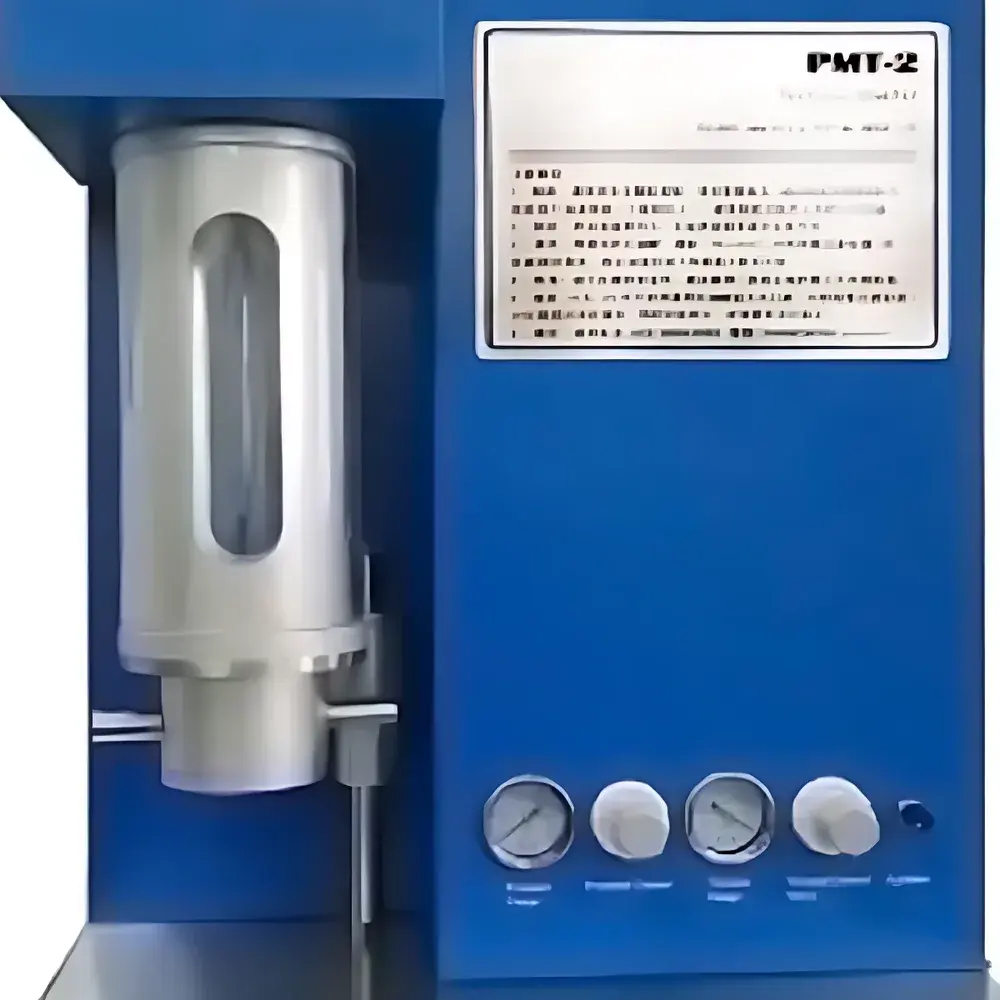

PULUODY PMT-2K Offline Photoresist Liquid Particle Counter
| Brand | PULUODY |
|---|---|
| Model | PMT-2K |
| Instrument Type | Optical Particle Counter |
| Detection Principle | Dual-Laser Narrow-Beam Light Scattering |
| Detection Range | 0.1–0.5 µm (standard), customizable 1–100 µm or 4–70 µm(c), down to 0.1 µm(c) |
| Sample Flow Control | Precision Piston Pump + Electromagnetic Flow Regulation |
| Accuracy | ±3% typical |
| Sampling Precision | <±1% |
| Coincidence Limit | 1000 particles/mL (2.5% coincidence error) |
| Calibration Standards | JJG 1061, ISO 21501-2, NIST-traceable latex spheres |
| Output | Particle count per mL & ISO 4406 / NAS 1638 contamination codes |
| Interface | 4–20 mA analog output,超标 alarm (customizable) |
| Power Input | 100–265 VAC, 50–60 Hz |
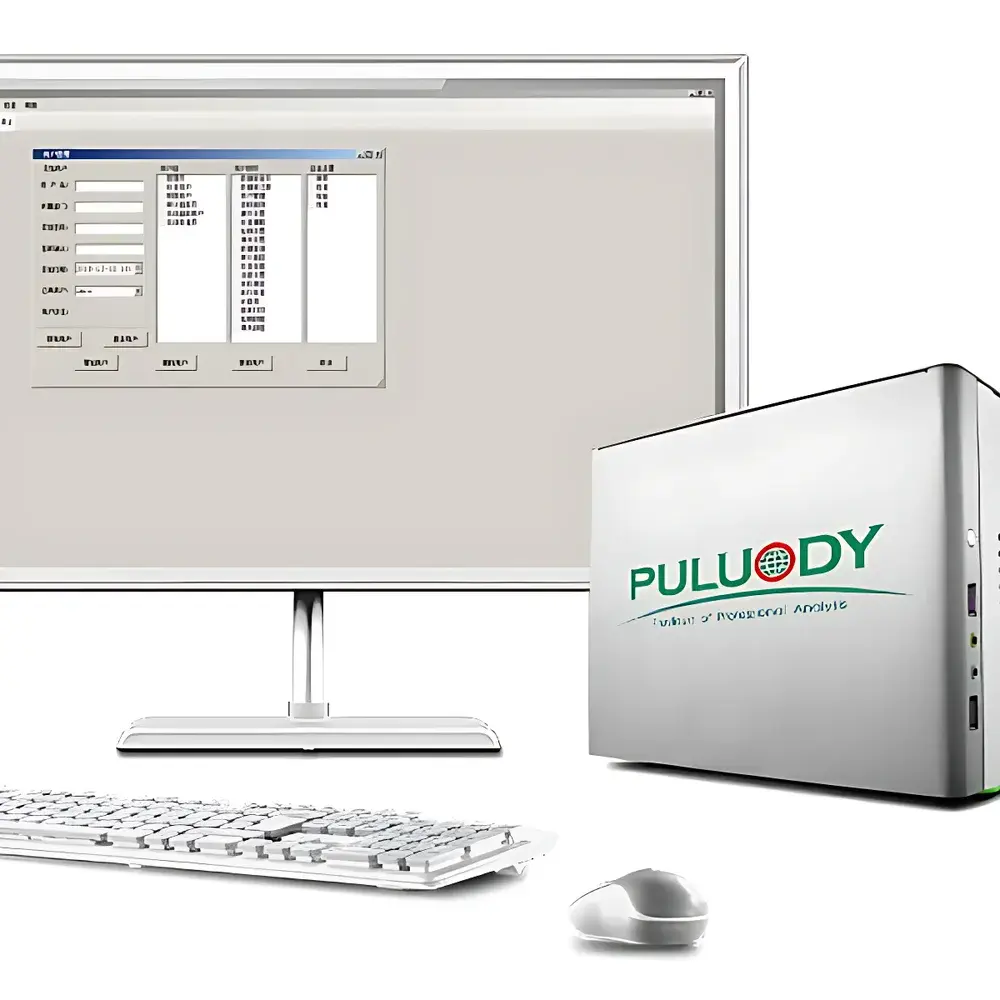
| Software | V8.3 Integrated Analysis & Calibration Software (PC & Touchscreen GUI) |
| Compliance | Designed for GLP/GMP environments |
Overview
The PULUODY PMT-2K Offline Photoresist Liquid Particle Counter is an engineered solution for high-sensitivity particulate contamination analysis in ultra-clean process liquids—specifically formulated for semiconductor photolithography applications. It operates on the principle of dual-laser narrow-beam light scattering, a detection methodology optimized to resolve sub-micron particles in low-conductivity, low-viscosity organic solvents such as photoresist carriers, developer solutions, and rinse chemistries. Unlike generic liquid particle counters designed for aqueous systems, the PMT-2K integrates fluidic architecture and optical calibration protocols tailored for non-aqueous media, minimizing refractive index mismatch artifacts and ensuring metrological integrity across critical size bands (0.1–0.5 µm). Its offline configuration enables controlled, repeatable sampling from batch vessels, filtration validation loops, or post-process storage tanks—supporting quality release testing, cleaning verification, and root-cause analysis of defect excursions in front-end semiconductor fabrication.
Key Features
- Dual-laser narrow-beam optical sensor (8th-generation design) with independent wavelength channels for improved signal-to-noise ratio and reduced Mie scattering bias in transparent organic liquids
- Precision piston pump coupled with electromagnetic flow regulation ensures volumetric accuracy better than ±1% and repeatability essential for ISO 4406 compliance reporting
- Configurable detection thresholds: standard 0.1–0.5 µm resolution with optional user-defined ranges (e.g., 4–70 µm(c) per ISO 21501-2 or 1–100 µm for polymer agglomerate screening)
- Integrated V8.3 analysis software supporting dual operational modes: standalone touchscreen interface (color LCD) and PC-hosted platform with full data export (CSV, PDF, XML), trend logging, and statistical process control (SPC) charting
- Analog 4–20 mA output with programmable alarm thresholds for integration into facility SCADA or MES systems—enabling automated contamination event escalation
- Designed for traceability: full calibration history logging, NIST-traceable latex sphere verification, and optional JJG 1061-compliant metrological validation documentation
Sample Compatibility & Compliance
The PMT-2K is validated for use with photoresists (including chemically amplified resists), developers (TMAH-based and organic), strippers, spin-coating solvents (PGMEA, EL, etc.), ultrapure water (UPW), and nanoparticle dispersions in low-dielectric-constant media. Its wetted path employs chemically inert materials (e.g., fused silica flow cell, PFA/PEEK tubing) resistant to aggressive solvents and trace metals. The instrument meets core requirements for cleanroom-compatible instrumentation per SEMI F20 and ISO 14644-1 Class 1–5 environments. When operated under documented procedures—including daily system suitability checks, scheduled recalibration, and electronic record retention—it supports adherence to ISO 9001, IATF 16949, and semiconductor-specific quality frameworks (e.g., JEDEC J-STD-020, SEMI C106). For regulated pharmaceutical or biotech applications involving organic solvents, the system may be qualified per ASTM E2457 and aligned with USP and guidance when configured with Part 11-compliant software modules.
Software & Data Management
The V8.3 software suite separates analytical measurement logic from calibration management—a deliberate architectural choice to prevent software-induced drift during routine operation. Each test session generates immutable metadata: timestamp, operator ID, sample ID, environmental conditions (optional external sensor input), raw pulse height distribution, and final concentration report (particles/mL and corresponding ISO 4406 code). Audit trails are time-stamped, tamper-evident, and exportable in encrypted formats compliant with FDA 21 CFR Part 11 Annex 11 expectations. Batch-level reporting includes pass/fail flags against user-defined limits, statistical summaries (mean, SD, CV%), and histogram overlays for longitudinal comparison. Data integrity is reinforced via role-based access control (RBAC), electronic signatures, and automatic backup to network drives or cloud repositories (AWS S3 or Azure Blob Storage, customer-configured).
Applications
- Photomask and wafer-level contamination monitoring: quantifying residual particles after develop/rinse steps and correlating counts with defect density on patterned wafers
- Filtration validation: measuring pre- and post-filter particle loadings to verify removal efficiency of 0.1 µm-rated membranes in resist recirculation loops
- Chemical supplier qualification: batch release testing of photoresist formulations per internal specifications or industry standards (e.g., SEMI C112)
- Cleaning process verification: tracking particle decay kinetics during megasonic or brush scrub cycles in front-end tool maintenance
- Nanoparticle dispersion stability assessment: monitoring agglomeration onset in colloidal suspensions used in advanced packaging or display manufacturing
- UPW loop surveillance: offline spot-checking of point-of-use purity where online sensors lack sufficient sensitivity below 0.2 µm
FAQ
Can the PMT-2K measure particles in undiluted photoresist?
Yes—the optical path and flow cell geometry are optimized for high-refractive-index organic solvents without mandatory dilution. However, viscosity-dependent flow rate adjustments and optional temperature stabilization (20–25°C) are recommended for optimal precision.
Is calibration traceable to international standards?
All factory calibrations use NIST-traceable polystyrene latex spheres certified per ISO 21501-2. On-site verification kits and third-party calibration services (via PULUODY-accredited labs) support ongoing traceability.
Does the system support automated reporting for ISO 4406 classification?
Yes—software automatically computes and displays ISO 4406:2021 codes (e.g., 14/12/10) based on cumulative counts in three size channels (≥4 µm, ≥6 µm, ≥14 µm), with configurable bin definitions.
What maintenance is required for long-term reliability?
Quarterly optical alignment verification, semi-annual pump seal replacement, and annual full-system performance qualification (PQ) using reference standards are recommended. Preventive maintenance logs are auto-generated within the software.
Can data be integrated into a central LIMS or MES?
Yes—via OPC UA or RESTful API (optional license), enabling bidirectional communication with LabVantage, Thermo Fisher SampleManager, or Siemens Opcenter Execution. Raw pulse data and summary reports are both exportable.



