
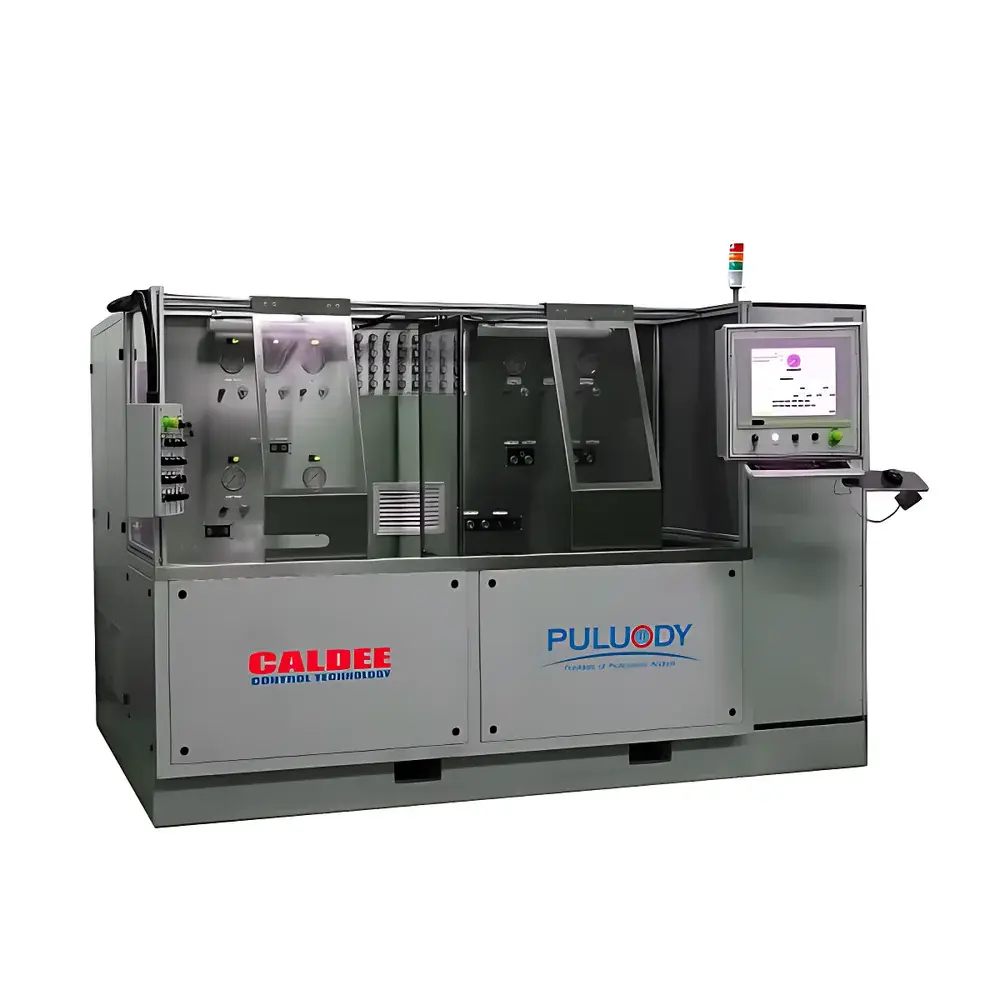
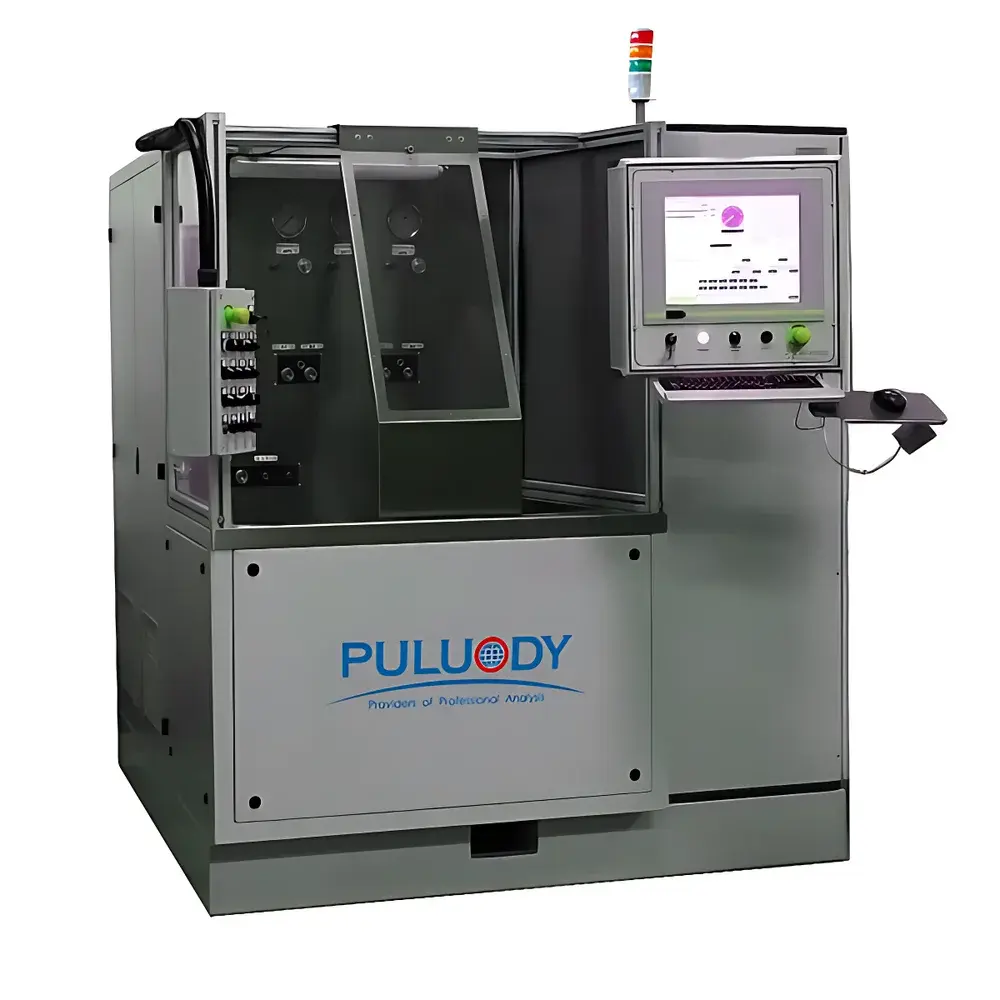
PULUODY CCACS1.0-01 Aviation Hydraulic Fluid Solid Contamination Control Station
| Brand | PULUODY |
|---|---|
| Origin | Shaanxi, China |
| Model | CCACS1.0-01 |
| Instrument Type | Optical Particle Counter |
| Detection Principle | Light Obscuration (LO) |
| Laser Sensor | 7th-Generation Dual-Laser Narrow-Beam Detector |
| Channel Count | 1000 adjustable channels |
| Size Range | 0.1 µm (c) to 100 µm |
| Resolution | >95% |
| Accuracy | ±3% typical |
| Coincidence Limit | 10,000 particles/mL (5% error) |
| Sample Flow Rate | 5–1500 mL/min |
| Viscosity Range | 0–99 mm²/s (offline), up to 500 mm²/s (pressurized) |
| Temperature Range | Fluid 0–80°C, Ambient −15–50°C |
| Calibration Standards | JJG 1061, ISO 21501-4, GB/T 11446.9, GJB 420B-2006, SAE AS4059F, MIL-STD-1246C, HB 6639/HB 6649, NAVAIR 01-1A-17 |
| Compliance | GLP/GMP-ready data integrity, 21 CFR Part 11-compatible audit trail (via optional software module) |
| Interface | RS232/RS485, USB, LAN, 4–20 mA analog output, MODBUS protocol |
Overview
The PULUODY CCACS1.0-01 Aviation Hydraulic Fluid Solid Contamination Control Station is a fully integrated, laboratory-grade optical particle counter engineered for precision monitoring, classification, and control of solid particulate contamination in aviation hydraulic fluids, fuel systems, lubricants, and ultra-pure process liquids. Based on the internationally recognized light obscuration (LO) principle—where particles passing through a focused laser beam generate transient reductions in detected light intensity—the system quantifies particle concentration and size distribution across 1000 programmable detection channels. Designed specifically to meet stringent aerospace fluid cleanliness requirements, it supports real-time compliance verification against GJB 420B-2006, SAE AS4059F, MIL-STD-1246C, HB 6639, and other military, civil aviation, and spaceflight standards. The station integrates four functional subsystems: a high-stability motive unit, a closed-loop cleaning circuit with precision metering pumps, a real-time monitoring sensor array, and a centralized control architecture—enabling automated self-cleaning cycles, dynamic parameter adjustment, and traceable contamination trending.
Key Features
- Seventh-generation dual-laser narrow-beam sensor with enhanced signal-to-noise ratio, delivering improved repeatability (<±3% typical) and reduced drift under continuous operation.
- 1000-channel resolution supporting customizable binning—from standard 4/6/8/16/32/64/128-bin configurations to user-defined ranges (e.g., 1–100 µm or 4–70 µm(c)), including sub-micron capability down to 0.1 µm(c).
- Integrated industrial control platform co-developed with Advantech, featuring ruggedized军工-grade embedded PC architecture, color LCD touchscreen interface, and redundant power management.
- Full compliance with international calibration protocols: traceable calibration using NIST-traceable polystyrene latex (PSL) spheres per JJG 1061; optional certification from National Defense Science & Technology Commission’s Level-1 Particle Metrology Station (No. 116) or Xi’an Zhongte Institute of Metrology.
- Modular software architecture (CCACS1.0 Analysis Suite) with validated modules for pre-filtration, fine filtration, final rinse, particle detection, system calibration, and performance validation—all operating under configurable SOP-driven workflows.
- Multi-standard support engine enabling on-the-fly switching between Chinese national/military standards (GJB, HB, QJ), U.S. DoD specifications (MIL-STD, NAVAIR), European aerospace norms (SAE, ROCT), and semiconductor-grade water testing (GB/T 11446.9).
Sample Compatibility & Compliance
The CCACS1.0-01 accommodates a broad range of aviation-related fluids—including MIL-PRF-5606, MIL-PRF-83282, MIL-PRF-87257, JP-5, JP-8, and synthetic ester-based hydraulic media—as well as purified water (Type I/II/III per ASTM D1193), cleaning solvents (e.g., isopropyl alcohol, hydrocarbon blends), and post-rinse effluents from component manufacturing. Its pressurized sampling manifold supports viscosity ranges up to 500 mm²/s, ensuring stable flow dynamics even with high-viscosity fluids. All measurement outputs—including particle counts per milliliter and ISO 4406 or NAS 1638 cleanliness codes—are generated in accordance with GLP-aligned documentation practices. Data integrity safeguards include electronic signatures, time-stamped audit trails, and exportable CSV/PDF reports compliant with FDA 21 CFR Part 11 when paired with optional validation packages.
Software & Data Management
The CCACS1.0 analysis platform provides a unified interface for instrument configuration, method development, result interpretation, and regulatory reporting. It supports automated generation of calibration curves, pass/fail decision logic based on embedded standards libraries, real-time graphical display of particle size histograms and cumulative distributions, and configurable acoustic/optical alarm thresholds. Raw datasets (≥20,000 test records stored locally; unlimited via USB mass storage) retain full metadata—including operator ID, environmental conditions, calibration status, and version-controlled firmware logs. Integration with enterprise-level systems is achieved via native MODBUS TCP/RTU, RS485-to-USB gateways, and Ethernet LAN connectivity—enabling seamless interoperability with PULUODY Smart Factory MES, LIMS, or SCADA environments.
Applications
- Verification of hydraulic fluid cleanliness prior to aircraft system installation or maintenance release (per HB 6639/HB 6649).
- Monitoring contamination levels during ground support equipment (GSE) servicing and mobile refueling operations.
- Validation of filter efficiency and service life in critical flight control actuators and servo-valve assemblies.
- Qualification testing of newly manufactured components (e.g., fuel nozzles, pump housings) following QJ 2850 and QJ 3024-1998 excess material control protocols.
- Baseline assessment and trending of fluid degradation in long-term storage or depot-level preservation programs.
- Supporting cleanroom process validation for avionics cooling fluids and inert gas purge systems requiring ISO Class 5–8 particulate control.
FAQ
Does the CCACS1.0-01 comply with FDA 21 CFR Part 11 for electronic records and signatures?
Yes—when deployed with the optional GxP Validation Package, the system provides role-based access control, immutable audit trails, electronic signature capture, and full lifecycle documentation aligned with Part 11 requirements.
Can the instrument be calibrated to both military and commercial aerospace standards simultaneously?
Yes—the software allows concurrent loading of multiple standard sets (e.g., GJB 420B and SAE AS4059F), with automatic conversion between coding schemes and cross-referenced reporting.
Is remote diagnostics and firmware updates supported?
Yes—via secure LAN connection and PULUODY Remote Support Protocol (PRSP), certified engineers can perform health checks, log analysis, and over-the-air updates without onsite intervention.
What is the recommended calibration frequency and what reference materials are used?
Annual calibration is recommended using GBW-certified PSL suspensions; interim verification may be performed using in-house reference samples traceable to national metrology institutes.
Does the system support integration into an Industry 4.0 digital twin infrastructure?
Yes—through native OPC UA and MQTT interfaces (available as add-on modules), enabling bidirectional data exchange with predictive maintenance platforms and AI-driven contamination forecasting engines.



