
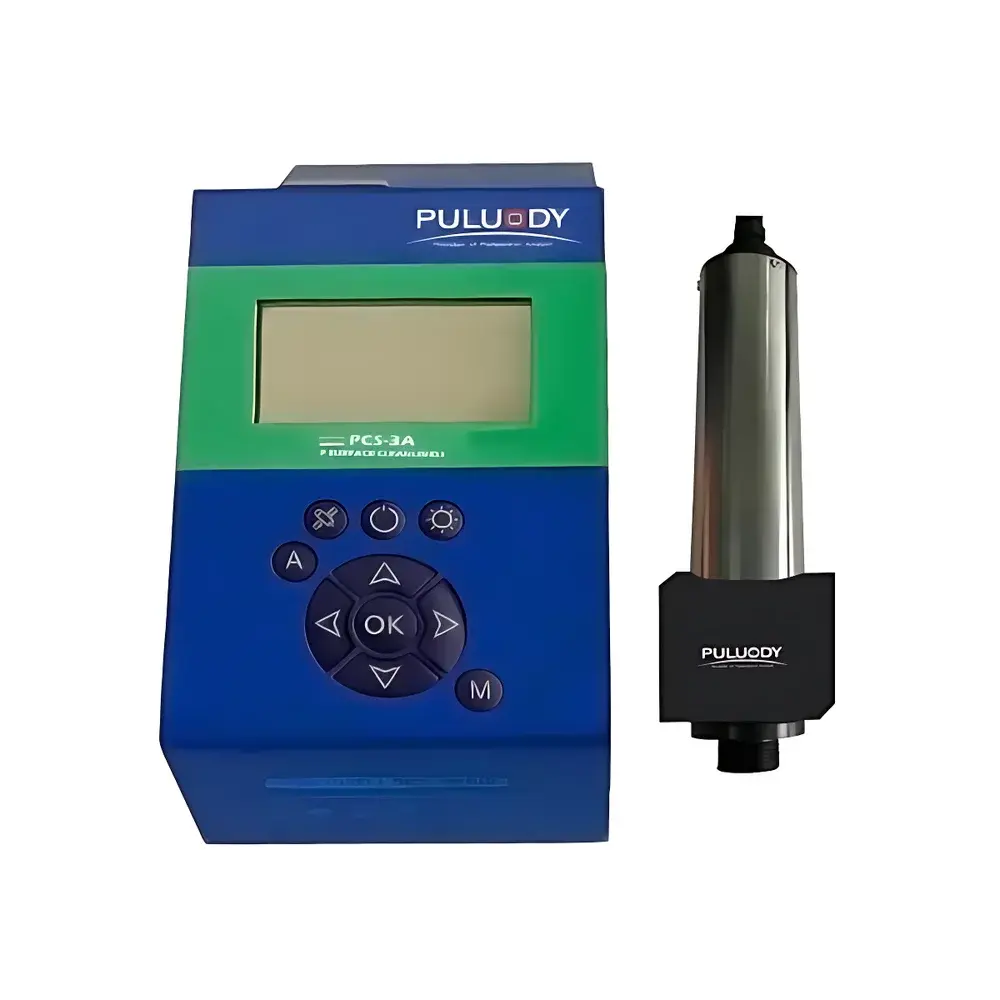
PULUODY PSC-3A-1 Metal Surface Cleanliness Analyzer
| Brand | PULUODY |
|---|---|
| Origin | Shaanxi, China |
| Manufacturer Type | Authorized Distributor |
| Origin Category | Domestic (China) |
| Model | PSC-3A-1 |
| Price | USD 31,800 (approx.) |
| Measurable Contaminants | Oils, greases, coolants, cutting fluids, waxes (C5–Cn hydrocarbons) |
| Cleanliness Scale | 0–100% relative contamination level |
| Resolution | 0.01% |
| Accuracy | ±0.5% |
| Fluorescence Units (FU) | 0–1950 FU |
| FU Resolution | 0.01 FU |
| FU Accuracy | ±0.5% |
| Oil Film Thickness | 0–9950 mg/mm² |
| Thickness Resolution | 0.1 mg/mm² |
| Thickness Accuracy | ±0.5% |
| Measurement Spot Diameter | 0–1.5 mm or 0–5 mm (selectable) |
| Working Distance | 3.5–4.5 mm or 20 mm (dual-mode optical path) |
| Excitation Source | Dynamic X-ray Fluorescence (XRF) |
| Excitation Power | 150 µW |
| Detection Frequency | ≥50 Hz |
| Calibration Reference | Surface-specific calibration supported |
| Metrological Traceability | Certified reference materials traceable to GBW (China) and NIST (USA) |
| Calibration Modes | Auto-calibration, manual calibration, multi-point calibration |
| Measurement Points | 1–5 points per sample (user-configurable) |
| Communication Interface | RS-485 or RS-232 |
| Control Platform | PC-based or industrial computer |
| Power Supply | Rechargeable Li-ion battery or AC adapter (220 V AC) |
Overview
The PULUODY PSC-3A-1 Metal Surface Cleanliness Analyzer is a non-destructive, in-situ analytical instrument engineered for quantitative assessment of organic surface contaminants—primarily hydrocarbon-based residues—on metallic substrates. It operates on the principle of dynamic X-ray fluorescence (XRF) excitation, where low-power X-rays induce characteristic secondary emission from light elements (e.g., carbon, oxygen) within surface-bound organic films. Unlike conventional gravimetric or solvent-extraction methods, the PSC-3A-1 delivers real-time, contactless measurement of residual oil, grease, coolant, cutting fluid, and wax contaminants (C5–Cn aliphatic/aromatic compounds) without sample preparation or solvent consumption. Its design targets high-reproducibility quantification across aerospace, automotive, power generation, and precision manufacturing environments where strict adherence to cleanliness specifications—such as ASTM D7665, ISO 16232, SAE AS4059, and IEST-STD-CC1246—is mandatory prior to assembly, coating, bonding, or vacuum processing.
Key Features
- Dynamic XRF detection with 150 µW excitation power ensures stable signal-to-noise ratio while minimizing radiation exposure and thermal drift.
- Dual working distance configuration (3.5–4.5 mm for high-resolution localized analysis; 20 mm for large-area or recessed component scanning).
- Adjustable spot size (0–1.5 mm or 0–5 mm diameter) enables optimization for micro-feature inspection or macro-scale uniformity mapping.
- Multi-point measurement capability (1–5 user-defined locations per scan) supports statistical evaluation of surface heterogeneity.
- Triple calibration architecture: automatic baseline correction, manual offset adjustment, and multi-point reference calibration using certified GBW/NIST-traceable standards.
- Real-time detection frequency ≥50 Hz allows dynamic monitoring during cleaning process validation or inline quality gate checks.
- Integrated dual-output metric system: relative contamination (%) and absolute fluorescence units (FU), both traceable to primary standards.
- Oil film thickness quantification (0–9950 mg/mm²) derived from calibrated FU-to-mass correlation curves, validated against gravimetric reference methods.
Sample Compatibility & Compliance
The PSC-3A-1 is validated for use on ferrous and non-ferrous metals including aluminum alloys, titanium, stainless steel, nickel superalloys, and electroplated surfaces. It accommodates curved, textured, and thermally treated substrates without requiring surface flattening or masking. Instrument performance complies with ISO/IEC 17025 requirements for testing laboratories and supports audit-ready documentation for GMP/GLP-regulated sectors. All calibration data, measurement logs, and operator actions are timestamped and stored with optional digital signature support—enabling compliance with FDA 21 CFR Part 11 when deployed with validated software configurations. Reference material traceability is maintained through GBW-certified oil-coated metal foils (China National Institute of Metrology) and NIST SRM 2587 (hydrocarbon-contaminated stainless steel).
Software & Data Management
The analyzer interfaces via RS-232 or RS-485 to Windows-based control software that provides full instrument parameterization, spectral visualization, trend analysis, and report generation. Raw FU spectra, % contamination values, oil film thickness calculations, and measurement location metadata are exportable in CSV, XML, and PDF formats. Audit trail functionality records all calibration events, user logins, method changes, and result modifications. Software supports configurable pass/fail thresholds aligned with customer-specific cleanliness classes (e.g., ISO 16232 Class C, D, or E), with automated alerting upon deviation. Data integrity safeguards include encrypted local storage, role-based access control, and optional integration with LIMS or MES platforms via OPC UA or RESTful API.
Applications
- Aerospace: Verification of residual machining oils on turbine blades, landing gear components, and fuel system fittings prior to anodizing or sealing.
- Automotive: In-process validation of brake caliper, transmission housing, and EV battery enclosure cleanliness before painting or adhesive bonding.
- Power Generation: Assessment of lube oil residue on steam turbine rotors and generator windings after maintenance cleaning cycles.
- Semiconductor Equipment: Monitoring hydrocarbon carryover on vacuum chamber interior surfaces following plasma cleaning procedures.
- Hydraulic Systems: Quantitative verification of flushing efficacy in high-pressure manifold blocks and servo-valve bodies.
- Medical Device Manufacturing: Residue screening on stainless-steel surgical instruments post-cleaning and pre-sterilization.
FAQ
Does the PSC-3A-1 require consumables or solvents during operation?
No—this is a non-contact, non-destructive XRF-based system requiring no reagents, wipes, or extraction media.
Can it distinguish between different types of oils (e.g., mineral vs. synthetic)?
It quantifies total hydrocarbon mass loading but does not speciate molecular composition; complementary FTIR or GC-MS is recommended for chemical identification.
Is the instrument suitable for measuring cleanliness on painted or anodized surfaces?
Yes—provided the coating thickness remains below 5 µm and contains no interfering fluorescent elements (e.g., Zn, Ti, Cr at high concentrations).
How is measurement uncertainty validated?
Uncertainty budgets are established per ISO/IEC Guide 98-3 (GUM), incorporating contributions from detector stability, calibration standard uncertainty, positioning repeatability, and environmental temperature drift.
What training and documentation are provided with the system?
Includes operator certification training, IQ/OQ protocol templates, calibration certificate with GBW/NIST traceability statement, and full technical manual compliant with IEC 61000-4 electromagnetic compatibility standards.



