
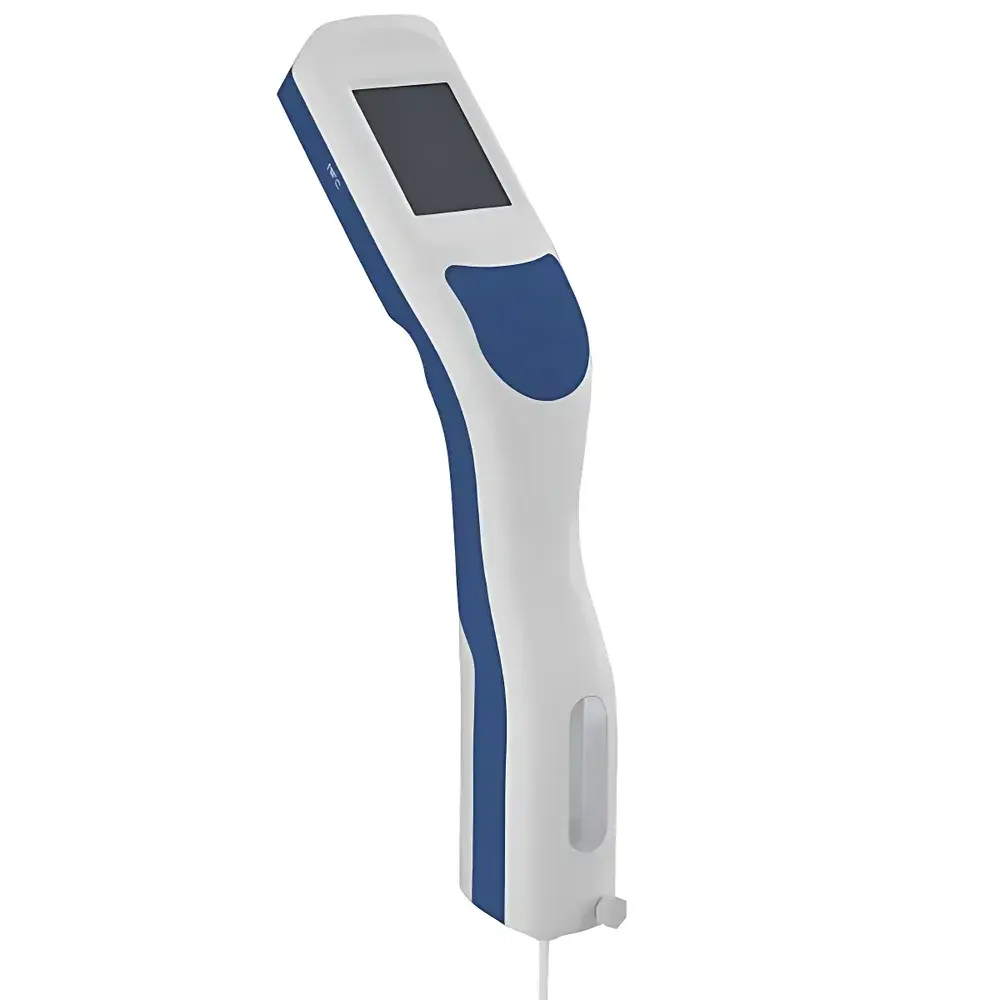
PULUODY DMA-135D Digital Handheld Density Meter
| Brand | PULUODY |
|---|---|
| Model | DMA-135D |
| Principle | U-tube Oscillation Method |
| Measurement Range | 0.0000–3.0000 g/cm³ |
| Resolution | 0.0001 g/cm³ |
| Accuracy | ±0.001 g/cm³ |
| Repeatability | ±0.0005 g/cm³ |
| Temperature Range | 0.0–50.0 °C |
| Temp. Resolution | 0.1 °C |
| Temp. Accuracy | ±0.2 °C |
| Temp. Repeatability | ±0.1 °C |
| Sample Volume | 2 mL |
| Sampling Method | Manual syringe or integrated pump (for liquids < 2000 mPa·s) |
| Measurement Time | ≤60 s |
| Display | 2.4″ color LCD, 320×240 pixels |
| Power | 9 V alkaline battery |
| Battery Life | ~90 h |
Overview
The PULUODY DMA-135D Digital Handheld Density Meter is a portable, microprocessor-controlled instrument engineered for rapid, high-precision density determination of liquid samples based on the U-tube oscillation principle. It operates by measuring the resonant frequency shift of a dual-U-shaped borosilicate glass sensor tube when filled with a sample—frequency being inversely proportional to the square root of the sample’s density. This physical relationship, governed by the mass-spring system dynamics of the vibrating tube, enables direct, calibration-free density calculation in g/cm³ (or kg/m³), with simultaneous temperature compensation via an integrated Pt100-grade thermistor. Designed for field-deployable and benchtop use, the DMA-135D delivers laboratory-grade metrological performance without requiring external power sources, environmental enclosures, or complex fluid handling infrastructure.
Key Features
- Compact, ergonomic handheld form factor with integrated sampling pump and syringe-compatible inlet port—enabling operation in production lines, storage tanks, mobile labs, or remote sites.
- Third-generation PULUODY U-tube sensor fabricated from high-stability borosilicate glass, optimized for mechanical robustness, thermal inertia control, and long-term drift resistance.
- Real-time temperature measurement and automatic density correction across 0.0–50.0 °C, complying with ISO 12185 and ASTM D4052 requirements for temperature-controlled density reporting.
- High-resolution 2.4-inch color TFT display (320×240 pixels) with intuitive icon-driven UI, supporting multi-language menu navigation and on-screen statistical summary (mean, SD, min/max of up to 99 measurements).
- Battery-powered operation using a standard 9 V alkaline cell, delivering approximately 90 hours of continuous use—ideal for extended field campaigns or audit-ready deployments where AC power is unavailable.
- Single-button start sequence with full measurement cycle completed in ≤60 seconds—including fill detection, oscillation stabilization, temperature equilibration, and result validation.
Sample Compatibility & Compliance
The DMA-135D accommodates a broad spectrum of Newtonian and mildly non-Newtonian liquids, including hydrocarbons, aqueous solutions, alcohols, glycols, organic solvents, lubricants, surfactant formulations, food-grade oils, pharmaceutical excipients, and electroplating baths. Its 2 mL sample requirement minimizes waste and enables testing of high-value or hazardous materials. The instrument meets the technical requirements of GB/T 29617–2013, GB/T 2013–2010, and SH/T 0604–2000, and its measurement traceability aligns with national metrological verification regulations for digital density meters. While not intrinsically rated for hazardous areas, it supports optional IP54-rated protective sleeves for industrial environments. All density outputs are referenced to 20 °C unless otherwise specified, and results may be exported in standardized units including g/cm³, kg/m³, °API, specific gravity (SG), and Brix (when paired with validated concentration conversion tables per ISO 2173 or AOAC 932.12).
Software & Data Management
Data logging is performed internally with timestamped storage of up to 99 measurement records, each retaining density, temperature, measurement duration, and operator ID (manually entered). USB-C interface enables firmware updates and raw data export in CSV format for integration into LIMS, ERP, or QA documentation systems. Though the device does not feature built-in 21 CFR Part 11 compliance (e.g., electronic signatures or audit trails), its deterministic measurement algorithm, immutable internal clock, and fixed calibration constants support GLP-aligned documentation practices. Optional PC software (PULUODY DensityLink v3.x) provides batch reporting, trend analysis, calibration certificate generation, and automated compliance report templates aligned with ISO/IEC 17025 internal audit requirements.
Applications
The DMA-135D serves as a primary density verification tool across regulated and non-regulated sectors. In petroleum refining, it verifies crude assay batches, monitors blending accuracy of fuel additives, and checks diesel/biodiesel blend ratios. In pharmaceutical manufacturing, it supports excipient qualification, syrup density verification per USP , and cleaning validation of CIP rinse waters. In food & beverage production, it quantifies alcohol content in spirits (via density–ethanol correlation curves), validates sugar concentration in fruit juices, and ensures consistency in edible oil refining. Additional use cases include QC of metalworking fluids in automotive OEM plants, density profiling of photoresist developers in semiconductor fabs, and routine calibration checks of fixed-installation online densitometers in chemical process skids.
FAQ
What is the minimum and maximum viscosity the DMA-135D can measure?
The instrument is optimized for liquids with dynamic viscosity below 2000 mPa·s at measurement temperature. Higher viscosities may prolong oscillation damping time and compromise repeatability; pre-warming viscous samples to reduce viscosity is recommended.
Does the device require factory recalibration?
No routine recalibration is required under normal use. The sensor is factory-calibrated using certified reference standards traceable to NIM (China National Institute of Metrology). Users may perform verification checks using air and pure water at 20 °C.
Can the DMA-135D measure slurries or suspensions?
It is not suitable for heterogeneous mixtures containing undissolved solids >5 µm or air bubbles, as these disrupt oscillation stability and induce measurement noise. Filtration or degassing is mandatory prior to analysis.
Is temperature control active or passive?
The unit employs passive thermal equilibration only—the sensor reaches ambient temperature equilibrium via conduction. For applications demanding strict isothermal conditions, users must precondition samples to target temperature before injection.
How is measurement uncertainty estimated for compliance reporting?
Total expanded uncertainty (k=2) is ≤±0.0015 g/cm³ when operating within specification limits, derived from Type A (repeatability) and Type B (calibration, temperature, resolution) components per GUM (JCGM 100:2008).
Related Products






