
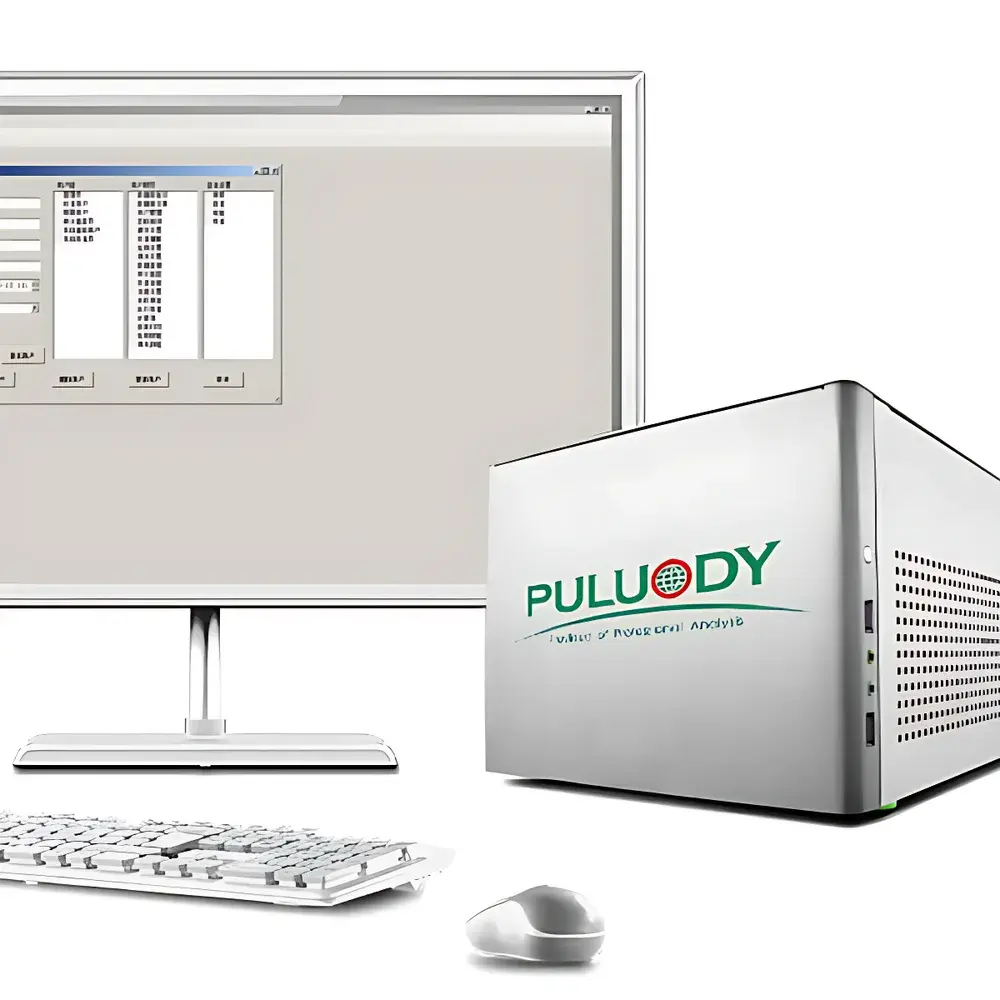
PULUODY PMT-2SH Dual-Laser Narrow-Beam Optical Particle Counter for Acid/Base Chemical Liquids
| Brand | PULUODY |
|---|---|
| Origin | Shaanxi, China |
| Manufacturer Type | Authorized Distributor |
| Regional Classification | Domestic (China) |
| Model | PMT-2SH |
| Instrument Type | Optical Particle Counter |
| Detection Principle | Dual-laser light scattering with narrow-beam geometry |
| Calibration Standards | JJG 1061, ISO 21501-4, NIST-traceable latex sphere reference materials |
| Detection Range | 0.1–0.5 µm, 0.2–2.0 µm, 0.5–20.0 µm (user-definable sub-ranges: 1–100 µm or 4–70 µm(c) |
| minimum detectable size | 0.1 µm(c)) |
| Sampling Accuracy | < ±1% |
| Counting Accuracy | ±3% typical |
| Coincidence Limit | ≤2.5% error at 1000 particles/mL |
| Flow Control | Precision metering piston pump + electromagnetic flow regulation |
| Output Interface | 4–20 mA analog output |
| Alarm Function | Configurable particle concentration threshold alert |
| Data Reporting | Particles per mL and ISO 4406 / NAS 1638 contamination code |
| Power Input | 100–265 VAC, 50–60 Hz |
| Software | PULUODY V8.3 Integrated Analysis & Calibration Suite (PC + tablet-compatible) |
Overview
The PULUODY PMT-2SH is a high-sensitivity optical particle counter engineered specifically for the quantitative analysis of insoluble particulate contamination in aggressive acid and base chemical liquids—commonly encountered in semiconductor wet processing, flat-panel display manufacturing, photovoltaic wafer cleaning, and advanced nanofiltration validation. It employs dual-wavelength, narrow-beam laser scattering technology (eighth-generation sensor architecture), enabling stable, low-noise detection of sub-micron particles down to 0.1 µm(c) in highly corrosive media such as HF-based etchants, ammonium hydroxide solutions, sulfuric-peroxide mixtures (SPM), and dilute KOH baths. Unlike conventional single-laser counters, the PMT-2SH’s coaxial dual-laser configuration mitigates refractive index mismatch errors and improves sizing fidelity across heterogeneous chemistries—critical when measuring polymeric residues, metal oxides, or silica agglomerates suspended in low-dielectric-index solvents. Its sealed optical path and chemically resistant fluidic manifold (constructed from PFA, sapphire, and ceramic components) ensure long-term operational integrity without sensor fouling or calibration drift.
Key Features
- Dual-laser narrow-beam optical detection system optimized for acid/base stability and refractive index compensation
- Precision piston-driven sampling with electromagnetic flow feedback control (<±1% volumetric accuracy)
- Modular detection ranges: factory-configured channels at 0.1–0.5 µm, 0.2–2.0 µm, and 0.5–20.0 µm; fully customizable user-defined bins (1–100 µm or 4–70 µm(c))
- Integrated contamination grading per ISO 4406:2017 and NAS 1638 standards, with real-time pass/fail logic against process control limits
- Touchscreen HMI with intuitive workflow navigation and wireless keyboard/mouse support for lab or cleanroom deployment
- 4–20 mA analog output with programmable alarm thresholds for integration into SCADA, DCS, or MES systems
- V8.3 software platform supporting GLP-compliant audit trails, electronic signatures, and 21 CFR Part 11–ready data archiving (optional)
Sample Compatibility & Compliance
The PMT-2SH is validated for use with aqueous and organic liquid matrices exhibiting pH 0–14, including but not limited to TMAH developers, SC-1/SC-2 cleans, DI water rinse streams, CMP slurries, and polymer-based photoresist strippers. Fluidic contact materials comply with SEMI F57 and ASTM D7199 requirements for particle-free chemical delivery. All calibration procedures adhere to JJG 1061–2010 (Chinese national metrological verification regulation) and ISO 21501-4:2018 (determination of particle size distribution by light scattering). Instrument performance verification includes traceability to NIST SRM 1963 and ISO 21501-4 reference latex suspensions. The system supports IQ/OQ documentation packages aligned with GMP Annex 11 and FDA guidance on computerized system validation.
Software & Data Management
PULUODY V8.3 software provides dual-mode operation: standalone analysis mode for offline sample evaluation and metrology mode for sensor calibration, linearity verification, and background noise profiling—ensuring separation between measurement and qualification functions. Data export formats include CSV, PDF reports (with embedded metadata), and XML for LIMS integration. Audit trail logging records all user actions, parameter changes, and calibration events with timestamps and operator IDs. Optional modules enable automated report generation compliant with ISO/IEC 17025 and internal QA protocols. Tablet-based data acquisition (iPad-supported via Wi-Fi) allows mobile monitoring during equipment qualification or chamber-to-chamber mapping.
Applications
- In-line monitoring of ultrapure rinse water in semiconductor track systems
- Offline verification of filter integrity in nano-scale membrane filtration skids
- Contamination trending in TFT-LCD panel cleaning baths and ITO etch lines
- Validation of cleaning efficacy for MEMS packaging substrates and silicon carbide wafers
- Quantitative assessment of gelatinous residue in pharmaceutical-grade solvent recovery loops
- Particle shedding analysis during ultrasonic bath maintenance in medical device manufacturing
FAQ
Can the PMT-2SH measure particles in concentrated HF solutions?
Yes—the fluidic path is constructed with PFA-lined stainless steel and sapphire optical windows, rated for continuous exposure to ≤49% HF at ambient temperature.
Is calibration traceable to international standards?
All factory calibrations are performed using ISO 21501-4–compliant NIST-traceable latex standards; calibration certificates include uncertainty budgets per ISO/IEC 17025.
Does the system support remote diagnostics and firmware updates?
Yes—via secure Ethernet or optional cellular gateway; remote access requires prior authorization and TLS 1.2 encryption.
What is the maximum allowable particle concentration before coincidence error exceeds specification?
Coincidence error remains ≤2.5% up to 1000 particles/mL at the 0.5–20.0 µm channel; higher concentrations require dilution per ASTM D7199 Annex A3.
Can the instrument be integrated into a PLC-controlled cleanroom environment?
Yes—4–20 mA analog output, digital I/O ports, and Modbus TCP protocol support direct interfacing with Allen-Bradley, Siemens, and Mitsubishi controllers.



