
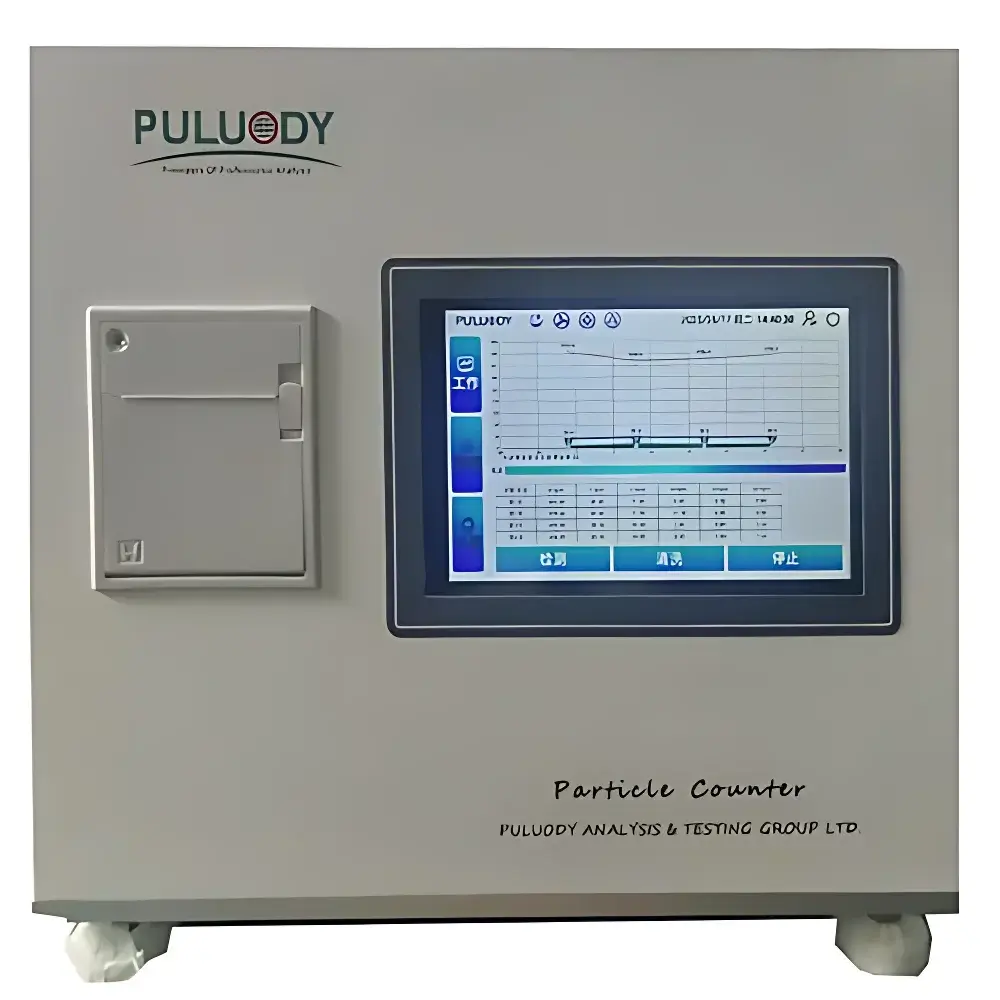
PULUODY DPC-1511 Oilfield Water Re-injection Liquid Particle Counter
| Brand | PULUODY |
|---|---|
| Origin | Shaanxi, China |
| Model | DPC-1511 |
| Dispersion Method | Wet Dispersion |
| Instrument Type | Laboratory Laser Particle Size Analyzer |
| Measurement Range | 1–500 µm |
| Repeatability | <1% |
| Measurement Time | 60 sec |
| Detection Principle | Optical Diffraction & Scattering / Laser Flow Imaging |
| Compliance | ISO 13320, ISO 13321 |
| Sample Throughput | One sample per ≤2 min |
| Software Interface | Bilingual (English/Chinese), Windows-compatible |
| Reporting | D3, D10, D25, D50, D75, D80, D90, D97, D100, Span, Specific Surface Area, Aspect Ratio, Circularity Distribution |
Overview
The PULUODY DPC-1511 Oilfield Water Re-injection Liquid Particle Counter is a dual-mode laboratory-grade particle characterization system engineered for high-precision, trace-level particulate monitoring in produced water and secondary recovery injection streams. It operates on two complementary physical principles: (1) ensemble-based optical diffraction and scattering—fully compliant with ISO 13320 (laser diffraction) and ISO 13321 (dynamic light scattering)—and (2) real-time laser flow imaging, enabling simultaneous size, shape, and morphology analysis at single-particle resolution. Designed specifically for upstream oilfield applications, the DPC-1511 meets the stringent requirements of SY/T 5329–2012 (Recommended Water Quality Criteria for Clastic Reservoir Water Flooding) and SY/T 6596–2016 (Gas Field Water Injection Technical Specifications). Its optical architecture integrates a seventh-generation dual-laser narrow-beam detector array, delivering stable signal acquisition across a dynamic range spanning 1 nm to 2000 µm—with dedicated sub-ranges optimized for nanoscale colloids (1–10,000 nm), fine silt/clay suspensions (0.02–2000 µm), and field-relevant injection-grade particles (1–500 µm). Unlike conventional batch-mode analyzers, the DPC-1511 employs continuous laminar flow hydrodynamic focusing, eliminating sedimentation and re-agglomeration during measurement—a critical advantage for unstable reservoir brines and polymer-flooding fluids.
Key Features
- Modular optical detection platform supporting both laser diffraction (ISO 13320) and laser flow imaging (particle-by-particle morphometry) in a single instrument
- Seventh-generation dual-laser narrow-beam detector with enhanced signal-to-noise ratio and extended operational lifetime (>10,000 h)
- Hydrodynamic focusing cell with coaxial sheath flow design—ensures monolayer particle alignment and eliminates out-of-focus blur during high-speed imaging
- Full-range programmable measurement: selectable sub-ranges include nano (1–10,000 nm), micro (0.02–2000 µm), or targeted injection-water mode (1–500 µm)
- Automated workflow: one-touch execution of alignment, background subtraction, concentration optimization, data acquisition, statistical analysis, report generation, and system rinse
- Electrical and fluidic isolation architecture—minimizes electromagnetic interference and thermal drift, ensuring long-term baseline stability
- Integrated sampling module with dual-path configuration: static cuvette (for low-volume, high-viscosity samples) and recirculating wet dispersion unit (for representative field water analysis)
Sample Compatibility & Compliance
The DPC-1511 is validated for aqueous suspensions typical of oilfield operations—including formation water, filtered produced water, polymer-thickened injectants, and scale inhibitor blends. It accommodates salinities up to 300,000 ppm TDS and suspended solids concentrations from 0.1 mg/L to 1000 mg/L without dilution. All measurements adhere to ISO/IEC 17025 traceability frameworks; factory calibration is performed using NIST-traceable polystyrene latex standards (PSL), with optional third-party metrological verification available through CNAS-accredited laboratories. The system supports audit-ready data integrity protocols compatible with GLP and GMP environments: full electronic audit trail, user-access logging, version-controlled method files, and FDA 21 CFR Part 11–compliant electronic signatures (when deployed with validated software configuration).
Software & Data Management
The embedded PULUODY Particle Analysis Suite (PPAS v4.2) runs natively on Windows OS (10/11, 64-bit) and offers bilingual interface switching (English/Chinese) without language-dependent functionality loss. Data processing algorithms implement Mie theory (for refractive index–adjusted sizing) and Fraunhofer approximation (for rapid screening), with automatic selection based on user-defined material properties. Output includes standardized metrics: D3, D10, D25, D50, D75, D80, D90, D97, D100, span, specific surface area, aspect ratio distribution, and circularity histogram. Reports are exportable in 20 configurable templates—including SY/T 5329–2012–compliant summary sheets—and support direct conversion to PDF, CSV, PNG, and XML formats. Raw scatter pattern matrices and image stacks are archived in HDF5 format for retrospective reprocessing.
Applications
- Monitoring suspended solids in tertiary recovery injection water to ensure compliance with SY/T 5329–2012 permeability damage thresholds (e.g., ≤2 mg/L >2 µm particles)
- Quantifying clay dispersion, iron sulfide fines, and bacterial aggregates in sour gas field waters per SY/T 6596–2016 specifications
- Validating filtration efficiency of cartridge, membrane, and centrifugal units in water treatment skids
- Tracking particle generation during hydraulic fracturing fluid breakdown and proppant embedment simulations
- Supporting root-cause analysis of downhole screen plugging and near-wellbore formation damage
- Quality control of chemical additives (e.g., scale inhibitors, biocides) where undissolved particulates may compromise efficacy
FAQ
What regulatory standards does the DPC-1511 comply with for oilfield water analysis?
It conforms to ISO 13320 (laser diffraction), ISO 13321 (dynamic light scattering), and Chinese petroleum industry standards SY/T 5329–2012 and SY/T 6596–2016.
Can the instrument differentiate between organic and inorganic particles?
While not a compositional analyzer, its flow imaging mode enables morphological classification (e.g., angular vs. rounded, fibrous vs. spherical) that—combined with density or refractive index assumptions—supports empirical differentiation.
Is third-party calibration supported throughout the instrument’s service life?
Yes. PULUODY maintains a CNAS-accredited calibration chain, and users may schedule periodic metrological verification by authorized national institutes.
Does the system require external compressed air or vacuum sources?
No. All fluid handling—including sheath flow generation and cell rinsing—is driven by integrated peristaltic and diaphragm pumps.
How is data security ensured in multi-user laboratory environments?
Role-based access control (RBAC), encrypted local database storage, and optional integration with enterprise LIMS via ASTM E1384-compliant HL7 messaging.



