
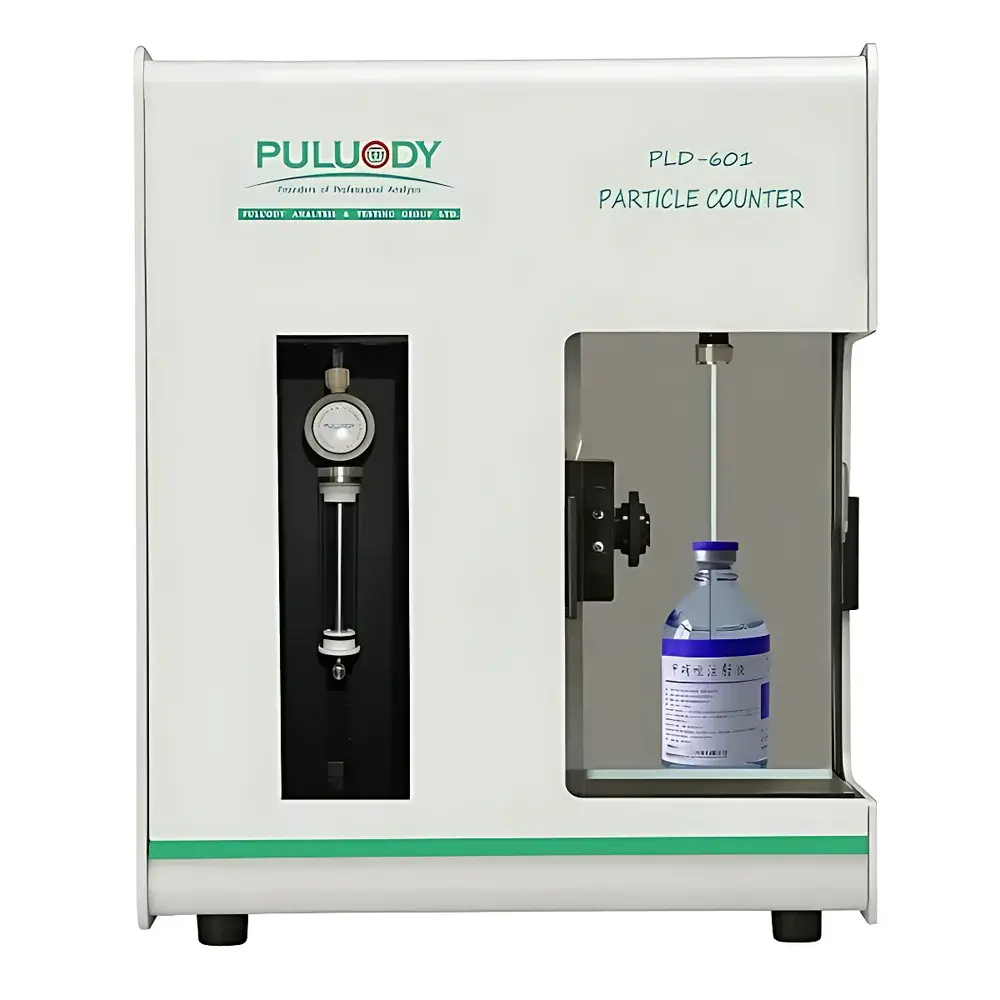
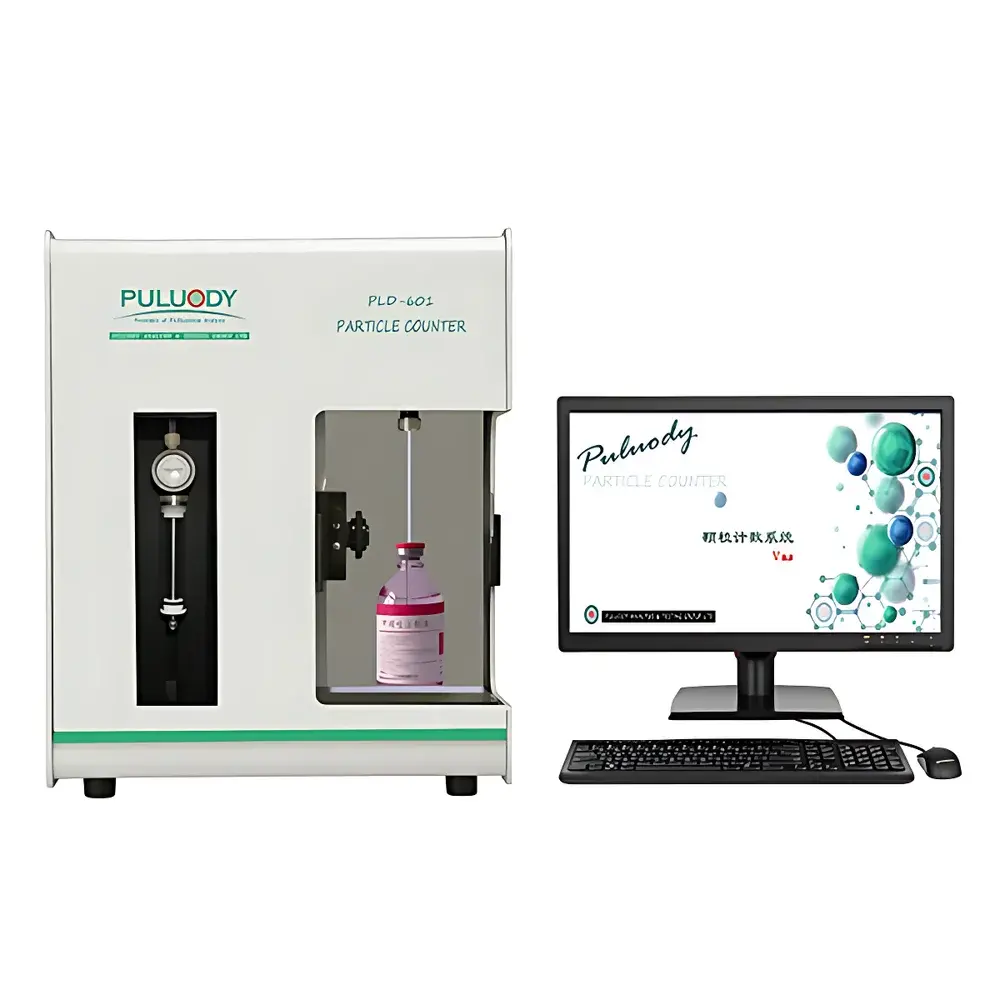
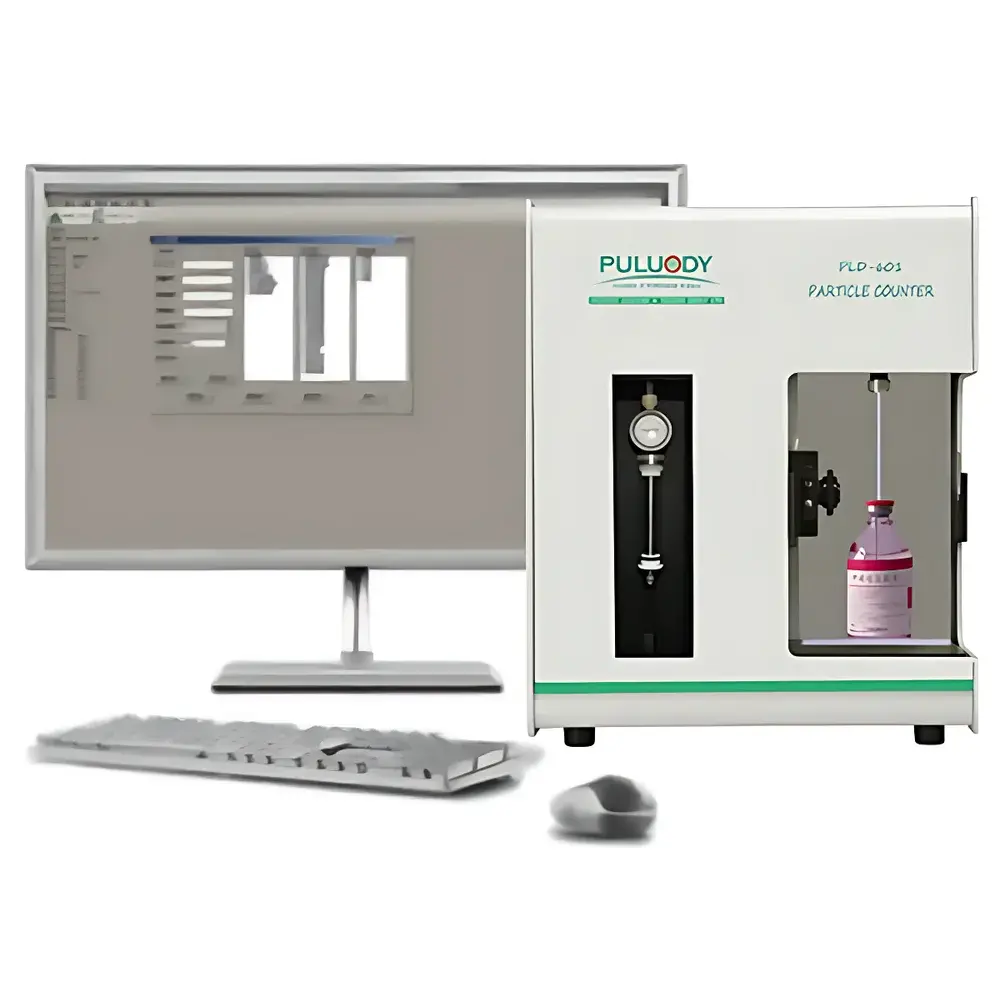
PULUODY PLD-601-1 Sterile Powder Particle Analyzer with Customizable 16-Channel Optical Particle Counter
| Brand | PULUODY |
|---|---|
| Origin | Shaanxi, China |
| Manufacturer Type | Authorized Distributor |
| Country of Origin | China |
| Model | PLD-601-1 |
| Instrument Type | Optical Particle Counter |
| Sensor Generation | 8th-Generation Dual-Laser Narrow-Beam Detector |
| Software Version | V8.9 Integrated PC-Based Analysis Software |
| Compliance Standards | Chinese Pharmacopoeia 2015 & 2020, USP <788> & <789>, EP 2.9.19, BP, GB 8368 |
| Calibration Traceability | JJG 1061, ISO 21501-4, NIST-Traceable Latex Standards |
| Detection Range | 1–450 µm (extended range 0.03–3000 µm optional) |
| Custom Channel Configurations | 4, 6, 8, 16, 32, 64, or 128 user-defined size bins |
| Sampling Flow Rate | 5–150 mL/min |
| Rinse Flow Rate | 5–500 mL/min |
| Sample Temperature Range | 0–80 °C |
| Ambient Operating Temperature | −15–50 °C |
| Sampling Accuracy | < ±1% |
| Coincidence Limit | ≤2.5% error at 1000 particles/mL |
| Resolution | >95% (per ChP 2015/2020), <10% (per USP/ISO 21501-4) |
| Display Interface | Color LCD touchscreen + optional wireless keyboard/mouse |
Overview
The PULUODY PLD-601-1 Sterile Powder Particle Analyzer is a high-precision optical particle counter engineered for regulatory-compliant particulate contamination assessment in parenteral pharmaceutical manufacturing and quality control laboratories. It employs an 8th-generation dual-laser narrow-beam detection principle—based on light extinction and scattering—to quantify and size insoluble particles suspended in liquid-phase samples. Unlike generic particle counters, the PLD-601-1 is specifically validated for sterile powder reconstitution testing per Chinese Pharmacopoeia (ChP) 2020 Edition Section 0903, USP , and EP 2.9.19, enabling rigorous evaluation of injectables, lyophilized powders, ophthalmic solutions, vaccines, WFI, and packaging components. Its architecture integrates dual-flow precision control—via a calibrated piston pump and ultra-stable electromagnetic flow regulation—to ensure repeatable volumetric sampling across variable viscosities and particulate loadings. The system operates without sample dilution or filtration, preserving native particle morphology and count integrity.
Key Features
- Customizable multi-channel analysis: Supports user-defined binning configurations—including 16 discrete size channels—as standard, with scalable options up to 128 bins for granular distribution profiling.
- Dual-laser narrow-beam sensor: Minimizes signal noise and improves sizing resolution for sub-5 µm particles critical in sterile drug evaluation.
- Regulatory-grade flow control: Piston pump delivers sampling accuracy < ±1%, while programmable rinse flow (5–500 mL/min) ensures cross-sample carryover < 0.01%.
- Wide dynamic operating range: Validated for sample temperatures from 0 °C to 80 °C and ambient conditions from −15 °C to 50 °C—suitable for cold-chain biologics and hot-fill processes.
- Pharmacopeial compliance by design: Preconfigured test protocols for ChP 2020, USP , EP 2.9.19, and GB 8368; automated pass/fail reporting aligned with acceptance criteria.
- Full audit trail capability: V8.9 software logs all operator actions, parameter changes, calibration events, and result exports—supporting GLP/GMP documentation requirements and FDA 21 CFR Part 11 readiness.
Sample Compatibility & Compliance
The PLD-601-1 accommodates a broad spectrum of pharmaceutical and biotech samples, including reconstituted sterile powders, concentrated injectables, ophthalmic preparations, vaccine suspensions, water-for-injection (WFI), and extractables/leachables from IV bags, stoppers, and filters. It supports direct measurement of terminal filter efficiency (e.g., 0.22 µm sterilizing filters) via upstream/downstream comparative counting. All detection algorithms and size calibrations are traceable to ISO 21501-4 and JJG 1061 standards, with verification using NIST-traceable polystyrene latex (PSL) reference materials. The instrument meets mechanical and electrical safety requirements per IEC 61010-1 and electromagnetic compatibility per IEC 61326-1. For regulated environments, it supports IQ/OQ documentation packages and can be integrated into enterprise LIMS via ASTM E1384-compliant data export (CSV, XML, PDF).
Software & Data Management
V8.9 Analysis Software provides a unified interface for method setup, real-time particle visualization, statistical distribution analysis (cumulative/differential histograms), and regulatory report generation. Each test record includes embedded metadata: operator ID, timestamp, environmental conditions, calibration status, and raw scatter/extinction pulse data. Batch processing enables trend analysis across multiple lots or timepoints. Data integrity safeguards include role-based access control (RBAC), electronic signatures, and immutable audit logs with hash-verified timestamps. Export formats comply with ALCOA+ principles: all reports include full traceability to original sensor pulses, with no post-acquisition interpolation or smoothing applied. Software validation documentation (SVVP/SAT) is available upon request for GxP deployments.
Applications
- Quantitative insoluble particle testing of lyophilized drug products per ChP 2020 Section 0903 and USP .
- Terminal filter challenge studies and filter integrity verification for aseptic processing lines.
- Particulate shedding assessment of elastomeric closures, glass vials, and polymer-based delivery devices.
- Process monitoring of cleaning-in-place (CIP) rinse efficacy and equipment wear debris in bioreactor systems.
- Ultra-pure water qualification for pharmaceutical manufacturing (PW, WFI, Purified Water).
- Comparative analysis of particle generation during powder handling, milling, and blending operations.
FAQ
Does the PLD-601-1 support USP for ophthalmic preparations?
Yes—the instrument’s optical configuration and software modules are pre-validated for ophthalmic suspension testing per USP , including specified flow rates, sample volumes, and size thresholds (≥10 µm and ≥25 µm).
Can channel boundaries be adjusted in real time during analysis?
No—channel definitions are configured prior to acquisition and locked during run execution to ensure data integrity and regulatory consistency. However, post-acquisition re-binning is supported in V8.9 for exploratory analysis.
Is the system compatible with 21 CFR Part 11 requirements?
Yes—V8.9 software includes electronic signature workflows, audit trail review tools, and permission-level controls required for Part 11 compliance. Full validation support documentation is provided.
What maintenance is required for the dual-laser sensor?
The sealed laser module requires no routine alignment or recalibration. Annual performance verification using PSL standards and flow-rate validation are recommended as part of a preventive maintenance program.
How is carryover addressed between high-load and low-load samples?
The system implements an adaptive rinse protocol with programmable duration and flow rate (5–500 mL/min), verified to reduce residual particle carryover to < 0.01% under worst-case conditions (e.g., 10⁴ particles/mL).



