
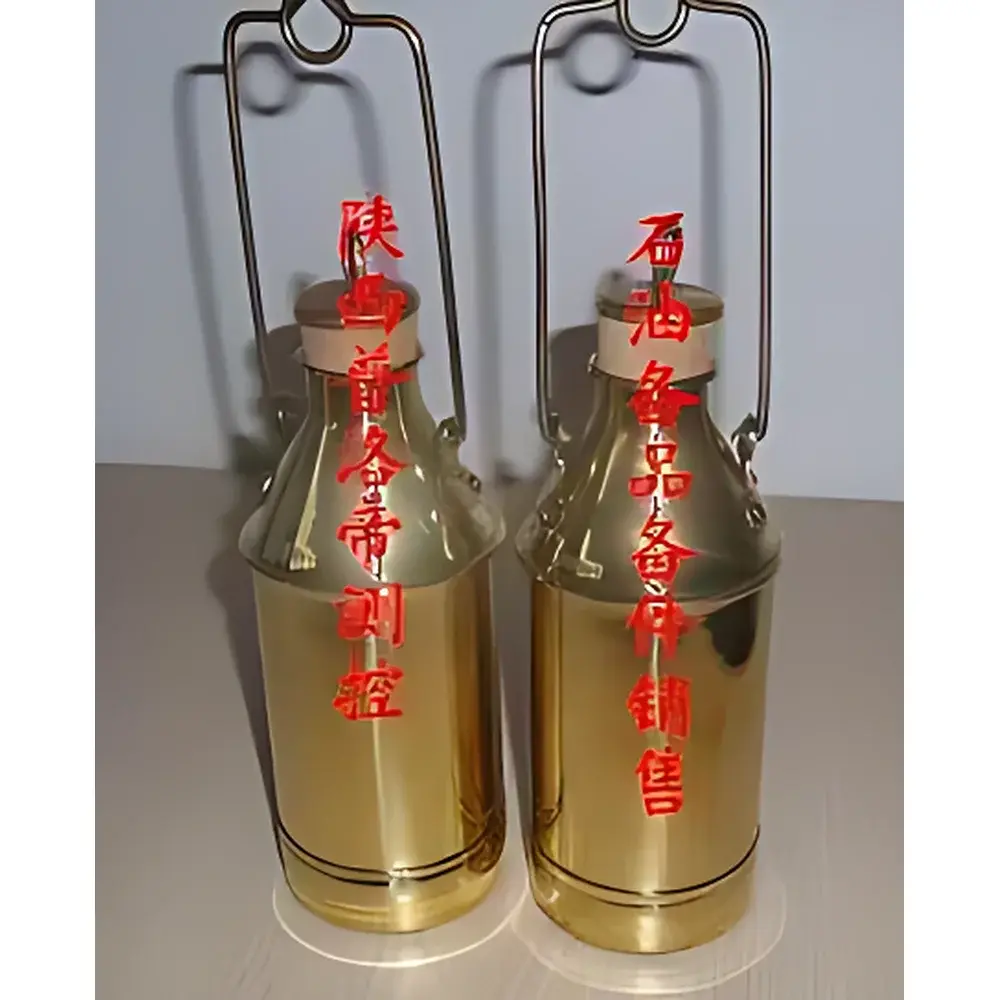
PLULODY PLD Series Thin-Wall Weighted Sampling Cans
| Brand | PLULODY/PULUODY |
|---|---|
| Origin | Shaanxi, China |
| Manufacturer Type | Direct Manufacturer |
| Region of Origin | Domestic (China) |
| Model | PLD Series |
| Pricing | Upon Request |
Overview
The PLULODY PLD Series Thin-Wall Weighted Sampling Cans are precision-engineered manual sampling devices designed for representative, contamination-free collection of liquid petroleum and chemical products from static storage tanks, road tankers, marine vessels, pipelines, and process vessels. Based on the fundamental principle of gravity-driven displacement sampling, the can submerges vertically under its own weighted mass, allowing controlled ingress of sample fluid through a calibrated bottom inlet valve upon reaching the target depth. The device operates exclusively under ambient pressure and temperature conditions—no external power, pumps, or pressurization systems are required. Its design strictly complies with internationally referenced sampling standards including GB/T 4756–2015 “Manual Sampling of Petroleum Liquids” and GB/T 6680–2003 “General Rules for Sampling of Liquid Chemical Products”, ensuring methodological traceability for quality control, custody transfer, and regulatory reporting workflows in downstream refining, terminal operations, and bulk chemical logistics.
Key Features
- Thin-wall brass construction (C26800 alloy) optimized for density-to-volume ratio: provides rapid, stable vertical descent without deformation or buoyancy-induced tilt during immersion;
- Integrated spring-loaded inlet valve with positive-seal closure mechanism—prevents premature filling during descent and eliminates cross-depth contamination;
- Rated operational temperature range: −60 °C to +100 °C, validated for use with hydrocarbons, solvents, lubricants, and non-oxidizing aqueous solutions;
- Chemical compatibility: inert toward copper, tin, and austenitic stainless steels (e.g., 304/316); not suitable for halogenated solvents, strong oxidizers, or hydrogen sulfide–saturated media;
- Standard volumetric capacities: 330 mL, 500 mL, and 1000 mL—with metrological calibration marks etched directly onto the can body per ISO 4787 requirements;
- Equipped with certified antistatic sampling rope (surface resistivity < 10⁶ Ω/sq) and grounding clamp; supports full electrostatic dissipation path per IEC 60079-32-1 and NFPA 77 guidelines.
Sample Compatibility & Compliance
The PLD Series is validated for sampling non-aerated, low-viscosity to medium-viscosity liquids exhibiting Newtonian flow behavior under static conditions. It is not intended for volatile organic compounds requiring vapor-tight containment (e.g., ASTM D5842), nor for multiphase or suspended-solid-laden streams. All units undergo individual hydrostatic pressure testing at 1.5× maximum service pressure and visual inspection for wall integrity prior to shipment. Documentation includes material certification (mill test report per ASTM B135), dimensional conformity report, and compliance statement referencing GB/T 4756, GB/T 6680, and EN 13094:2003 (Petroleum products — Manual sampling). Units may be supplied with optional traceable calibration certificates (ISO/IEC 17025 accredited) upon request.
Software & Data Management
As a fully mechanical, non-electronic sampling tool, the PLD Series requires no firmware, drivers, or software integration. However, it is fully compatible with digital sampling workflow platforms used in modern laboratories and terminals—including LIMS (Laboratory Information Management Systems) and QMS (Quality Management Systems)—via standardized sample ID tagging, chain-of-custody logging, and manual entry of depth, time, temperature, and operator credentials. When paired with PLULODY’s optional digital depth gauge and thermal probe accessories, metadata can be exported in CSV or XML format for audit-ready record retention aligned with GLP and ISO/IEC 17025 documentation requirements.
Applications
- Routine grab sampling of crude oil, gasoline, diesel, jet fuel (Jet A-1), and base oils from fixed-roof or floating-roof storage tanks;
- Quality verification sampling during loading/unloading operations at marine terminals and rail depots;
- In-process sampling of batch reactors and blending lines in petrochemical and specialty chemical manufacturing;
- Reference sampling for instrument calibration of online analyzers (e.g., NIR, density meters, water-in-oil sensors);
- Regulatory compliance sampling for environmental monitoring (e.g., EPA Method 1664B preparatory step) and customs inspection protocols.
FAQ
What is the maximum allowable descent speed during sampling?
The recommended maximum descent velocity is 1 m/s to ensure laminar entry and avoid turbulent mixing at the interface.
Can the brass body be substituted with stainless steel?
No—brass (C26800) is specified for its optimal density, machinability, corrosion resistance in hydrocarbon environments, and non-sparking properties per ASTM E2811; stainless steel variants are not offered.
Is the soft cork stopper compliant with USP Class VI requirements?
Standard natural cork stoppers are not USP-certified; however, FDA-compliant silicone or PTFE-faced elastomeric closures are available as custom options.
How often should the inlet valve mechanism be inspected or serviced?
Visual inspection before each use is mandatory; full disassembly and cleaning with solvent-rinsed lint-free cloth is recommended after every 50 deployments or when particulate buildup is observed.
Does PLULODY provide calibration services for volume accuracy verification?
Yes—accredited volumetric calibration (traceable to NIM, China) is available as an add-on service with certificate issued per JJG 196–2023 (General Verification Regulation for Volumetric Apparatus).



