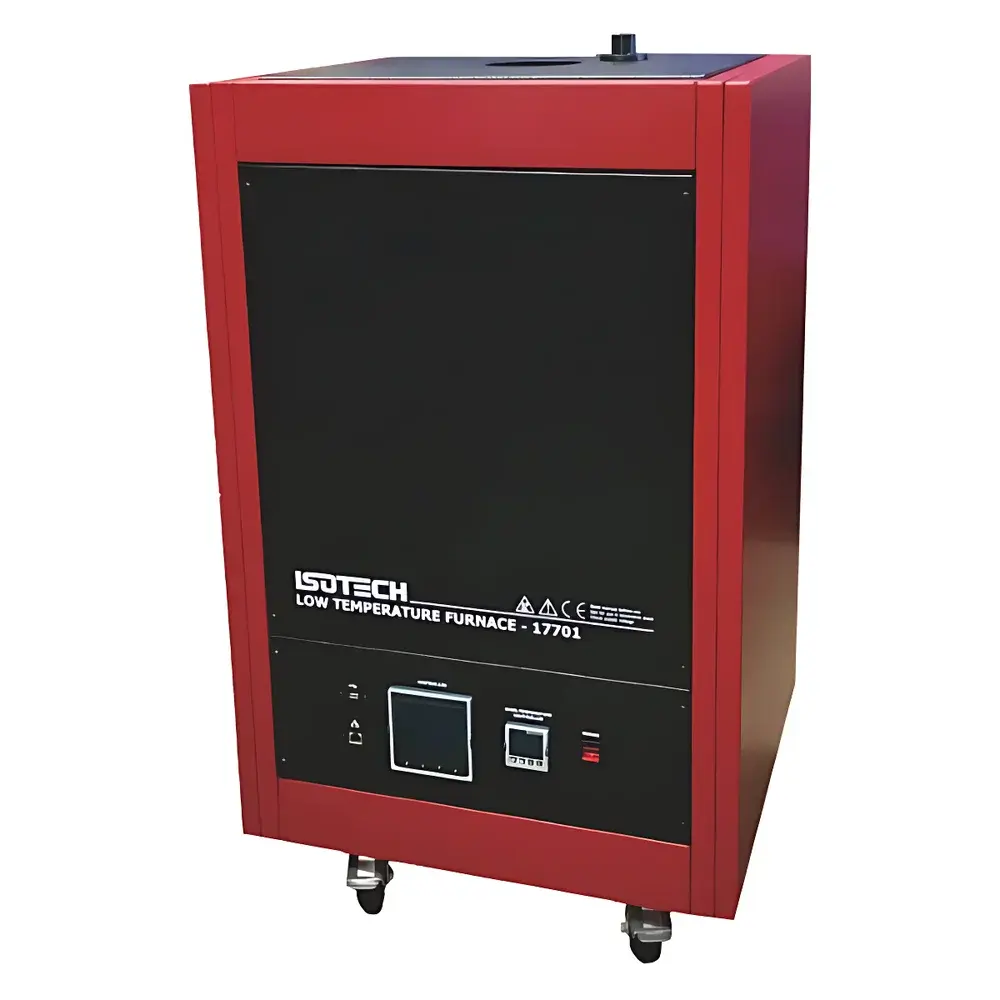
ISOTECH Fixed-Point Cell Furnace Models 17701, 17703 & 465
| Brand | ISOTECH |
|---|---|
| Origin | United Kingdom |
| Model Numbers | 17701, 17703, 465 |
| Application | High-Accuracy Temperature Fixed-Point Realization (In, Sn, Zn, Al) |
| Construction | Stainless Steel Core Tube with Parallel Wound Heating Element |
| Axial Temperature Gradient | <0.1 °C/cm in Working Zone |
| Plateau Duration | ≥20–40 h (dependent on cell type and thermal mass) |
| Control System | PID-Based Automatic Temperature Stabilization |
| Safety | Integrated Power-Fail Protection Circuitry |
| Compliance | Designed for use in accordance with ITS-90 realization protocols |
Overview
The ISOTECH Fixed-Point Cell Furnace series—comprising models 17701, 17703, and 465—is a precision thermal system engineered for the reproducible realization of defining fixed points of the International Temperature Scale of 1990 (ITS-90). These furnaces are purpose-built to host sealed metal-cell assemblies—such as indium (In, 156.5985 °C), tin (Sn, 231.928 °C), zinc (Zn, 419.527 °C), and aluminum (Al, 660.323 °C)—and maintain stable, uniform thermal conditions during phase-transition plateau periods. At their core lies a high-purity stainless steel cylindrical core tube, precisely machined to accommodate standard fixed-point cells with minimal radial clearance. A parallel-wound resistive heating element ensures symmetrical heat distribution along the axial length, minimizing axial temperature gradients (<0.1 °C/cm) across the designated working zone—typically spanning 100–150 mm. This low-gradient architecture directly supports extended plateau durations (20–40+ hours), enabling high-resolution thermometric calibrations compliant with ISO/IEC 17025 requirements for national metrology institutes and accredited calibration laboratories.
Key Features
- Stainless steel core tube with optimized geometry for standardized fixed-point cell insertion and thermal contact uniformity
- Parallel-wound heating element design ensuring axial thermal symmetry and minimized hot/cold spots
- PID-based digital temperature controller with programmable ramp rates, setpoint hold, and real-time deviation monitoring
- Integrated power-fail protection circuitry that maintains furnace integrity and prevents thermal shock upon unexpected shutdown
- Front-panel interface with LED display for setpoint, actual temperature, and status indicators (e.g., “Stabilizing”, “Plateau Active”, “Alarm”)
- Thermal insulation configuration optimized for low external surface temperature and minimal ambient heat dissipation
- Designed for compatibility with standard ITS-90 reference cells from NIST, NPL, PTB, and other NMIs
Sample Compatibility & Compliance
The 17701, 17703, and 465 furnaces support industry-standard sealed fixed-point cells conforming to ISO 5725 (accuracy of measurement methods) and ASTM E220 (standard test method for calibration of thermocouples by comparison techniques). Each model is dimensionally matched to specific cell families: 17701 for In/Sn cells (≤250 °C), 17703 for Zn cells (up to 420 °C), and 465 for Al cells (up to 660 °C). All units are constructed and tested per IEC 61000-6-2 (immunity) and IEC 61000-6-4 (emissions) standards. The furnaces do not incorporate active cooling; therefore, they operate within ambient temperature ranges of 15–30 °C and relative humidity ≤75% non-condensing. Documentation includes traceable factory calibration reports referencing NPL-traceable references, supporting GLP and GMP audit readiness.
Software & Data Management
While these furnaces operate as standalone analog/digital hybrid instruments, optional RS-232 or USB-to-serial interfaces enable integration with third-party data acquisition systems (e.g., LabVIEW, MATLAB, or custom Python scripts). Firmware supports ASCII command protocol for remote setpoint adjustment, temperature readback at 1 Hz resolution, and event logging (e.g., plateau start/end timestamps, thermal deviation alerts). Audit trail functionality—including user ID tagging and timestamped parameter changes—is available when paired with compliant laboratory information management systems (LIMS) meeting FDA 21 CFR Part 11 requirements. Raw temperature time-series data export is supported in CSV format for post-analysis using uncertainty budgeting tools aligned with GUM (JCGM 100).
Applications
- Primary calibration of Standard Platinum Resistance Thermometers (SPRTs) against ITS-90 defining fixed points
- Validation and verification of industrial PRTs, thermocouples, and digital thermometers in metrology labs
- Supporting interlaboratory comparisons under CIPM Mutual Recognition Arrangement (MRA) frameworks
- Temperature scale dissemination in national metrology institutes and ISO/IEC 17025-accredited calibration service providers
- Research into phase-transition thermodynamics, including supercooling behavior and nucleation kinetics in pure metals
- Training platforms for temperature metrology courses at technical universities and regional standards bodies
FAQ
What fixed-point temperatures can be realized with each model?
Model 17701 is optimized for In (156.6 °C) and Sn (231.9 °C); 17703 for Zn (419.5 °C); and model 465 for Al (660.3 °C). Each furnace’s thermal design targets minimal axial gradient specifically within the respective melting range.
Is external water or gas cooling required?
No. These are self-contained, air-cooled furnaces. Forced-air cooling is not required, though adequate ventilation around the base is recommended for sustained operation above 400 °C.
Can the furnace be used for freezing-point or melting-point determinations of non-standard materials?
Not recommended. The thermal profile, control algorithm, and validation are strictly optimized for high-purity ITS-90 metal cells. Deviation from specified cell types compromises plateau stability and measurement uncertainty.
Does the system include calibration documentation?
Yes—each unit ships with a UKAS-accredited calibration certificate (traceable to NPL) covering furnace uniformity, setpoint accuracy, and plateau duration performance at one representative fixed point.
What maintenance is required?
Annual verification of thermal uniformity and controller linearity is advised. No consumables are required; the heating element and core tube are designed for >10,000 operating hours under normal usage conditions.