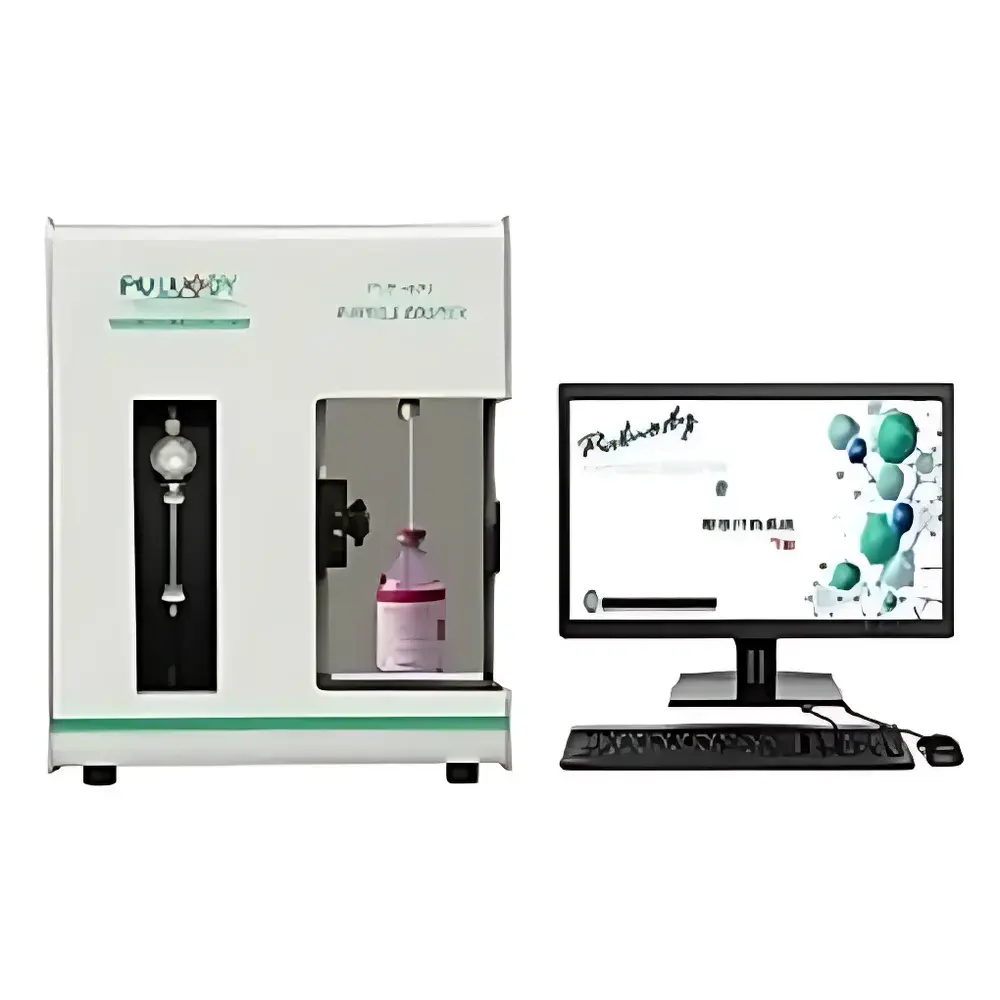
PULUODY PLD-601 Pharmaceutical Packaging & Heart Valve Insoluble Particle Analyzer
| Brand | PULUODY |
|---|---|
| Origin | Shaanxi, China |
| Manufacturer Type | Authorized Distributor |
| Product Origin | Domestic (China) |
| Model | PLD-601 |
| Pricing | Upon Request |
| Sensor Technology | 8th-Generation Dual-Laser Narrow-Beam Particle Sensor |
| Flow Control | Precision Metering Plunger Pump + Ultra-Precise Electromagnetic Flow Control System |
| Software | V8.9 Integrated Analysis Software (PC & Touchscreen) |
| Compliance | ChP 2020 <0903>, USP <788>/<789>/<797>, EP 10/9.0/8.0, BP 2019, JP 17, ISO 21501, ISO 11171, GB/T 11446.9–2013, YBB 00272004–2015, GB 8368 |
| Detection Range | 1–500 µm (optional 0.03–3000 µm) |
| Channel Count | 1000 user-definable channels (min. 4, max. 1000) |
| Resolution | >95% (ChP-calibrated), <10% (USP/ISO-calibrated) |
| Sampling Accuracy | <±1% |
| Measurement Accuracy | ±3% typical |
| Coincidence Limit | 1000 particles/mL (2.5% coincidence error) |
| Sample Flow Rate | 5–150 mL/min |
| Rinse Flow Rate | 5–500 mL/min |
| Fluid Temp. Range | 0–80 °C |
| Ambient Temp. Range | −15–50 °C |
| Calibration Standards | JJG 1061, ISO 21501, NIST-traceable latex spheres |
| Data Integrity | FDA 21 CFR Part 11 compliant (audit trail, electronic signature, role-based 5-level access, backup/restore, power-fail recovery) |
Overview
The PULUODY PLD-601 Pharmaceutical Packaging & Heart Valve Insoluble Particle Analyzer is a fully compliant, laboratory-grade instrument engineered for quantitative analysis of insoluble particulate contamination in parenteral drug products, medical devices, and high-purity fluids. It operates on the light-blockage (optical obscuration) principle—where particles suspended in a liquid stream pass through a precisely collimated dual-laser sensing zone, generating transient voltage pulses proportional to particle cross-sectional area. This method aligns with pharmacopoeial requirements including Chinese Pharmacopoeia (ChP) 2020 Edition , United States Pharmacopeia (USP) , , and , European Pharmacopoeia (EP), Japanese Pharmacopoeia (JP), and ISO 21501–1 for calibration and performance verification. The PLD-601 is specifically validated for use in evaluating pharmaceutical packaging components—including IV bags, stoppers, tubing, syringe barrels—and cardiovascular implantables such as polymeric heart valve housings and delivery catheters—where micro-scale debris from material degradation or manufacturing residue poses critical biocompatibility and safety risks.
Key Features
- 8th-generation dual-laser narrow-beam sensor architecture delivering enhanced signal-to-noise ratio and improved discrimination of sub-micron particles down to 1 µm (with optional configuration extending to 0.03 µm)
- Dual-mode flow control system integrating a precision metering plunger pump and ultra-stable electromagnetic flow regulation—ensuring volumetric accuracy better than ±1% across full operational range (5–150 mL/min)
- 1000-channel high-resolution particle sizing capability with fully customizable binning; supports simultaneous reporting per ChP, USP, ISO, and custom thresholds (e.g., 4–70 µm(c), 1–100 µm, or 0.1 µm(c))
- FDA 21 CFR Part 11-compliant software platform (V8.9) featuring five-tier user permission management, immutable audit trail, electronic signatures, automatic data backup, and seamless restore functionality
- Integrated thermal management enabling stable operation at fluid temperatures from 0 °C to 80 °C—critical for temperature-sensitive biologics and ophthalmic solutions
- Comprehensive validation support package including traceable calibration against NIST-certified latex standards, JJG 1061 verification protocols, and certification by National Defense Science & Technology Commission Level-1 Particle Metrology Station No. 116
Sample Compatibility & Compliance
The PLD-601 is qualified for direct analysis of a broad spectrum of regulated samples without dilution or filtration pre-treatment: sterile aqueous injectables (including lyophilized powders reconstituted per monograph), ophthalmic solutions, vaccines, injection-grade water (WFI, PW), elastomeric closures, polyolefin IV bags, silicone-coated catheters, and polymeric heart valve components. Its measurement protocol satisfies regulatory expectations under ICH Q5A(R2), ISO 10993–12, and AAMI ST72 for extractables and leachables assessment. Instrument qualification documentation conforms to GMP Annex 15 and ASTM E2919–19 for automated particle counters used in sterile product release testing. All firmware, software, and hardware configurations are maintained under formal change control, supporting GLP/GMP audits and regulatory inspections.
Software & Data Management
The V8.9 analysis suite provides a dual-interface environment—fully functional touchscreen GUI for benchtop operation and synchronized PC-based advanced reporting. Raw pulse data, histogram distributions, cumulative counts, and pass/fail status per pharmacopoeial threshold are stored in encrypted SQLite databases with SHA-256 hashing. Audit logs record all user actions—including method edits, result overrides, calibration events, and report exports—with timestamp, operator ID, and IP address. Electronic signatures comply with ALCOA+ principles (Attributable, Legible, Contemporaneous, Original, Accurate, Complete, Consistent, Enduring, Available). Data export options include CSV, PDF, XML, and LIMS-compatible ASTM E1382–22 format. Optional integration with enterprise systems via HL7 or RESTful API enables real-time data ingestion into quality management platforms.
Applications
- Pharmaceutical Quality Control: Routine batch release testing of injectables per ChP , USP , and EP 2.9.19; filter integrity validation; extractables profiling of primary packaging materials
- Medical Device Evaluation: Quantification of wear debris from transcatheter heart valves, stent crimping residues, and polymer particulates shed during balloon inflation or deployment simulations
- Water & Cleanroom Monitoring: Particle load assessment in WFI distribution loops, clean steam condensate, and Class A/B environmental monitoring points per ISO 14644–1
- Electronics & Semiconductor Support: Slurry cleanliness verification for CMP processes, ultrapure water (UPW) qualification per SEMI F63, and post-etch rinse analysis
- Regulatory Submission Support: Generation of raw datasets and summary reports aligned with FDA eCTD Module 3 technical documentation requirements
FAQ
Does the PLD-601 meet current FDA requirements for data integrity in regulated environments?
Yes. Its V8.9 software implements full 21 CFR Part 11 compliance—including role-based access control, electronic signatures, time-stamped audit trails, and data immutability—validated per Annex 11 and PIC/S TR18.
Can the instrument be used to test silicone oil droplets in prefilled syringes?
Yes. With appropriate refractive index compensation and low-viscosity flow optimization, the PLD-601 detects silicone oil globules ≥2 µm in diameter per USP Annex II guidance.
Is third-party metrological verification available for this model?
Yes. PULUODY maintains active accreditation partnerships with CNAS-certified labs including the Northwest Institute of Metrology (Xi’an) and the National Institute of Metrology (Beijing), offering ISO/IEC 17025-compliant calibration certificates.
What sample volume is required for a single test run?
Standard test volumes range from 5 mL to 25 mL depending on expected particle concentration; minimum detectable volume is 1.5 mL using programmable low-flow mode with extended dwell time.
How does the system handle viscous or protein-rich samples that may cause sensor fouling?
The PLD-601 integrates an automated multi-stage rinse cycle (up to 500 mL/min) with configurable solvent selection (water, IPA, or custom buffers), coupled with real-time baseline drift compensation algorithms to maintain optical stability between runs.