
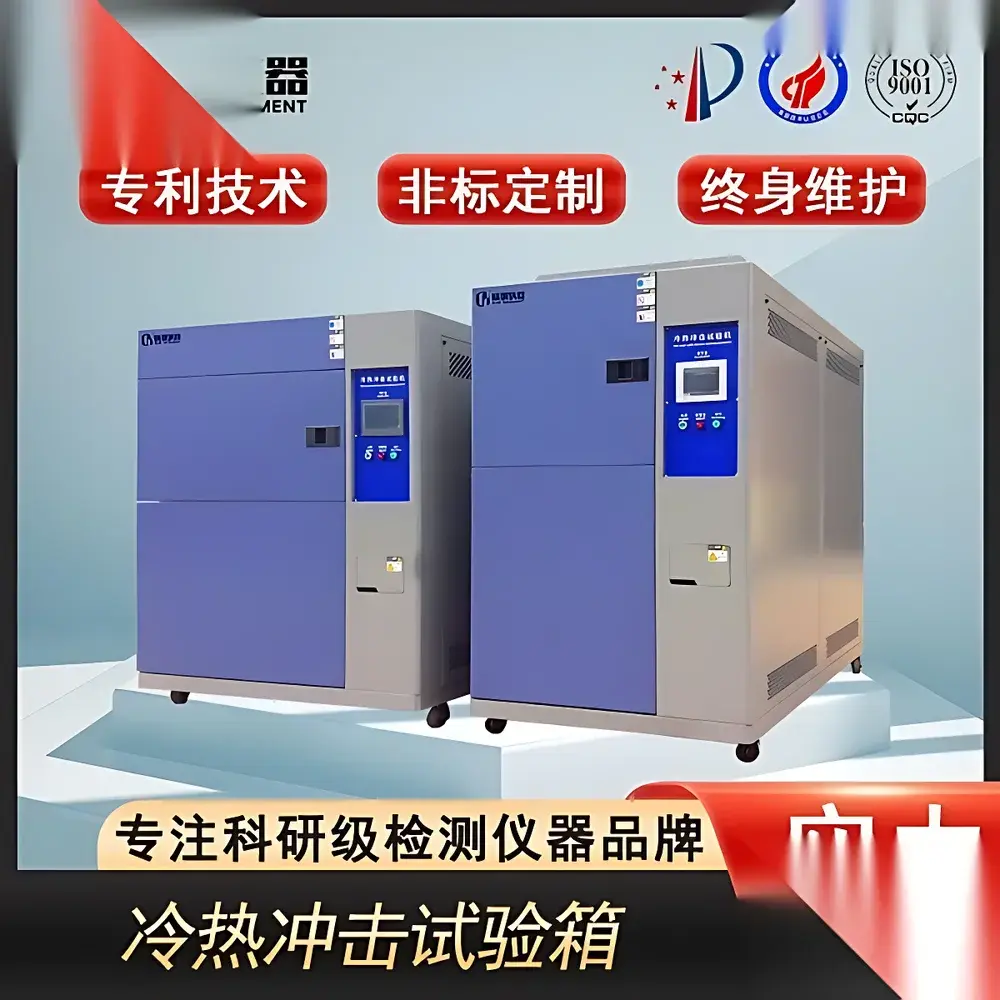
English Product Name
| Brand | Other Brands |
|---|---|
| Origin | Imported |
| Manufacturer Type | Authorized Distributor |
| Temperature Range | −40 °C to +150 °C (Test Chamber) |
| High-Temp Zone | +60 °C to +200 °C |
| Low-Temp Zone | −55 °C to −10 °C |
| Temp. Uniformity | ±2.0 °C |
| Temp. Stability | ±0.5 °C |
| Transfer Time (Basket) | ≤10 s |
| Recovery Time (−40 °C → +150 °C) | ≈5 min |
| Soak Time per Zone | ≥30 min |
| Heating Power | 3.5 kW (Hot Zone) |
| Cooling Power | 2.5 kW (Cold Zone) |
| Internal Dimensions | 300 × 300 × 300 mm (W×H×D) |
| External Dimensions | 1400 × 1870 × 1350 mm (W×H×D) |
Overview
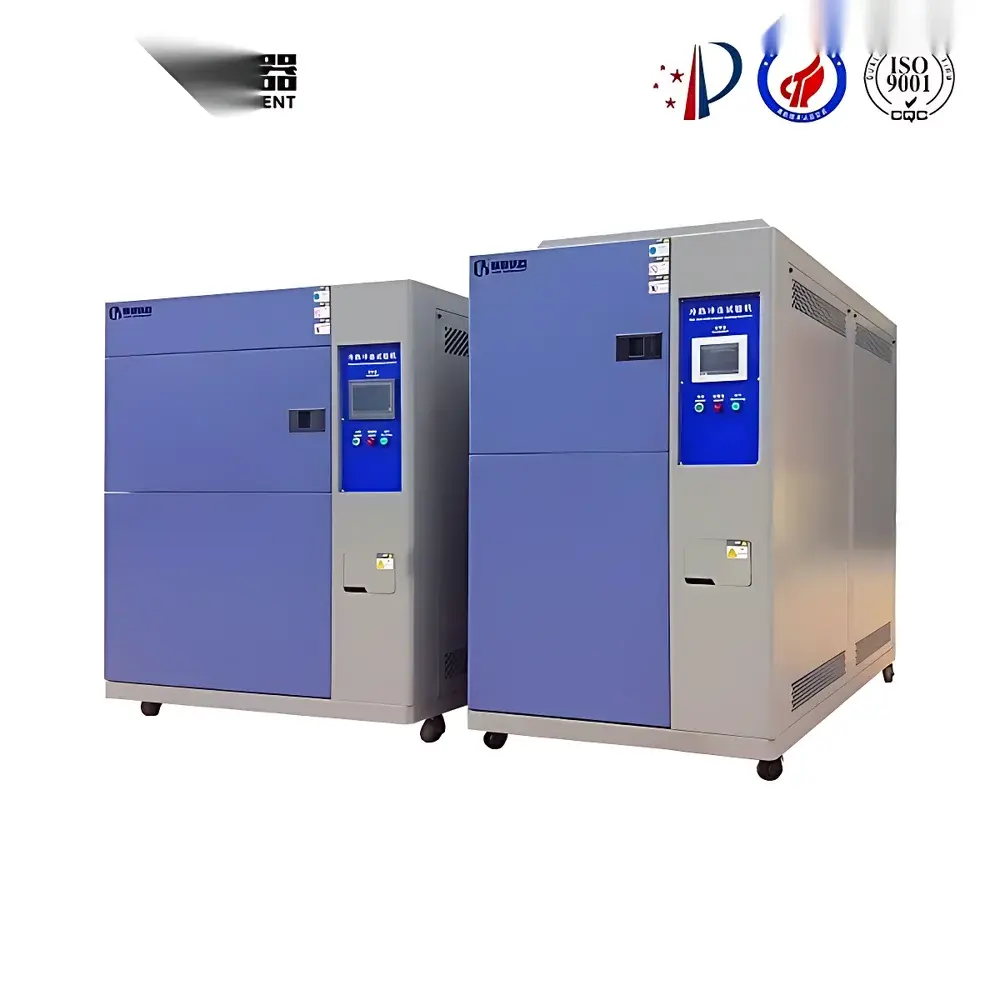
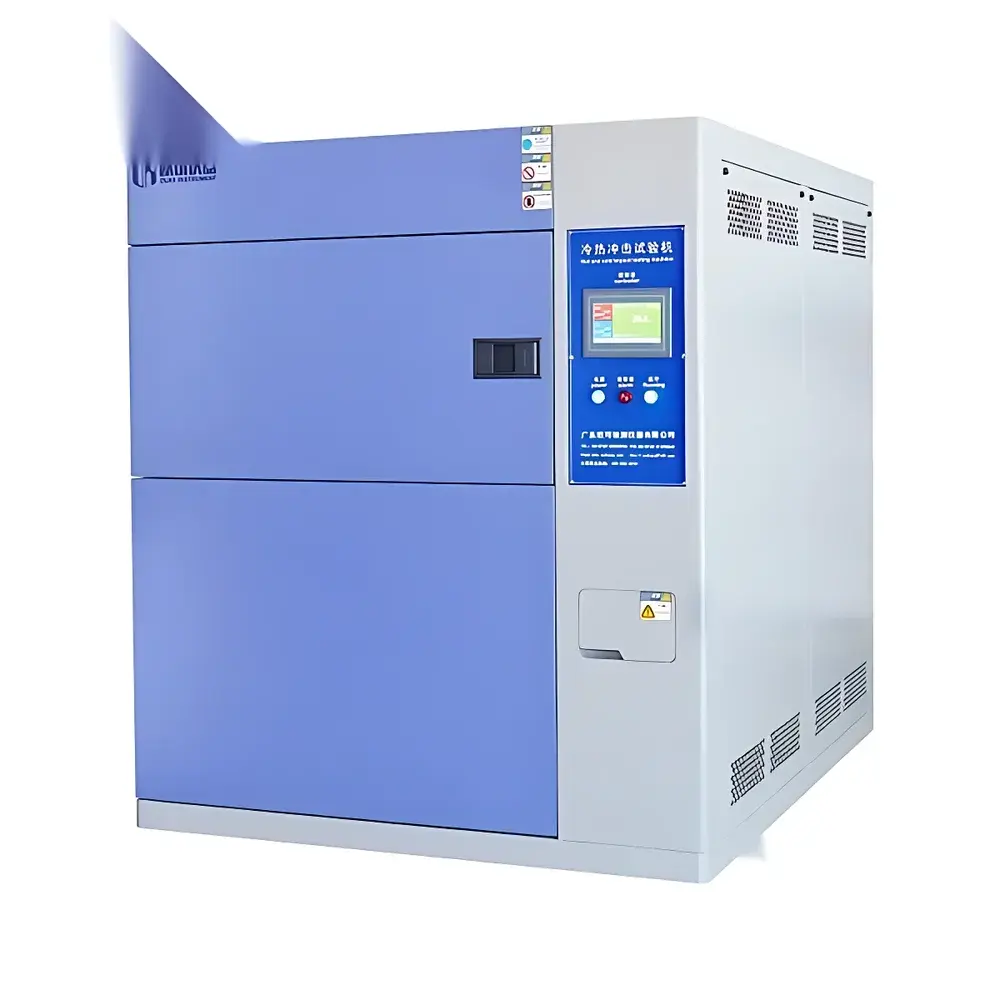
The OK-TS-80A Thermal Shock Test Chamber is a dual-compartment, air-cooled thermal shock system engineered for rapid, repeatable temperature transitions between extreme low and high thermal environments. It operates on the two-zone static chamber principle—featuring independent hot and cold reservoirs maintained at stable setpoints—combined with a vertically actuated stainless steel test basket that transfers samples between zones in under 10 seconds. This architecture enables precise, high-fidelity simulation of thermal stress conditions encountered during product lifecycle events such as solder joint fatigue, material delamination, seal integrity failure, and electronic component solderability degradation. Designed for laboratory and production-line reliability validation, the chamber complies with fundamental thermal testing principles defined in IEC 60068-2-14 (Test N: Change of Temperature) and supports method development aligned with JEDEC JESD22-A104 (Temperature Cycling) and MIL-STD-810H Method 503.4 (Temperature Shock). Its BTC (Balance Temperature Control) algorithm, implemented via PID-driven SSR output modulation, ensures dynamic thermal equilibrium by continuously matching heater output to real-time heat loss—enabling extended-duration stability without overshoot or drift.
Key Features
- Independent dual-zone architecture: Hot zone preheats to +200 °C; cold zone cools to −55 °C—both thermally isolated to prevent cross-contamination and ensure rapid recovery.
- High-speed pneumatic basket transfer mechanism with ≤10-second movement time and positional repeatability < ±0.3 mm.
- Precision temperature control: ±0.5 °C stability and ±2.0 °C uniformity across full working volume (30 L), verified per ASTM E742 and ISO 16750-4 Annex C protocols.
- Robust thermal insulation: Ceramic fiber (alumina-silica) in hot zone; closed-cell polyurethane foam (density ≥45 kg/m³) in cold zone—minimizing standby energy consumption and ambient heat leakage.
- Forced-air circulation system: 90 W SIROCCO fan with stainless steel extended shaft and multi-blade impeller ensures laminar, turbulence-free airflow and eliminates thermal stratification.
- Industrial-grade heating and cooling subsystems: 3.5 kW finned-tube stainless steel heaters (hot zone); 2.5 kW cascade refrigeration circuit (cold zone) with R404A/R23 refrigerant blend.
Sample Compatibility & Compliance
The OK-TS-80A accommodates standard test specimens up to 10 kg mass and 280 mm diagonal dimension within its 300 mm cubic workspace. Compatible with PCB assemblies, automotive ECUs, aerospace connectors, medical device housings, and polymer-based packaging. The chamber meets structural and operational requirements of GB/T 10586–2014 (Environmental Testing Equipment – General Specifications), GB/T 10592–2008 (Specifications for Low-Temperature Test Chambers), and GB/T 2423.1–2021 (Environmental Testing – Part 2-1: Tests – Test A: Cold) and GB/T 2423.2–2021 (Test B: Dry Heat). While not inherently humidity-controlled, it serves as a foundational platform for dry thermal shock qualification per IPC-9701A, AEC-Q200, and IATF 16949 clause 8.3.4.2 (Design and Development Controls).
Software & Data Management
Equipped with an embedded 7-inch TFT touchscreen HMI running real-time OS firmware, the system provides local parameter configuration, profile programming (up to 99 segments), event logging (timestamped temperature, basket position, alarm status), and USB data export (CSV format). Optional RS485/Modbus RTU interface enables integration into centralized MES or SCADA platforms. All operational logs—including calibration history, maintenance alerts, and thermal cycle counts—are retained with non-volatile memory. Audit trail functionality satisfies GLP/GMP documentation requirements per FDA 21 CFR Part 11 when paired with user-access controls and electronic signature modules (available as add-on license).
Applications
- Accelerated reliability assessment of surface-mount technology (SMT) assemblies undergoing reflow soldering process validation.
- Qualification of encapsulated sensors and MEMS devices exposed to automotive under-hood thermal transients.
- Evaluation of adhesive bond strength retention in composite aircraft structures after repeated cryogenic-to-thermal cycling.
- Verification of hermetic seal integrity in implantable medical electronics per ISO 14708-1 Annex D.
- Material science studies on phase transition behavior in shape-memory alloys and thermoplastic elastomers.
FAQ
What is the maximum sample weight supported during thermal shock cycling?
The basket is rated for continuous operation with loads up to 10 kg. Exceeding this may compromise transfer accuracy and long-term mechanical integrity.
Does the chamber support programmable dwell times per zone?
Yes—soak duration in each temperature zone is fully configurable from 1 minute to 999 minutes per cycle segment.
Is external water cooling required for the refrigeration system?
No—the unit uses air-cooled condensers and requires only standard 220–240 V AC, 50/60 Hz power supply with dedicated 20 A circuit.
Can the OK-TS-80A be validated per IQ/OQ protocols?
Yes—factory-installed NIST-traceable PT100 sensors (Class A tolerance) and documented calibration certificates enable full GxP-compliant installation and operational qualification.
What maintenance intervals are recommended for sustained performance?
Compressor oil analysis every 12 months; refrigerant leak check every 6 months; air filter replacement every 3 months; full thermal mapping verification annually or after relocation.



