
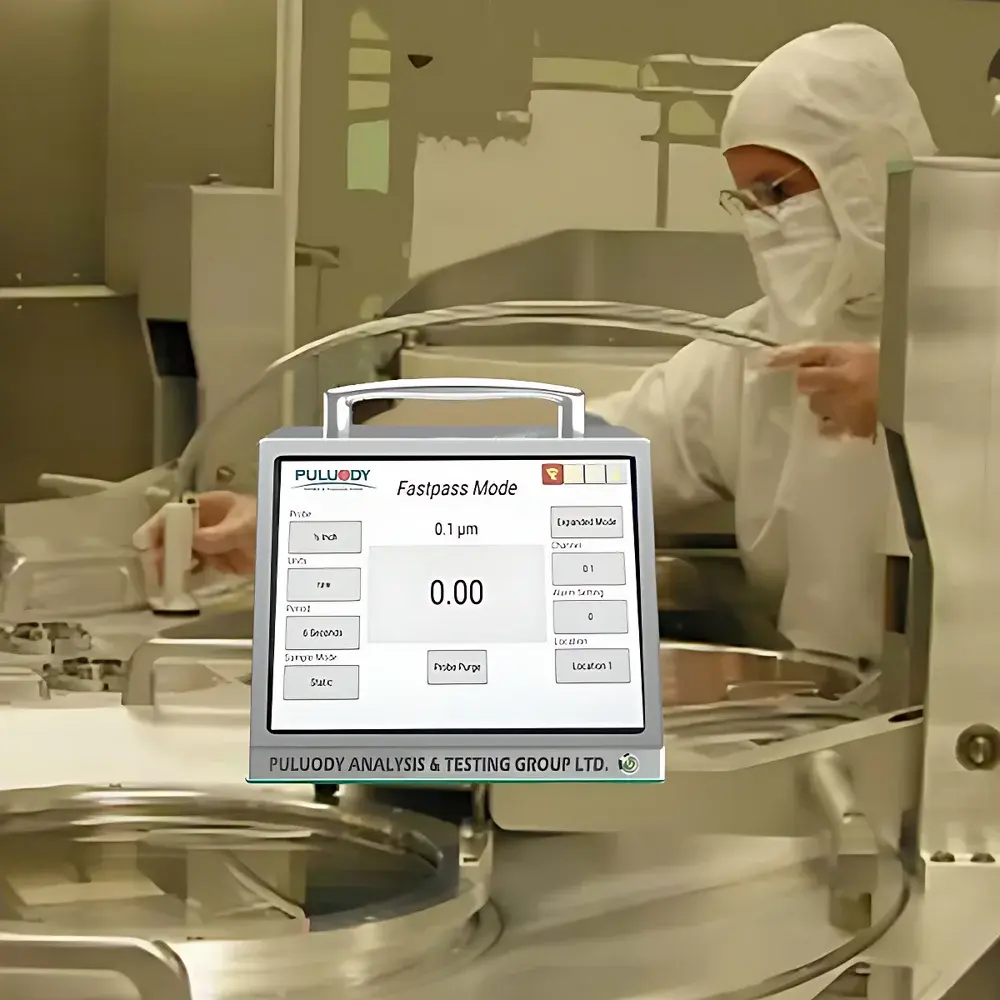
PULUODY Surface Particle Counter P-III
| Brand | PULUODY |
|---|---|
| Model | P-III |
| Type | Optical Surface Particle Counter |
| Measurement Principle | Light Scattering (Laser-Based) |
| Particle Size Channels | Configurable across 6 preset modes (A–F), down to 0.1 µm |
| Accuracy | ±30% for size distribution & concentration |
| Flow Rate | 2.83 L/min or 28.3 L/min (selectable) |
| Sampling Duration | 3–60 s (programmable) |
| Compliance | ISO 14644-1, ISO 14644-9, ISO 21501-4, JIS B 9921 |
| Data Integrity | Audit trail, role-based access control, electronic records (21 CFR Part 11–ready architecture) |
| Operating Environment | 5–45 °C, ≤90% RH (non-condensing) |
| Power Supply | AC 100–240 V, 50/60 Hz |
| Interface Options | RS232, RS485, LAN, USB |
| Detection Modes | Count, Mass, Net Efficiency |
| Alarm Outputs | Customizable count/mass thresholds |
| Probe Flexibility | Multiple interchangeable sampling probes for flat, curved, recessed, or confined surfaces |
Overview
The PULUODY Surface Particle Counter P-III is an industrial-grade optical particle counter engineered specifically for non-contact, quantitative surface contamination assessment in ultra-clean manufacturing environments. Unlike traditional air-sampling particle counters, the P-III employs calibrated laser scattering optics coupled with a precisely controlled laminar airflow probe system to extract and analyze particles directly from solid surfaces—including wafers, photomasks, optical lenses, medical device housings, and chamber interior walls. Its measurement principle adheres to the fundamental physics of Mie scattering, optimized for low-angle detection geometry to maximize sensitivity to sub-micron particulates while minimizing specular reflection interference. Designed for integration into semiconductor front-end process validation, display panel fabrication QC workflows, and Class 1–100 cleanroom surface qualification protocols, the P-III delivers traceable, repeatable data aligned with ISO 14644-9’s requirements for surface particle monitoring—making it a critical tool for contamination control engineers and process reliability teams.
Key Features
- Laser-based optical detection with six configurable particle size channel sets (A–F), supporting resolution down to 0.1 µm—enabling granular analysis for both semiconductor wafer defect screening and high-precision optics inspection.
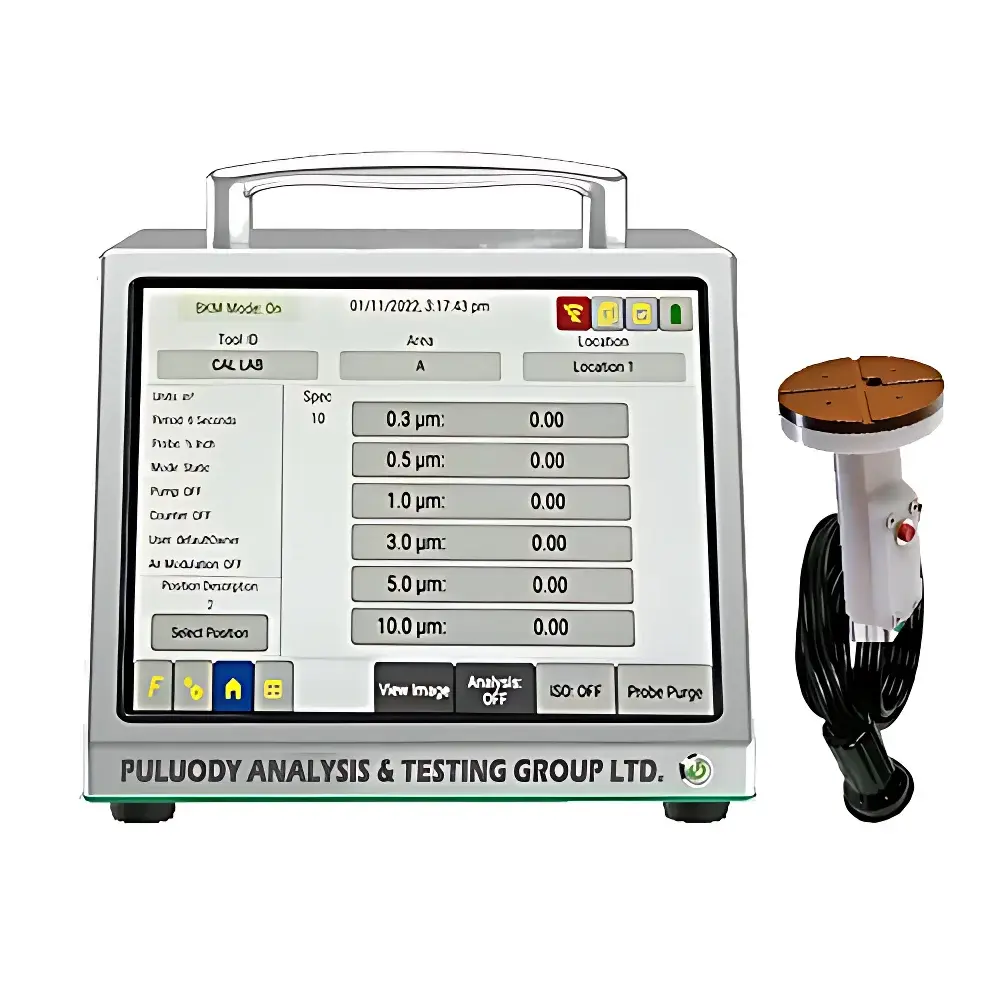
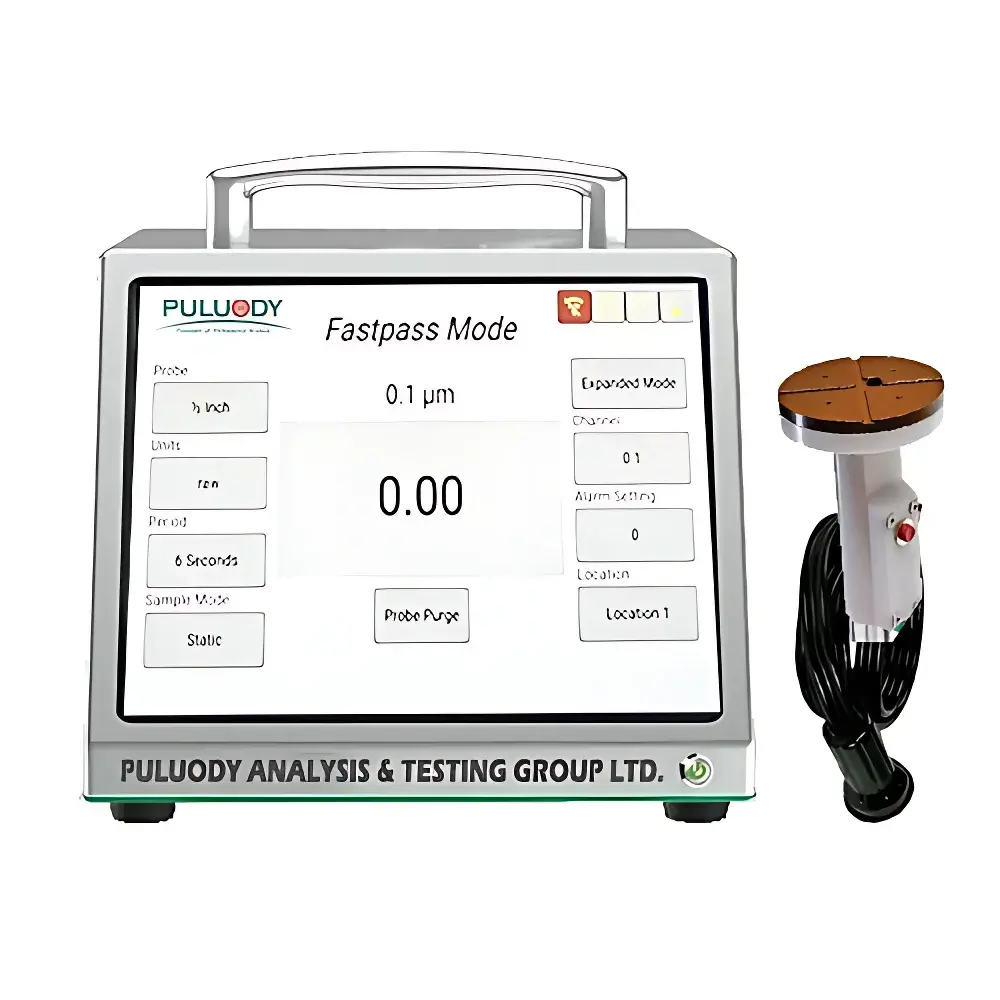
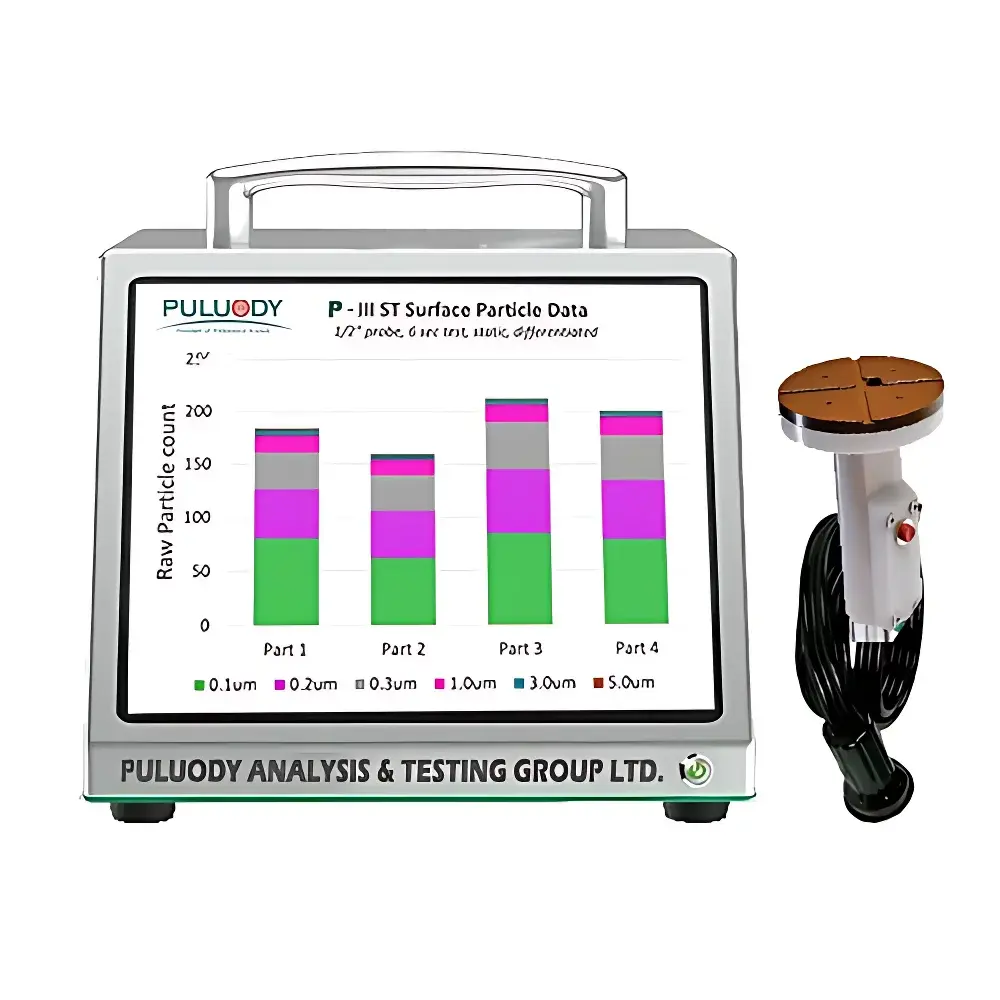
- 7-inch high-brightness capacitive touch display with intuitive GUI for real-time histogram visualization, on-device report generation, and parameter configuration without external PC dependency.
- Dual hot-swappable battery system ensures uninterrupted operation during extended shift cycles or preventive maintenance (PM) windows—eliminating downtime during battery replacement in 24/7 production lines.
- Programmable sampling: selectable flow rates (2.83 L/min or 28.3 L/min), user-defined durations (3–60 s), and detection modes (count, mass-equivalent, net efficiency) to match application-specific statistical confidence and throughput requirements.
- Comprehensive alarm architecture: dual-threshold (count/mass), RS485 digital output, and optional external sound/light activation—fully configurable per SOP and integrated into facility SCADA or MES systems.
- Firmware-upgradable platform via USB interface; supports future calibration updates, new channel configurations, and enhanced data export formats without hardware modification.
Sample Compatibility & Compliance
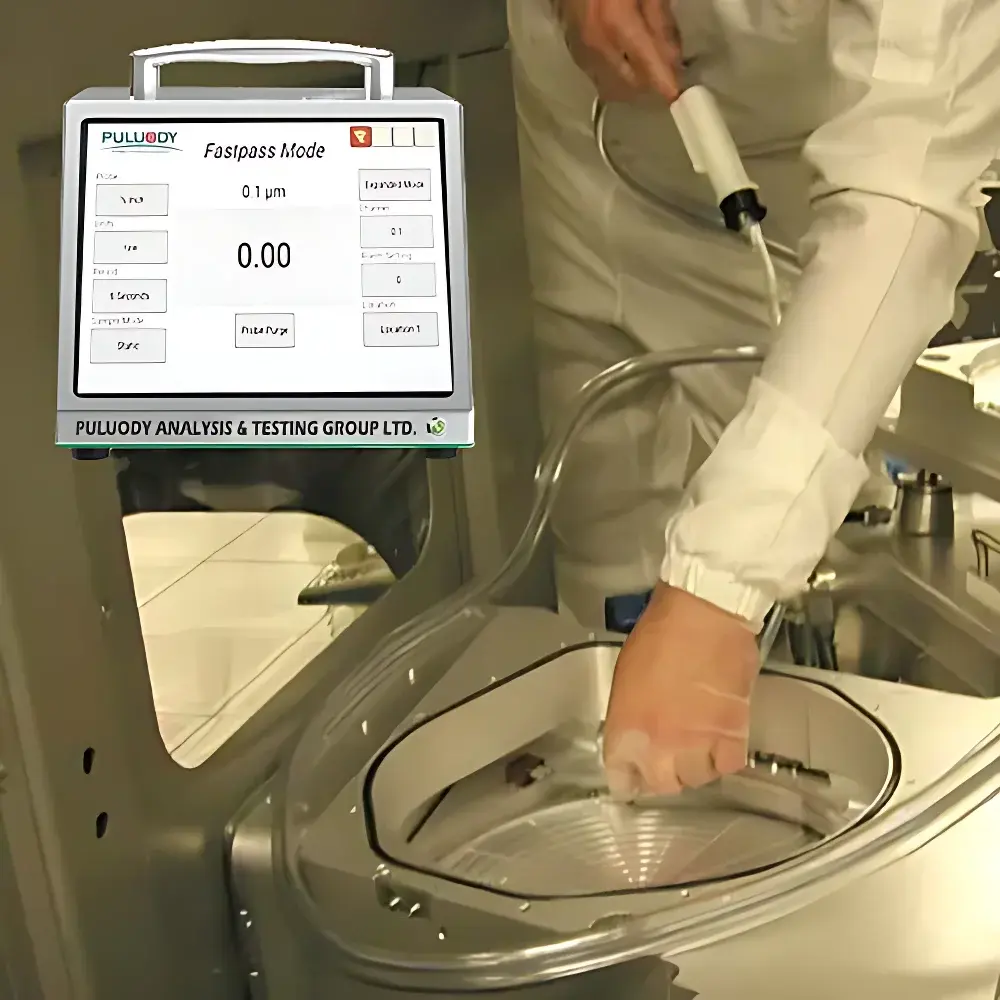
The P-III accommodates diverse surface geometries through its modular probe system—including flat-scan, contour-following, and recessed-cavity probes—ensuring consistent aspiration velocity and particle recovery across substrates ranging from 300 mm silicon wafers to curved endoscopic instrument housings. All measurement protocols are traceable to ISO 14644-1 (airborne particle classification) and ISO 14644-9 (surface cleanliness by particle concentration), with documented equivalence to JIS B 9921 and ISO 21501-4 for instrument performance verification. The system implements full ALCOA+ data integrity principles: audit trails record all user actions (login, parameter changes, report exports), role-based permissions restrict calibration and configuration access, and electronic records are cryptographically timestamped and immutable—meeting baseline expectations for FDA 21 CFR Part 11 compliance in regulated GMP/GLP environments.
Software & Data Management
Data acquisition, analysis, and reporting are managed through embedded firmware with optional cloud-sync capability (via LAN). Raw count data is stored indefinitely on internal flash memory with time-stamped metadata (operator ID, location tag, probe serial, environmental conditions). Export formats include CSV (for statistical process control tools), PDF reports with embedded histograms and pass/fail annotations, and XML for LIMS integration. Firmware updates preserve historical calibration coefficients and user-defined SOP templates. Optional USB-connected thermal printer enables on-site hardcopy documentation compliant with internal audit requirements.
Applications
- Semiconductor manufacturing: Quantitative validation of wafer surface cleanliness pre-lithography, post-CMP, and after chamber PM—reducing unnecessary rework and shortening equipment turnaround time by up to 50%.
- Flat-panel display production: Monitoring particle shedding from spacers, polarizer films, and TFT array substrates to prevent yield loss in high-resolution AMOLED and microLED lines.
- Medical device assembly: Final surface verification of implant-grade stainless steel components, silicone seals, and polymer tubing prior to sterile packaging—supporting ISO 13485 quality system evidence.
- Aerospace optics: Contamination control for infrared sensor windows and laser cavity mirrors where sub-0.5 µm particulates induce wavefront distortion.
- Advanced packaging: Characterizing die attach pad cleanliness in fan-out wafer-level packaging (FO-WLP) processes where conductive particle residues cause short circuits.
FAQ
What surface types can the P-III reliably sample?
It supports flat, slightly curved, and recessed surfaces using application-specific probes—validated for silicon, quartz, stainless steel, fused silica, and polymer substrates.
Is the P-III suitable for ISO Class 1 cleanroom use?
Yes; its design meets ISO 14644-9 Annex B requirements for surface monitoring instrumentation, including zero-particle background verification and recovery efficiency validation.
How is calibration maintained over time?
Calibration uses NIST-traceable PSL standards; field verification is performed using certified reference slides, with results logged automatically in the audit trail.
Can the P-III integrate with our existing MES or CMMS?
Via RS485 or LAN, it supports Modbus TCP and custom ASCII protocols for seamless data ingestion into enterprise quality systems.
Does the system support multi-user permission levels?
Yes—administrator, operator, and viewer roles are enforced at firmware level, with password complexity and session timeout policies configurable per site policy.
Related Products



