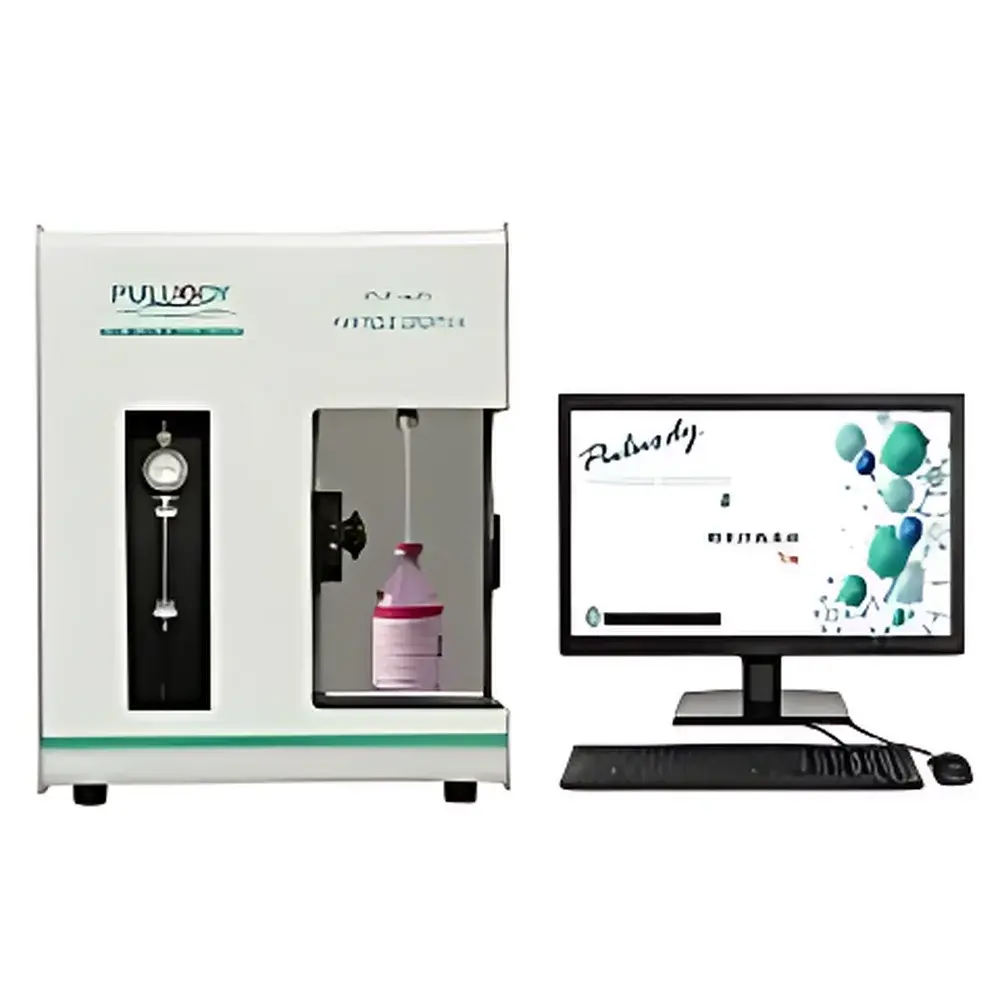
PULUODY PLD-601 Pharmaceutical Packaging and Single-Use Needle Insoluble Particle Analyzer
| Brand | PULUODY |
|---|---|
| Origin | Shaanxi, China |
| Manufacturer Type | Authorized Distributor |
| Country of Origin | China |
| Model | PLD-601 |
| Price | USD 23,500 (approx.) |
Overview
The PULUODY PLD-601 Insoluble Particle Analyzer is a regulatory-compliant, laboratory-grade instrument engineered for quantitative detection and size-resolved counting of insoluble particulate matter in parenteral pharmaceuticals, medical packaging materials, single-use drug delivery components (e.g., prefilled syringe needles, IV connectors, tubing), and associated aqueous solutions. It operates on the principle of light extinction (also known as optical blockage or light obscuration), per USP , EP 2.9.19, and ChP 0903. The system integrates an eighth-generation dual-laser narrow-beam particle sensor—co-developed with UK-based PULUODY R&D—to deliver high signal-to-noise ratio detection across a broad dynamic range. Its core measurement architecture adheres to ISO 21501-4:2018 for calibration traceability and supports compliance with FDA 21 CFR Part 11, EU Annex 11, and GLP/GMP data integrity requirements through embedded audit trail, electronic signatures, and five-level user permission control.
Key Features
- Eighth-generation dual-laser narrow-beam optical sensor with ultra-low background noise and enhanced sensitivity down to 0.01 µm (detection threshold configurable per pharmacopoeial method)
- Dual-precision fluidic control: high-accuracy metering piston pump + ultra-stable electromagnetic flow regulation, ensuring volumetric accuracy < ±1% and repeatability < ±3%
- 1000-channel resolution capability—fully customizable channel binning (e.g., 4–128 bins) for granular particle size distribution analysis per USP , ChP 0903, or ISO 4406
- Wide operational range: particle sizing from 1 µm to 500 µm standard; optional extended range (0.03–3000 µm) available via sensor configuration
- Temperature-controlled fluid path (0–80 °C) and ambient operating range (−15–50 °C) suitable for cold-chain product testing and high-temperature sterilant validation
- V8.9 Analytical Software Suite with integrated data backup/recovery, power-fail recovery, and full 21 CFR Part 11 compliance modules including electronic signature workflow and immutable audit log
- Touchscreen HMI with bilingual (English/Chinese) interface; optional wireless keyboard/mouse support for lab-integrated workflows
Sample Compatibility & Compliance
The PLD-601 is validated for direct analysis of pharmacopeia-specified sample types including sterile powders for injection, large-volume parenterals (LVPs), small-volume parenterals (SVPs), ophthalmic solutions, vaccines, water for injection (WFI), purified water, and pharmaceutical packaging components (e.g., stoppers, seals, plastic containers, IV bags, and single-use needle assemblies). It supports filter challenge testing—including terminal filter efficiency evaluation per ASTM F838—and quantifies particle removal rates for both pre- and post-filtration samples. Regulatory alignment includes ChP 2020 Edition (0903), USP //, EP 10.0/9.0, JP 17, BP 2019, WHO International Pharmacopoeia (IntPh IV), YBB00272004-2015 (pharmaceutical packaging), GB 8368 (infusion devices), and ISO 21510 (medical device particulate testing). Calibration traceability is maintained via NIM Northwest Metrology Center or DFKW Grade I Particle Calibration Station No. 116, with reference standards compliant to JJG 1061, ISO 21501-4, and NIST-traceable latex sphere suspensions.
Software & Data Management
The V8.9 PC-based analytical software provides full lifecycle data governance: real-time particle count histograms, cumulative/differential size distribution plots, pass/fail reporting against user-defined limits (e.g., ChP 0903 thresholds: ≥10 µm ≤ 25 particles/mL; ≥25 µm ≤ 3 particles/mL), and automated batch summary reports. All raw data files are stored in encrypted, non-editable binary format with SHA-256 checksum verification. Audit trails record every user action—including parameter changes, result edits, and report exports—with timestamps, operator ID, and IP address (where networked). Electronic signatures comply with ALCOA+ principles and support multi-tier approval workflows for QC release documentation. Data export formats include CSV, PDF/A-2, and XML for LIMS integration.
Applications
- Pharmaceutical manufacturing: QC release testing of injectables, lyophilized products, and excipient solutions per compendial methods
- Primary packaging qualification: particulate shedding assessment of rubber stoppers, polymer vials, syringe barrels, and single-use needle hubs under simulated use conditions
- Medical device validation: particulate generation testing of IV sets, infusion pumps, and blood circuit components per ISO 10993-12 and AAMI TIR42
- Water system monitoring: WFI, PW, and ultrapure water (UPW) compliance verification per USP and ISO 8573-7
- Process troubleshooting: identification of wear debris in filling lines, filtration breakthrough events, and cleaning validation residue carryover
- Cross-industry extension: semiconductor CMP slurries, biopharma cell culture media, cosmetic emulsions, and food-grade suspensions requiring ISO 11171-compliant particle profiling
FAQ
Does the PLD-601 meet FDA 21 CFR Part 11 requirements for electronic records and signatures?
Yes—the system implements full Part 11 compliance including role-based access control, audit trail with immutable timestamps, electronic signature capture with biometric or token-based authentication, and data integrity safeguards such as checksum verification and write-once archival storage.
Can the instrument be calibrated to ISO 21501-4 or USP reference standards?
Yes—calibration is performed using NIST-traceable polystyrene latex spheres per ISO 21501-4:2018 and verified against USP procedural specifications. Certificate of Calibration is issued by either NIM Northwest Metrology Center or DFKW Particle Calibration Station No. 116.
Is the 1000-channel resolution used for all measurements, or is it configurable per test method?
Channel configuration is fully user-definable: operators may select discrete binning schemes (e.g., 4-channel for ChP 0903, 32-channel for detailed PSD analysis) without hardware modification. The underlying 1000-channel detector enables interpolation and retrospective re-binning.
What sample volume precision is achieved during automated aspiration?
Volumetric accuracy is ≤ ±1% across the full flow range (5–150 mL/min), validated per ISO 8655-6 using gravimetric methods and certified pipettes.
How does the system handle sample carryover between runs?
Automated rinse cycles operate at up to 500 mL/min with programmable duration and solvent selection. Residual particle carryover is verified to < 0.1% via sequential blank testing per USP guidance.