
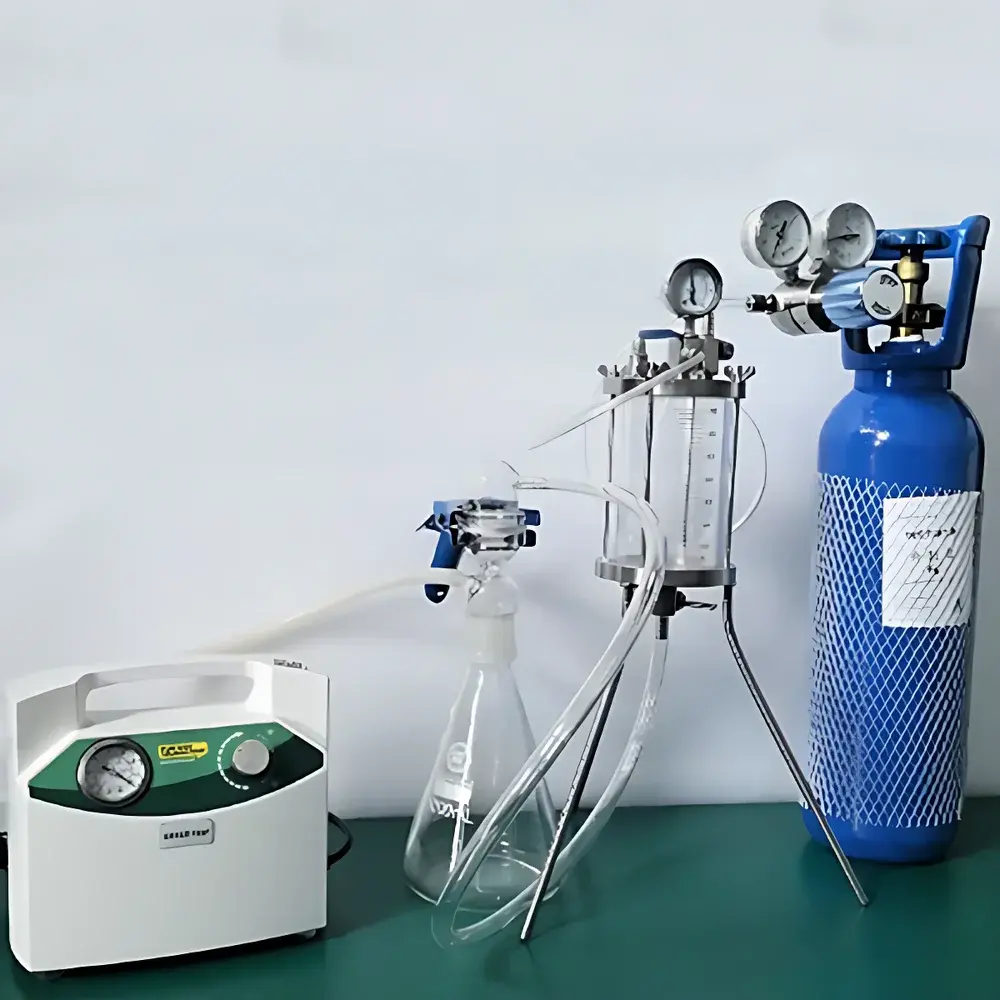
PULUODY PSD-351B Microfiltration Membrane Filtration Apparatus for Suspended Solids Analysis
| Brand | PULUODY |
|---|---|
| Model | PSD-351B |
| Origin | Shaanxi, China |
| Instrument Type | Laboratory Water Quality Analyzer |
| Application Scope | Surface Water, Groundwater, Domestic Wastewater, Industrial Effluent, Oilfield Injection Water |
| Compliance Standards | SY/T 5329–2012, GB 11901–1989, GB/T 606–2006, GB/T 11133–2015, GB 7600–2014 |
| Gas Source | Nitrogen (externally supplied or optional integrated regulator) |
| Filter Diameter | φ43 mm |
| Housing Materials | Corrosion-resistant stainless steel + optical-grade acrylic |
| Pressure Regulation | Integrated pressure-reducing valve, precision pressure gauge, and dual-stage flow control valves |
| Temperature Monitoring | Digital electronic thermometer (±0.5 °C accuracy) |
| Timing | Manual stopwatch interface with synchronized logging capability |
| Membrane De-airing Function | Integrated venting mechanism to eliminate air bubbles on membrane surface |
| Filtration Mode | Constant-pressure gravimetric filtration |
Overview
The PULUODY PSD-351B Microfiltration Membrane Filtration Apparatus is a dedicated laboratory instrument engineered for the quantitative determination of suspended solids (SS) in aqueous samples according to standardized gravimetric procedures. It operates on the principle of constant-pressure membrane filtration—where a precisely measured volume of sample is driven through a defined-pore-size polymer membrane (φ43 mm) under controlled nitrogen gas pressure. The retained particulate matter is dried and weighed, enabling direct calculation of SS concentration (mg/L) per GB 11901–1989 and SY/T 5329–2012. Unlike vacuum-driven or pump-assisted systems, the PSD-351B employs regulated positive-pressure delivery, minimizing membrane clogging artifacts and ensuring high reproducibility across heterogeneous matrices—including turbid industrial effluents, saline oilfield injection water, and low-conductivity groundwater. Its modular architecture supports method traceability, operator safety, and compliance with routine environmental monitoring workflows.
Key Features
- Constant-pressure nitrogen-driven filtration system with integrated pressure regulator, precision Bourdon-tube pressure gauge (0–0.6 MPa range), and calibrated泄压阀 (pressure relief valve) for safe overpressure management
- Dual-valve flow path design: independent inlet, outlet, and purge valves enable precise sequence control—sample loading, pressurization, filtration termination, and membrane rinsing
- Optically transparent acrylic sample reservoir and filtrate collection chamber permit real-time visual monitoring of filtration progress and bubble formation
- Dedicated membrane de-airing function: built-in vent channel and manual purge port allow complete removal of entrapped air from the filter surface prior to measurement—critical for accurate mass retention
- Corrosion-resistant construction: 304 stainless steel fittings, anodized aluminum mounting frame, and chemically inert acrylic housings ensure long-term stability in aggressive wastewater and high-salinity injection water environments
- Integrated digital temperature sensor (range: 0–50 °C, resolution: 0.1 °C) and mechanical stopwatch interface support ambient-condition correction per ASTM D5907–22 guidelines
Sample Compatibility & Compliance
The PSD-351B is validated for use with a broad spectrum of water matrices requiring regulatory-compliant suspended solids quantification. These include surface water per EPA Method 160.2, groundwater per ISO 5667-12, domestic and industrial wastewater per ISO 11923, and oilfield injection water per SY/T 5329–2012 Annex B. Its filtration geometry and pressure control meet the dimensional and operational requirements of GB 11901–1989, including specified membrane diameter (φ43 mm), minimum drying time (≥1 h at 103–105 °C), and gravimetric repeatability thresholds (RSD ≤5% for duplicate analyses). All wetted materials comply with USP Class VI biocompatibility standards and exhibit no measurable leachables in ultrapure water blank tests.
Software & Data Management
The PSD-351B is a hardware-only platform designed for integration into GLP/GMP-aligned laboratory information management systems (LIMS). While it does not include embedded firmware or touchscreen controls, its mechanical design supports full audit-trail documentation: pressure readings are recorded manually or via external digital loggers compliant with FDA 21 CFR Part 11; temperature and timing data are captured synchronously using calibrated secondary instruments. Each unit ships with a traceable calibration certificate for pressure gauge and temperature sensor, referencing NIST-traceable standards. Optional accessories—including certified reference membranes, pre-weighed glass fiber filters (GF/C), and ISO/IEC 17025-accredited gravimetric balance validation kits—are available to support full analytical method validation per ISO/IEC 17025:2017 Clause 7.2.
Applications
- Regulatory compliance testing for municipal wastewater discharge permits (e.g., NPDES, EU Urban Wastewater Treatment Directive)
- Oilfield water quality assurance: monitoring suspended solids in produced water reinjection streams to prevent reservoir formation damage
- Drinking water treatment plant optimization: evaluating coagulation-flocculation efficiency via raw vs. clarified water SS differentials
- Environmental impact assessments: baseline and post-intervention suspended load analysis in riverine and lacustrine systems
- Pharmaceutical manufacturing: verification of pretreatment filtration integrity prior to reverse osmosis or ultrafiltration stages
- Academic and method development laboratories: comparative evaluation of membrane fouling kinetics under controlled pressure gradients
FAQ
Is nitrogen gas supply mandatory?
Yes—nitrogen is required as the pressurizing medium to avoid oxidation of sensitive samples and ensure inert atmosphere during filtration. A standard lab-grade N₂ cylinder (≥99.998% purity) with CGA-580 fitting is recommended.
Can the PSD-351B accommodate alternative membrane diameters?
No—the apparatus is mechanically optimized for φ43 mm circular membranes only. Use of non-standard sizes compromises seal integrity and invalidates compliance with GB 11901–1989 and SY/T 5329–2012.
Does the system support automated data logging?
Not natively. However, analog pressure and temperature outputs can be interfaced with third-party data acquisition systems (e.g., LabVIEW-compatible DAQ modules) for time-synchronized recording.
What maintenance intervals are recommended?
Quarterly inspection of O-rings and valve seats; annual recalibration of pressure gauge and temperature sensor by an ISO/IEC 17025-accredited provider.
Is the instrument suitable for hazardous or explosive atmospheres?
No—it lacks ATEX or IECEx certification and must be operated in general-purpose laboratory environments only.
Related Products







