
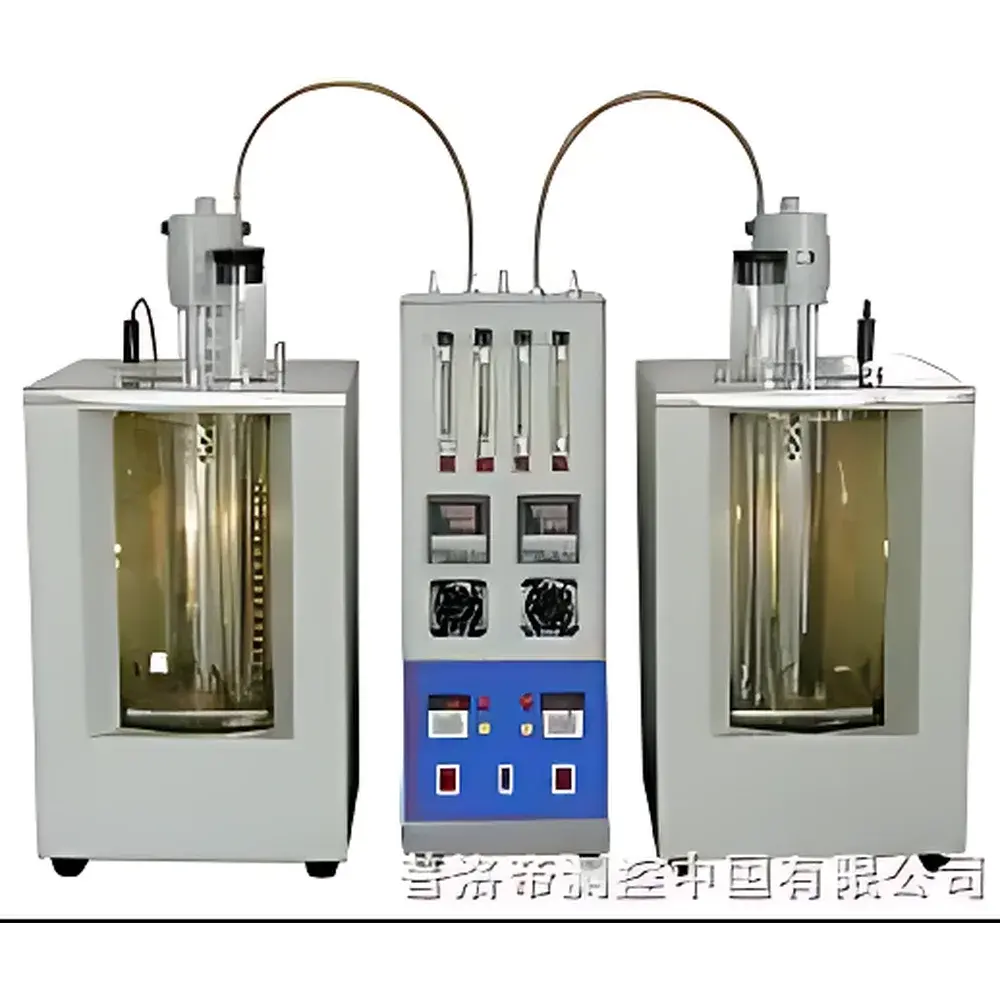
PULUODY PLD-12579A Lubricating Oil Foam Characteristics Tester
| Brand | PULUODY |
|---|---|
| Origin | Shaanxi, China |
| Manufacturer Type | Direct Manufacturer |
| Country of Origin | China |
| Model | PLD-12579A |
| Input Power | 2300 W |
| Power Supply | AC 220 V ±10%, 50 Hz |
| Temperature Control Range | 24 °C (low) to 93.5 °C (high) |
| Temperature Stability | ±0.5 °C |
| Stirring Motor Power | 25 W |
| Adjustable Temperature Setpoint Range | 0–99.9 °C |
| Timer Range | 0–99.99 hours |
| Portable Chiller Power | 200 W |
| Air Flow Rate | 16–160 mL/min |
Overview
The PULUODY PLD-12579A Lubricating Oil Foam Characteristics Tester is a precision-engineered instrument designed for the quantitative evaluation of foam tendency (FT) and foam stability (FS) in lubricating oils under standardized thermal and aerative conditions. It operates on the principle of controlled air sparging through a defined orifice into a heated or cooled oil sample, followed by visual or photometric assessment of foam volume development and decay kinetics over time. This methodology aligns with internationally recognized test protocols—specifically ASTM D892 (Standard Test Method for Foaming Characteristics of Lubricating Oils) and GB/T 12579 (Chinese national standard for determination of foam properties of lubricants)—ensuring data comparability across global laboratories and OEM specifications. The system integrates dual-temperature capability (24 °C and 93.5 °C), enabling evaluation across operational regimes relevant to cold-start and high-temperature service conditions typical in engine, hydraulic, and gear oil applications.
Key Features
- Dual-temperature water bath architecture with independent high- and low-temperature reservoirs, each equipped with PID-controlled heating/cooling loops and real-time digital monitoring
- High-reproducibility air delivery system featuring calibrated rotameter-based flow control (16–160 mL/min), integrated particulate and moisture filtration, and stainless-steel diffusion frits compliant with ASTM D892 geometry requirements
- Programmable digital timer with resolution to 0.01 hours (0–99.99 h), supporting both FT (initial foam volume after 5 min aeration) and FS (residual foam volume after 10 min rest) measurement sequences
- Integrated portable chiller unit (200 W) for rapid and stable sub-ambient temperature maintenance at 24 °C without external cryogenic supply
- Robust mechanical design including corrosion-resistant stainless-steel sample holders, sealed motor-driven stirrer (25 W), and thermally insulated housing to minimize ambient drift
- Compliance-ready configuration with traceable calibration documentation, accessible sensor ports, and stable thermal ramp profiles suitable for internal method validation
Sample Compatibility & Compliance
The PLD-12579A accommodates standard ASTM D892 glassware—including 1000-mL graduated cylinder and specified immersion depth fixtures—and supports sample volumes from 180 mL to 200 mL. It is validated for use with mineral-based, synthetic, and semi-synthetic lubricants, including engine oils (API SP, CK-4), turbine oils (ISO-L-TGA), hydraulic fluids (ISO-L-HM), and greases (after solvent dilution). All thermal and airflow parameters meet the tolerance envelopes defined in ASTM D892 Sections 6–8 and GB/T 12579 Clause 5. The instrument’s construction adheres to IEC 61010-1 safety standards for laboratory electrical equipment, and its temperature control subsystem supports GLP-compliant audit trails when paired with external data loggers.
Software & Data Management
While the PLD-12579A operates as a standalone benchtop instrument with analog/digital hybrid controls, it is engineered for seamless integration into regulated environments. All critical operating parameters—including setpoint temperature, actual bath temperature, airflow rate, and elapsed time—are displayed via front-panel LED indicators with ±0.1 °C and ±1 mL/min resolution. Optional RS-232 or USB-to-serial interface modules (available upon request) enable connection to LIMS or ELN platforms for automated data capture. When used in conjunction with 21 CFR Part 11–compliant software suites, the system supports electronic signatures, user access levels, and immutable audit logs for foam height readings manually entered post-test.
Applications
- Quality control release testing of finished lubricants against OEM foam specifications (e.g., General Motors GMW16038, Ford WSS-M2C913-A)
- Formulation development for anti-foam additive packages (e.g., silicone polymers, alkyl acrylates) and structure–performance correlation studies
- Stability assessment of re-refined base oils and bio-lubricants under oxidative stress conditions
- Root-cause analysis of field-reported foaming incidents in hydraulic systems and compressors
- Regulatory submission support for API licensing and REACH registration dossiers requiring standardized foam data
FAQ
What standards does the PLD-12579A comply with?
It fully implements ASTM D892 (Methods A, B, and C) and GB/T 12579, including prescribed temperature points, airflow rates, cylinder geometry, and timing sequences.
Can the instrument perform tests at intermediate temperatures between 24 °C and 93.5 °C?
Yes—the temperature setpoint range is adjustable from 0 °C to 99.9 °C, though official compliance with ASTM D892 requires validation only at the two specified reference points.
Is calibration certification included with shipment?
Each unit ships with a factory calibration report covering temperature sensors (traceable to NIM, China) and airflow meter (calibrated against primary standard rotameters). ISO/IEC 17025-accredited third-party calibration is available as an add-on service.
What maintenance is required for long-term accuracy?
Routine verification includes quarterly checks of bath temperature uniformity (±0.3 °C across cylinder zone), annual replacement of air filter elements, and biannual inspection of diffusion frit integrity per ASTM D892 Annex A2.
Does the system support automated foam height measurement?
The base configuration relies on operator-read meniscus observation per standard practice; however, optional digital image analysis modules with edge-detection algorithms can be retrofitted for objective foam layer quantification.





