
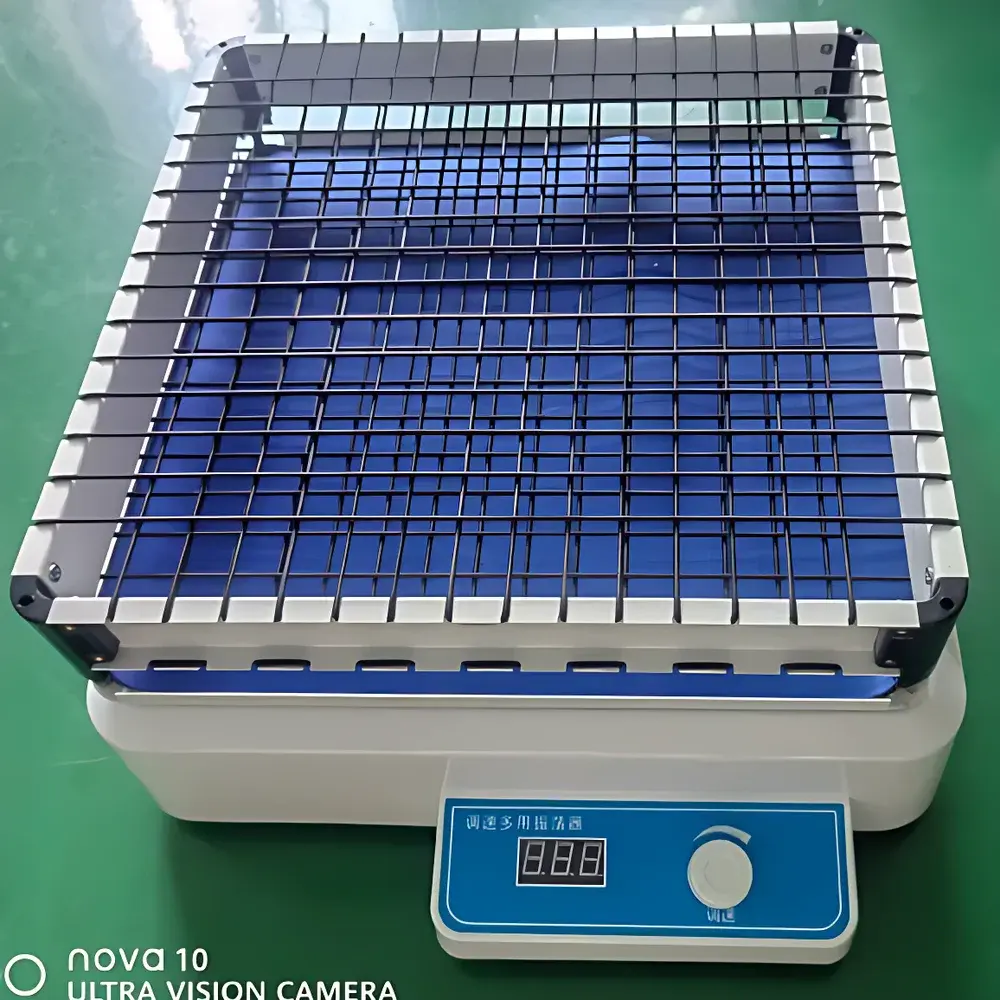
PULUODY PLD-GS2 Multi-Function Fully Automatic Orbital Shaker
| Brand | PULUODY |
|---|---|
| Model | PLD-GS2 |
| Drive Type | Orbital (Circular) Motion |
| Speed Range | 40–350 rpm |
| Display | Digital LED Speed & Timer |
| Timer Range | 1–10 h or Continuous Operation |
| Platform Dimensions | 360 × 360 mm |
| Oscillation Amplitude | 20 mm (customizable eccentricity available) |
| Max Load Capacity | 8 kg |
| Motor Power | 32 W |
| Input Voltage | AC 100–220 V, 50/60 Hz |
| Platform Material | Stainless Steel with Adjustable Spring-Loaded or Belt-Type Clamps (custom fixtures supported) |
| Noise Level | <55 dB(A) |
| Dimensions (L×W×H) | 450 × 390 × 110 mm |
| Net Weight | 11 kg |
| Compliance | CE-marked design principles |
Overview
The PULUODY PLD-GS2 Multi-Function Fully Automatic Orbital Shaker is an engineered platform for precise, reproducible, and uniform sample agitation under controlled rotational motion. It operates on the principle of orbital (circular) oscillation—where the platform rotates around a central axis with fixed eccentric displacement—generating gentle yet effective mixing ideal for suspension homogenization, cell culture maintenance, immunoassay plate incubation, and solvent extraction protocols. Unlike reciprocating or vortex shakers, the PLD-GS2 delivers consistent shear-free agitation across all positions on its 360 × 360 mm stainless steel platform, minimizing sample stratification and ensuring high inter-vial repeatability. Its microprocessor-controlled drive system supports stable speed regulation from 40 to 350 rpm with ±1 rpm accuracy, enabling method transfer between laboratories and alignment with standardized test procedures such as ASTM D2196 (viscosity measurement), USP (dissolution apparatus qualification), and ISO 8573-1 (compressed air contamination monitoring sample preparation).
Key Features
- Digitally calibrated speed control with real-time LED display (40–350 rpm), ensuring traceable operational parameters for audit-ready workflows
- Programmable timer with 1-minute resolution over 1–10 hour range or continuous mode, supporting unattended overnight incubations
- Robust 32 W brushless AC motor delivering low-noise operation (<55 dB[A]) and long-term thermal stability
- Modular clamping system: standard stainless steel spring-loaded fixtures compatible with Erlenmeyer flasks (50–2000 mL), test tubes, centrifuge tubes, and microplates; optional belt-type or custom-designed holders available upon request
- Stainless steel platform with anti-slip surface and integrated leveling feet for vibration-dampened performance on standard lab benches
- Wide-input universal power supply (AC 100–220 V, 50/60 Hz) enabling global deployment without external transformers
Sample Compatibility & Compliance
The PLD-GS2 accommodates heterogeneous vessel configurations simultaneously—including conical flasks, cylindrical bottles, multi-well plates, and reaction vials—without cross-contamination risk or positional bias. Its 20 mm amplitude provides optimal mixing efficiency for low-viscosity aqueous solutions, buffer preparations, bacterial broth cultures (e.g., E. coli, Bacillus subtilis), and ELISA wash steps. The unit meets mechanical safety requirements per IEC 61010-1 and incorporates electrical insulation compliant with double-insulation Class II standards. While not certified for use in explosion-proof or cleanroom-classified environments, it is routinely deployed in GLP-regulated analytical labs where instrument qualification (IQ/OQ/PQ) documentation is maintained. Its design facilitates routine calibration verification using NIST-traceable tachometers and load distribution testing per ISO/IEC 17025 Clause 6.5.
Software & Data Management
The PLD-GS2 operates as a standalone hardware platform without embedded firmware-based data logging. However, its digital interface supports manual parameter recording into electronic lab notebooks (ELNs) compliant with 21 CFR Part 11 when paired with validated third-party acquisition systems. Users may integrate the shaker into broader LIMS or MES ecosystems via external programmable logic controllers (PLCs) or RS-232/USB-to-serial adapters (optional). All operational settings—including speed setpoint, elapsed time, and run status—are retained post-power-cycle, reducing reconfiguration overhead during shift handovers or multi-user scheduling.
Applications
- Chemical analysis: Homogenization of calibration standards, digestion mixtures, and titrant solutions prior to spectrophotometric or chromatographic analysis
- Microbiology: Aeration-critical aerobic cultivation of microbial strains in shake flasks for biomass production and metabolic profiling
- Pharmaceutical QA/QC: Dissolution media conditioning, tablet coating suspension blending, and excipient dispersion validation
- Environmental testing: Extraction of heavy metals from soil leachates and preparation of wastewater digestate samples per EPA Method 3050B
- Academic research: Protein solubilization, antibody conjugation reactions, and nucleic acid hybridization support in molecular biology workflows
FAQ
Is the PLD-GS2 suitable for sterile applications?
It is not autoclavable or rated for ISO Class 5 environments; however, the stainless steel platform and removable clamps allow for ethanol wiping and UV surface decontamination between uses.
Can the oscillation amplitude be adjusted beyond 20 mm?
Yes—custom eccentric cam assemblies are available for amplitudes up to 35 mm, subject to load-dependent speed derating per mechanical specification sheet.
Does the unit include protocol memory or user profiles?
No—this is a manually operated instrument without onboard storage; parameter recall requires external documentation or integration with ELN platforms.
What certifications does the PLD-GS2 carry for international markets?
The device conforms to CE marking directives (EMC 2014/30/EU and LVD 2014/35/EU) and complies with RoHS 2011/65/EU; UL/cUL listing is not provided but can be pursued under private-label arrangements.
Is remote monitoring or network connectivity supported?
Not natively—but analog voltage output (0–5 V) for speed feedback and dry-contact relay outputs for run-status signaling are available via optional I/O expansion module.
Related Products



