
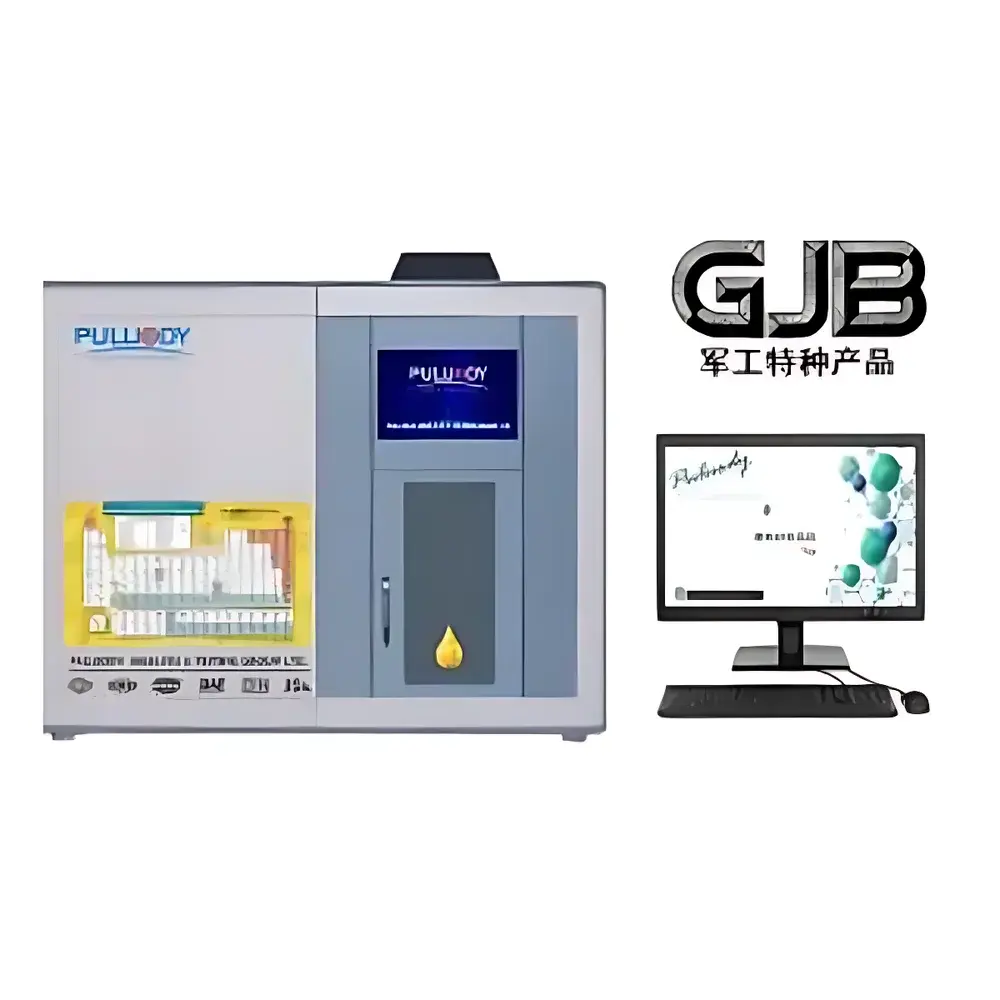
PULUODY P-ICP Rotating Disc Electrode Atomic Emission Spectrometer
| Brand | PULUODY |
|---|---|
| Model | P-ICP |
| Origin | Shaanxi, China |
| Power Supply | 800–1600 W |
| Power Stability | ≤0.2% |
| Detection Limit | down to 1 ppb (µg/L) |
| Repeatability (RSD) | ≤1.5% |
| Stability (RSD) | ≤2.0% |
| Accuracy | ±3% (method-dependent) |
| Spectral Range | 190–800 nm |
| Optical Resolution | ≤0.015 nm |
| RF Generator Frequency | 27.12 MHz |
| Grating Density | 2400 lines/mm |
| Grating Area | 80 × 110 mm |
| Sample Volume Required | >1 mL |
| Operating Temperature | 20–45 °C |
| Relative Humidity | 0–90% RH (non-condensing) |
| Elemental Coverage | ≥61 elements |
| Analysis Speed | ≥4 elements per minute |
| Linear Dynamic Range | 5 orders of magnitude |
| Certified Standards Compliance | ASTM D6595, ASTM D6728, NB/SH/T 0865, SN/T 1652, DL/T 1550, JJF (Defense) 1752018 |
Overview
The PULUODY P-ICP Rotating Disc Electrode Atomic Emission Spectrometer is a dedicated elemental analysis system engineered for rapid, multi-element quantification in liquid hydrocarbon matrices—including lubricants, hydraulic fluids, insulating oils, turbine oils, fuels, coolants, and other organic or aqueous-based industrial fluids. It operates on the principle of rotating disc electrode (RDE) atomic emission spectrometry: a precisely machined graphite disc electrode is rotated at high speed while immersed in the oil sample; an electric arc is generated between the disc and a counter-electrode, volatilizing and exciting analyte atoms. The emitted light is dispersed via a high-resolution Czerny-Turner monochromator equipped with a 2400-line/mm holographic grating and detected by a seventh-generation PULUODY solid-state photodetector array. This architecture delivers sub-ppb detection limits, excellent inter-run reproducibility (RSD ≤1.5%), and robust resistance to matrix-induced spectral interference—critical for condition monitoring of in-service oils where wear metals, contaminants, and additive depletion must be tracked with metrological traceability.
Key Features
- Simultaneous multi-element analysis capability covering ≥61 elements—including Al, Ba, Ca, Cr, Cu, Fe, Pb, Mg, Mn, Mo, Ni, Si, Zn, Na, K, V, Ti, Sn, Ag, Cd, Co, Ce, As, Bi, Sr, W, In, Zr, Li, and Sb—with standardized detection limits as low as 1 µg/L (ppb) for key wear metals.
- High-throughput operation: ≥4 elements quantified per minute under routine calibration conditions, enabling high-volume laboratory or field-deployed predictive maintenance workflows.
- Wide linear dynamic range exceeding five orders of magnitude (0.01 ppm to 10,000 ppm), permitting accurate quantification of both trace wear particles and major additive constituents within a single run.
- Integrated RF plasma excitation source operating at 27.12 MHz with digitally stabilized output power (800–1600 W, stability ≤0.2%), ensuring consistent atomization and excitation efficiency across varying sample viscosities and conductivities.
- Optical system featuring 190–800 nm spectral coverage, ≤0.015 nm resolution, and a large-format 80 × 110 mm ruled grating—optimized for resolving complex spectral overlaps common in used oil analysis (e.g., Fe I 238.204 nm / Cr I 238.203 nm).
- Modular hardware design supports optional co-mounted sensors for water activity (0–1 aw, ±0.02), Karl Fischer moisture (0.1–100,000 ppm), kinematic viscosity (0–500 cSt), and particle counting (1–450 µm, ISO 11171 compliant), enabling comprehensive fluid health assessment in one platform.
Sample Compatibility & Compliance
The P-ICP is validated for direct analysis of undiluted and minimally prepared oil samples—including mineral and synthetic lubricants, transformer oil (IEC 60296), aviation turbine fuel (ASTM D1655), diesel fuel (ASTM D975), antifreeze solutions, phosphate ester hydraulic fluids, and polymer-based dielectric coolants. It fully complies with internationally recognized standard methods governing elemental wear and contamination analysis: ASTM D6595 (used lubricants), ASTM D6728 (gas turbine and diesel fuels), NB/SH/T 0865 (Chinese national standard for in-service oils), SN/T 1652 (import/export fuel testing), DL/T 1550 (power industry insulating oil), and JJF (Defense) 1752018 (calibration protocol). Instrument performance meets GLP and GMP-aligned data integrity requirements, with full audit trail logging, electronic signature support, and 21 CFR Part 11–ready software configuration available upon request.
Software & Data Management
PICP-V2.1 analytical software—available in English, Chinese, Japanese, and Korean language variants—provides full method development, calibration management, spectral library interrogation (tens of thousands of reference lines), and automated quantitative reporting. The platform supports qualitative identification, semi-quantitative screening, and fully calibrated quantitative analysis with internal standard correction. All raw spectra, processed results, calibration curves, and QC metrics are stored in a relational database with configurable retention policies. Reports include method name, instrument ID, element, wavelength, intensity, concentration, RSD, units, analyst ID, and approval status—and export natively to PDF, Excel (.xlsx), Word (.docx), and plain text formats. Data reprocessing is permitted without re-acquisition; trend analysis modules enable time-series visualization of wear metal concentrations against equipment runtime or maintenance intervals, supporting ISO 13374–compliant machinery health diagnostics.
Applications
This instrument serves as a core analytical tool in oil condition monitoring (OCM) programs across aerospace (engine oil trending per SAE ARP5568), power generation (transformer and turbine oil surveillance per IEEE C57.104), marine propulsion (lube oil analysis per ISO 4406), rail transport (gearbox oil wear tracking), wind energy (gearbox and hydraulic fluid diagnostics), and heavy-duty off-highway equipment (hydraulic system contamination control per ISO 4406 and NAS 1638). It is routinely deployed in third-party ISO/IEC 17025 accredited laboratories, OEM technical centers, and in-plant QC/QA labs to support root cause failure analysis, remaining useful life estimation, and evidence-based oil change interval optimization. Its ability to quantify both metallic wear debris (Fe, Cu, Al, Cr) and non-metallic contaminants (Si, Na, B) enables holistic interpretation of degradation mechanisms—including abrasive wear, corrosion, coolant ingress, and dust ingestion.
FAQ
What sample preparation is required prior to analysis?
Minimal preparation: samples are homogenized and introduced directly into the RDE cell; no acid digestion or dilution is needed for most petroleum-based fluids.
Is calibration traceable to NIST or other national metrology institutes?
Yes—certified reference materials (CRMs) traceable to NIST SRM 1084a (used engine oil), NIST SRM 1634c (fuel oil), and ISO 8217-compliant standards are supported; instrument calibration verification follows JJF (Defense) 1752018 guidelines.
Can the system analyze water-contaminated or highly viscous oils?
Yes—the RDE technique is inherently tolerant of suspended particulates, water droplets (<5% v/v), and viscosities up to 500 cSt; optional pre-filtration or heating modules mitigate emulsion-related variability.
How is data security and regulatory compliance ensured?
PICP-V2.1 supports role-based access control, electronic signatures, immutable audit trails, and configurable data encryption—fully compatible with FDA 21 CFR Part 11, EU Annex 11, and ISO/IEC 17025 documentation requirements.
What maintenance intervals are recommended for the optical and plasma systems?
Routine maintenance includes weekly cleaning of the electrode chamber and quartz window; annual recalibration of the monochromator and RF generator output; biannual inspection of the detector array cooling system and argon purge integrity.





